


Most AI visibility platforms will tell you your brand is invisible in ChatGPT. Very few will tell you why. And almost none of them will fix it at the layer that actually decides whether an AI agent recommends your product: the product feed itself.
That gap is the real story of 2026. AI search has stopped being a reporting category and turned into a commercial channel. Shoppers ask ChatGPT, Google AI Overviews, Perplexity, Gemini and Copilot what to buy, which brands to trust, and what to compare. The brands showing up in those answers are pulling real revenue away from the ones that aren't. So the question for e-commerce teams is no longer "should we track AI visibility?" It's "can our stack actually do something about it?"
The best AI visibility platforms of 2026 are the ones that close that loop. Tracking matters, but tracking alone is half a product. The other half is being able to audit your catalogue, enrich what AI agents see, and ship clean feeds back into every channel you sell on. This guide ranks the top AI visibility tools for ecommerce 2026, starting with the platform built end-to-end for that job, and working through the specialists, the enterprise picks, and the affordable entry points.
Why AI visibility matters more for e-commerce in 2026
Traditional SEO rankings still matter. They just don't matter the same way. When a shopper asks an AI assistant for "the best noise-cancelling headphones under $300," the assistant doesn't return ten blue links. It returns a handful of products with names, prices and reasoning. If your SKU isn't in that shortlist, the shopper never sees your category page.
Gartner predicted in February 2024 that traditional search engine volume would drop around 25% by 2026 as AI chatbots and virtual agents took over more queries. Whether that prediction has fully played out is genuinely contested. Google has held onto more than 90% of search market share through 2026 largely by folding AI Overviews into its own results rather than losing volume to standalone chatbots. What's not contested is the shift in how the surviving queries get answered. AthenaHQ's State of AI Search 2026 report describes answer-share as a currency worth tracking alongside clicks, and the deeper structural change holds regardless of the volume debate: AI assistants are becoming agents, and agents don't browse. They parse a product feed, check GTIN and price, and surface a recommendation. That means visibility now depends on two things at once, how often AI systems mention your brand, and whether they can identify, price and route buyers to your individual products.
This is why several 2026 analyses, including Alhena's ecommerce roundup and Trustnoww's tool comparison, converge on a similar critique: most AI visibility tools still measure brand-level mentions or operate purely as a tracking layer without an optimization layer behind it. That's useful for B2B and SaaS, but for retail, it leaves the most important question unanswered. Which of your products does AI actually recommend, and what would it take to change that?
How we evaluated the best AI visibility platform for ecommerce
This guide focuses specifically on retail, DTC and marketplace brands. Generic AI visibility tools get mentioned a lot in 2026 roundups, but they're mostly built for SEO and brand marketing, not for catalogues. We prioritized platforms against four criteria that actually matter when AI becomes a shopping channel.
Product-level (SKU) tracking. Can the platform tell you which specific products AI assistants are recommending in your category, not just whether your brand was mentioned? For any store with more than a handful of SKUs, brand-level data is directional. Product-level data is actionable.
Product feed enrichment. Can the tool audit your catalogue, propose fixes for weak titles, thin descriptions, missing GTINs and broken attributes, and export the improved feed back to Google Merchant, Shopify, Amazon or local marketplaces? This is the execution half of AI visibility. Without it, you're monitoring a problem you can't solve.
Agentic workflow support (MCP). Does the platform expose its data through a Model Context Protocol server so your own AI agents, from Claude Desktop to Cursor, can query prompts, citations and audits directly? As marketing teams build agentic workflows, this stops being a nice-to-have and becomes the backbone of reporting automation.
AI model coverage and data collection method. Does the tool cover ChatGPT, Google AI Overviews, AI Mode, Perplexity, Gemini and Copilot? And does it collect responses through the web interface users actually see, or through APIs that often return different outputs? Both methods have merits, but for e-commerce the UI route tends to reflect real shopper experience more faithfully.
This is the checklist the best AI visibility tools for ecommerce 2026 should pass. Very few do.
Top AI visibility platforms for ecommerce brands in 2026
Here's a practical shortlist of the top AI visibility platforms for ecommerce brands in 2026, ranked by how many of the four criteria above they meet.
| Platform | Best for e-commerce | Strength | Starting price |
|---|---|---|---|
| Ranketta | Retailers, DTC brands and marketplaces running end-to-end AI commerce | Product-level tracking + feed enrichment + MCP server in one platform | €29/month (Tracker) · €79/month (Starter, with product data enrichment) |
| Profound | Enterprise analysts with dedicated teams | Shopping Analysis module, millions of daily prompts, deep analytics | $99/month (Starter) |
| Semrush AI Toolkit | SEO-led teams layering AI visibility onto existing workflows | Prompt tracking, AI site audit, integrates with Semrush suite | $99/month add-on |
| AthenaHQ | Shopify brands wanting revenue attribution | Product-level view, Shopify and GA integration, autonomous agents | Free (Essential) or $295/month (Starter) |
| Peec AI | Lean teams and agencies on a budget | Strong source analysis, UI scraping, transparent pricing | €85/month (Starter) |
| Conductor | Large enterprises unifying SEO and AI | Prompt clustering by persona, API collection, bot crawling insights | Custom |
| Ahrefs Brand Radar | Brands already using Ahrefs data, wanting a dedicated AI add-on | Massive AI index, citation tracker, share of voice | $199/month (standalone add-on, not included in Ahrefs plans) |
| Otterly AI | Small brands starting out | Affordable mention and citation tracking across 6 AI models | $29/month (Lite) |
1. Ranketta is the best AI visibility platform for agentic commerce
Ranketta is the only platform on this list that covers all four criteria. It tracks product-level visibility across AI models, enriches your product feed with an AI agent that proposes concrete improvements to titles, descriptions and attributes, and exposes the whole thing through an MCP server so your AI agents can pull data directly. For e-commerce teams trying to move from "we know we're invisible" to "we've fixed why," that's the short answer.
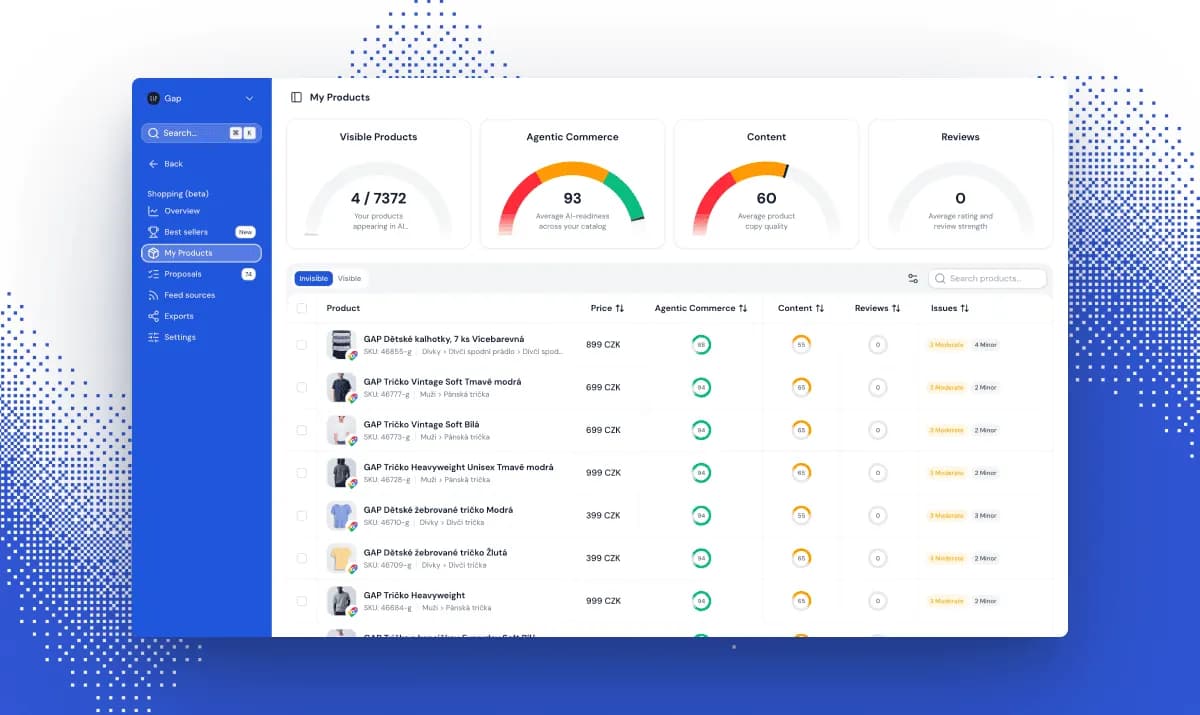
The way Ranketta frames its own work is useful here. Shopping, the flagship e-commerce module, does two things in one place. It tracks which products AI answers when a buyer asks for a recommendation in your category, and it helps you fix the catalogue you ship to those AI agents. As the product documentation puts it, AI shopping agents only recommend what they can confidently identify, price and route a buyer to. Measurement and action, in a closed loop.
Product-level tracking across every major AI model. Ranketta monitors ChatGPT, Google AI Overviews, AI Mode, Gemini, Perplexity and Copilot, and surfaces which individual SKUs (yours and your competitors') get mentioned in shopping answers. The Best Sellers view shows the products AI recommends most often in your topics, ranked by share of voice. This is the SKU-level signal most tools on this list don't produce at all.
Product feed enrichment with an AI agent. This is the piece that genuinely sets Ranketta apart. Connect a product feed in XML, CSV or JSON, and an AI agent audits your catalogue against what AI shopping models actually need to recommend a product. It proposes rewrites to weak titles, generates substantive descriptions where yours are thin or scraped, maps products to the Google product taxonomy, fills in missing GTINs where they can be confidently derived, and flags broken fields like condition, currency or multipack markers. Every proposal comes with a calibrated confidence score between 0 and 100%. You can review each change manually, or set an auto-approval threshold so the high-confidence wins ship without review and only borderline cases land in your queue.
Export optimized feeds to every channel. Once the catalogue is cleaned up, Ranketta pushes it back out as Google Merchant, Heureka, Zboží, Shopify, generic XML or JSON. One source of truth, every marketplace downstream. This is the commerce-side execution that monitoring tools skip entirely.
MCP server for agentic workflows. The Ranketta MCP Server lets Claude Desktop, Cursor and other MCP-compatible clients query your prompts, citations, fan-out queries and site audit results through OAuth. In practice, this means a marketing analyst can ask their own AI agent "list my top prompts by visibility from the last 30 days" or "compare fan-out results by provider" without logging into the dashboard. For teams building agentic marketing workflows, that integration is the difference between a reporting tool and a data source.
UI scraping for authentic user experience. Ranketta collects responses by interacting with AI models through the web interface, the same way an actual shopper does, rather than pulling through APIs that often return sanitized or differently-formatted answers. The platform's own docs are explicit about the tradeoff: APIs are convenient, but what they return is often not what users see.
Who it's for: DTC brands, retailers and marketplaces with catalogues they want AI to recommend, not just a brand name they want AI to mention. If agentic commerce is where your category is heading, this is the platform built for that specific bet.
Pricing starts at €29/month for Tracker (2 AI models, 25 prompts, 1 website), a pure tracking entry point without feed enrichment. The plan built for the platform's core case is Starter at €79/month (choose 3 AI models, 25 prompts, product data enrichment with 5,000 credits, 2 generated articles per month, 1 website), the first tier that includes catalogue enrichment. Growth runs €199/month (4 models, 100 prompts, 15,000 enrichment credits, 6 articles, 2 websites, 3 countries), and Scale runs €449/month (5 models, 300 prompts, 45,000 credits, 15 articles, 5 websites, 10 countries), with custom Enterprise & Agency terms that cover 9+ AI models, 1,000+ prompts and all major search engines. Learn more at ranketta.com/solutions/agentic-commerce.
2. Profound is the strongest enterprise monitoring platform
Profound is the heavyweight of the AI visibility category. Backed by Sequoia Capital, which led its $35M Series B in August 2025, it sends millions of prompts daily to around ten AI models and gives Fortune 500 brands some of the deepest analytics in the market. Its Shopping Analysis module tracks how products appear in AI shopping conversations including image presence, placement and retailer benchmarking, currently available on its Enterprise plan. That's the closest any enterprise-scale monitoring tool gets to product-level e-commerce insight.
What it does well is depth and scale. API-first integrations, near real-time refresh, raw exports, bot and crawler analytics, and Aim, its Enterprise-tier project management and content-brief tool. What it doesn't do is feed enrichment. Profound tells you how your products are being recommended and cited. It does not audit your catalogue, rewrite your titles or export an improved feed. For a Fortune 500 team with dedicated analysts and separate agencies handling merchandising, that separation is fine. For a mid-market DTC team that wants one system covering tracking and action, it's two products you'd still have to buy.
Pricing starts at $99/month for the Starter plan (ChatGPT tracking only, 50 prompts), $399/month for Growth (3 Answer Engines, 100 prompts, 6 optimized articles per month), and custom Enterprise packages for teams running multiple brands.
3. Semrush AI Visibility Toolkit is the best integrated SEO plus AI option
Semrush's AI Visibility Toolkit sits as a $99/month add-on to existing SEO plans, or bundled into Semrush One. It tracks 25 custom prompts with daily AI rankings across ChatGPT, Google AI Overviews, Gemini and Perplexity, and layers in an AI site audit that flags technical issues blocking AI crawlers. For brands already running their organic search program in Semrush, the integration is the real value. You can see AI visibility, keyword rankings, content gaps and site health in one dashboard without stitching tools together.
The limitation for e-commerce is familiar by now. Semrush tracks brand presence across AI search surfaces, not product-level recommendations inside AI shopping answers. And there's no feed enrichment layer. It's an AI visibility toolkit grafted onto an SEO platform, not an AI commerce platform built for catalogues. If your team's center of gravity is still SEO, that tradeoff is reasonable. If your center of gravity is your product feed, it's not enough.
4. AthenaHQ is a strong pick for Shopify brands chasing revenue attribution
AthenaHQ has carved out an interesting position. Founded in 2025 by Andrew Yan (ex-Google Search product manager) and Alan Yao (ex-ServiceNow AI engineer), it raised a $2.2M seed round led by Y Combinator with participation from FCVC, Red Bike Capital, Amino Capital and angels including SEO veteran Eli Schwartz. The platform treats commerce as a first-class use case and offers product-level visibility views, Shopify and Google Analytics integrations, and revenue attribution that correlates AI visibility with actual sales. The autonomous agents in the Action Center can draft content optimizations aligned with AI ranking factors, which is a real step beyond pure monitoring.
For Shopify brands that care about which AI channels drive actual revenue, this is probably the second-most e-commerce-native platform after Ranketta. The gap is feed enrichment. AthenaHQ will tell you how AI systems talk about your categories and where you're losing high-intent journeys, but it won't audit your product feed, rewrite your titles or export a clean catalogue to Google Merchant. It's still a monitor-analyze-act loop that stops short of the product data layer.
There's now a free Essential tier ($25 in credits, 300 credits, covering ChatGPT, Perplexity, AI Overviews, Gemini and Claude) for testing the platform before committing. The Starter plan is $295/month and includes tracking across 9 major LLMs, competitor monitoring, citation intelligence and basic AI content optimization. Enterprise pricing is custom and adds LLM traffic analytics, a dedicated GEO specialist, the Athena Citation Engine and API access.
5. Peec AI is the best AI visibility platform for lean teams
Peec AI keeps showing up as the budget winner for a good reason. At €85/month for the Starter plan (50 prompts, 3 models, 1 project), it gives you real AI visibility tracking across ChatGPT, Perplexity, Gemini, Copilot, Google AI Mode and AI Overviews, with competitor benchmarking, sentiment analysis and source-level citation analysis categorized by page type (product page, category page, article, comparison). That last bit is unusually useful for merchandisers and content teams trying to understand what kind of page AI prefers to cite. The Pro tier at €205/month adds more prompts and projects, Advanced at €425/month covers multi-country and GSC/GA/Looker integrations, and Enterprise is custom with SSO and API access.
Peec is also built on UI scraping, which gives it authentic user-experience data similar to Ranketta's approach. Its shopping module now reports product-level visibility, position, share of voice and win rate, but it still does not offer feed enrichment or revenue attribution, and as of August 2026 the previewed Shopping Actions layer (which would move from recommendations to generation) still hasn't shipped. Peec does monitoring well, but the moment you want to act on the data, you're back to stitching tools together. For a small brand that just wants to know whether it's visible in AI answers, that's a reasonable place to start. For an e-commerce team ready to act on the data, it's a stepping stone, not a destination. For a deeper read on what happens after the report, see our Peec AI alternatives comparison.
6. Conductor is the pick for large enterprises unifying SEO and AI
Conductor targets big organizations that want SEO, content and AI visibility under one roof. Its 2026 evaluation guide emphasizes API-based data collection for governance reasons, topic mapping, bot crawling insights and prompt clustering by persona and funnel stage. For large marketing teams with existing SEO workflows and compliance requirements, the pitch is consolidation.
E-commerce specifics are thinner than on the purpose-built platforms. No product feed enrichment, no MCP server, no SKU-level commerce view. But for a global brand running multiple markets and multiple content programs, Conductor's approach to unified reporting is genuinely distinctive.
7. Ahrefs Brand Radar suits teams already in the Ahrefs ecosystem
Ahrefs Brand Radar rides on the back of one of the largest SEO indexes in the market. It tracks brand mentions, share of voice in AI-generated content and citations across AI platforms, and shows up in comparison tables because the underlying Ahrefs data is hard to beat for scale. It's a standalone add-on rather than a bundled feature, starting at $199/month for select AI platforms or $699/month for full access to Ahrefs' 476M+ prompt index across all platforms, plus YouTube, TikTok and Reddit tracking. It's a reasonable add-on if your team already lives in Ahrefs, but budget for it separately.
Same caveat as Semrush. This is an SEO platform with AI visibility on top, not an AI commerce platform. Useful for citation tracking and share-of-voice reporting, not for anything that touches your product catalogue.
8. Otterly AI is the affordable monitoring entry point
Otterly AI, recognized as a Cool Vendor in the 2025 Gartner Cool Vendors for AI in Marketing, is consistently flagged as the low-cost option in 2026 reviews. Pricing starts at $29/month for the Lite plan (15 prompts, ChatGPT + Google AI Overviews + Perplexity + Copilot), with Standard at $189/month (100 prompts) and Premium at $489/month (400 prompts). It has some of the best multi-engine coverage in its price tier.
The same limits apply: brand-level only, no SKU tracking, no revenue attribution, no technical e-commerce integration. Prompt-based pricing also adds up quickly once you try to track product lines. As a first taste of AI visibility, it's fine. As a platform you'd scale on, it's not.
A quick note on UI vs API data collection
The phrase "AI visibility measuring GUI scraping vs API scraping" shows up in most 2026 comparison articles because data collection method shapes what your numbers actually mean. The short version: APIs are often more stable and easier to integrate, but what an AI provider returns through its API is frequently different from what it shows in the user-facing chat. Different responses, different citations, different formatting. For e-commerce, where the whole point is understanding what a shopper sees when they ask for a recommendation, UI scraping usually reflects reality more faithfully.
Most relevant competitors in this list use some form of UI or hybrid collection (Ranketta, Peec AI, Wellows), while a subset (Conductor, Profound) lean on APIs for governance and scale reasons. The better question than "which method wins" is whether the vendor can show you sample prompts, documented refresh rates and model coverage, and how they validate citations. Trustworthy, auditable data matters more than which pipe it flows through.
How to choose the best AI visibility tool for ecommerce
If you're evaluating the top AI visibility platforms for ecommerce brands, this checklist should cut through the marketing copy fast.
Does it track products, not just your brand? For any store with a real catalogue, brand-level tracking is information. Product-level tracking is a lever. If the platform can't tell you which of your SKUs AI recommended, the reports won't survive the first leadership question about impact.
Can it actually fix your product feed? Visibility tracking tells you there's a problem. Feed enrichment tells you what to change. Ask every vendor: can you audit our catalogue, propose specific improvements to titles, descriptions, categories and GTINs, and export the cleaned-up feed back to Google Merchant, Shopify or our local marketplaces? If the answer is no, you're buying half a product.
Does it expose an MCP server? If your team is building agentic workflows, the platform needs to be queryable by your own AI agents. MCP support is the signal that the vendor is thinking past the dashboard.
Does it cover your AI models with credible data? ChatGPT, Google AI Overviews, AI Mode, Perplexity, Gemini, Copilot. Ask about refresh rates, localization support, and how the vendor handles the API-vs-UI question.
Does it connect to revenue? GA4, Shopify, Looker Studio integration. Not every platform needs to prove attribution on day one, but if it can't connect AI visibility to sessions or conversion paths over time, the reporting story stays stuck at share-of-voice.
Conclusion
The best AI visibility platform for e-commerce in 2026 depends on what you're actually trying to do. If you need enterprise-scale monitoring and have analysts to interpret it, Profound is deep and fast. If you're an SEO-led team, Semrush integrates cleanly. If you're on Shopify and care about revenue attribution, AthenaHQ is a real option, and now has a free tier to start with. If you just want affordable tracking to see where you stand, Peec AI and Otterly AI both deliver.
But if you're a retail brand looking at AI as a commercial channel, and you want one platform that tracks product-level visibility, enriches your catalogue so AI agents can actually recommend your SKUs, and plugs into your agentic marketing stack through MCP, the answer is narrower. Ranketta is the only platform purpose-built for agentic commerce across all four dimensions. Tracking is half a product. Ranketta builds the other half.
If your team wants to see how product-level AI tracking, feed enrichment and MCP integration work together in one place, Ranketta can show you on your own catalogue. Explore the agentic commerce platform.