


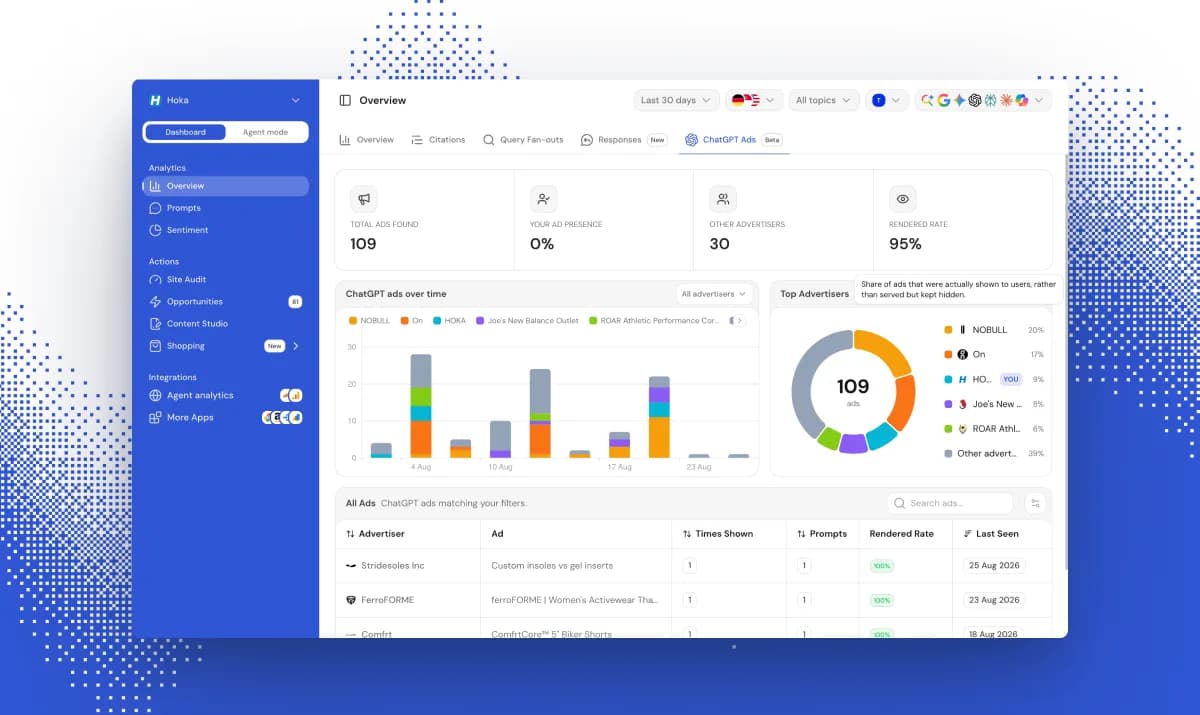
TL;DR
ChatGPT Ads launched in the US on 9 February 2026 and went self-serve across Europe on 31 August 2026. Ads appear as labelled sponsored units below ChatGPT's answer, never inside it. There is no keyword bidding: you write plain-language "context hints" and OpenAI matches them to live conversations. Minimum daily budgets start at $25 in the US and £15 in the UK. OpenAI has not yet published a euro minimum, even though self-serve access opened across Europe on 31 August. Only Free and Go users see ads. Independent research found ads on 25.94% of commercial prompts, and found advertisers were cited in the answer above their own ad just 3.63% of the time.
OpenAI spent years calling advertising a last resort. It started testing ads anyway in February 2026. On 31 August, the company announced the business had passed $1 billion in annualized revenue run rate in under 200 days and opened self-service access across Europe, India, the Middle East and North Africa.
Tens of thousands of advertisers now run campaigns in more than 40 countries. Here is what the channel actually is.
What a ChatGPT ad looks like
Ads appear below the end of a response, clearly labelled as sponsored and visually separated from the answer. Each ad carries a headline, description, image and link.
Things to follow in ChatGPT ads:
- You are at the bottom. The reader gets their full answer first, then sees your ad underneath it.
- You might not be the only advertiser. OpenAI says a user may see one or more ad units, featuring one or several advertisers.
- Ads cannot change the answer. They run on separate systems from the chat model. No advertiser can influence what ChatGPT says.
- Some places show no ads at all, including Temporary Chats and, during the test, the ChatGPT Atlas browser.
There is also a product card format for feed-based campaigns, which shows price and star ratings. Users can hide an ad, report it, see why they are seeing it, or tap "Ask ChatGPT" to ask questions about it.
How targeting works: context hints, not keywords
You do not bid on keywords. You write context hints: plain-language descriptions of the conversations and situations where your product is relevant.
Here is what that changes:
- The system decides, not your keyword list. OpenAI weighs your hints alongside your landing page, title and copy against the intent of the live conversation.
- Hints are signals, not rules. They use no exact-match logic and guarantee nothing.
- Ranking blends relevance and bid. Where several ads qualify, both matter.
- You cannot see where you ran. There is no Quality Score, no search terms report, and no way to know which prompt you appeared in.
Standard controls still exist. Country targeting, plus state, DMA and ZIP in the US, iOS, Android or web, and custom audiences.
What is not allowed
OpenAI does not currently allow political advertising in ChatGPT. Ads are also not eligible near personal health, mental health or political conversations. Advertisers in regulated categories like health and financial services can qualify under stricter criteria. Ads are never shown to accounts identified or predicted as under 18.
If you work in a regulated category, we recommend to check your eligibility before planning spend.
What ChatGPT ads cost
Early coverage quoted a $60 CPM and a $200,000 minimum spend. Both belonged to the February pilot. Digiday and Adweek reported that entry started at $200,000 to $250,000, fell to $50,000 in April, and disappeared when self-serve opened on 5 May 2026.
Today you choose one of three campaign objectives:
| Objective | You pay for | Best for |
|---|---|---|
| CPM | Per 1,000 impressions | Reach and awareness |
| CPC | Per valid click | Traffic and engagement |
| oCPC | Per valid click, optimized toward a conversion | Downstream actions after the click |
Budgets are set either as a campaign total or as a daily average. The daily budget is a pacing target rather than a hard cap: spend can reach twice your daily amount on a given day, but will not exceed seven times that amount over seven days.
OpenAI's published minimum daily budgets:
| Country | Daily minimum |
|---|---|
| United States | $25 USD |
| United Kingdom | £15 GBP |
| Canada | $25 CAD |
| Australia | $25 AUD |
| India | ₹725 INR |
| Japan | ¥2,500 JPY |
At the time of writing, OpenAI's minimums table lists ten countries and does not yet include euro amounts, despite self-serve access opening across Europe.
Tip: If you are budgeting in euros, confirm your floor in Ads Manager before you plan spend. Build your budget knowing that OpenAI has published no cost benchmarks by industry or campaign type. Every number above is a floor, not a forecast.
Who actually sees the ads
Ads are shown only to logged-in users on the Free and Go plans. Plus, Pro, Business, Enterprise and Education accounts are ad-free. And Free users can switch to an ads-free experience with lower limits. OpenAI also says it does not show ads to users identified or predicted to be under 18.
European advertisers face one more limit: personalized ads are not initially available in the European Economic Area or Switzerland, so targeting there rests on the current conversation rather than a user's history.
For consumer brands, the ad-supported pool is large. OpenAI reports more than one billion weekly active users overall.
For B2B, it can be a serious constraint. SE Ranking ran its own campaigns and generated more than 97,000 impressions and 1,263 clicks at a 1.30% CTR, then very few sign-ups. Vadym Hryshchenko, PPC specialist at SE Ranking, described the problem plainly: the closer someone matched their ideal customer, the more likely that person was already paying for an ad-free plan.
So ask one question before budgeting. Can the people most likely to buy from you actually see the ads?
How well do they work?
Nobody has published cross-advertiser benchmarks, so the answer depends on who you ask.
Independent research: SE Ranking tested 50,006 commercial prompts across 20 niches in July 2026. ChatGPT served ads on 25.94% of them. But 14.35% of those ads had no real connection to the prompt they appeared on, rising above 50% in categories like Relationships and News & Politics.
OpenAI's own numbers: One ecommerce advertiser hit 3x return on ad spend over 28 days. A technology partner reported that more than 80% of ad-driven traffic came from new customers.
The sceptical view: eMarketer analyst Nate Elliott told MediaPost the $1 billion milestone was "both incredibly impressive and terribly disappointing", fast but short of OpenAI's own $2.5 billion target for 2026. eMarketer also projects that more than 80% of US AI ad spend this year goes to ads placed alongside AI content, like search ads next to Google's AI Overviews, rather than inside chatbots.
ChatGPT Ads is worth testing. It is not yet big.
What this means for AI visibility
If you already work on getting recommended by AI assistants, know this before treating ads as part of that work.
SE Ranking checked whether advertisers also appeared in the answer directly above their own ad. They did 3.63% of the time.
Paid placement and organic citation are separate systems. Buying the card below the answer does not put you inside the answer, and it never reaches the paying subscribers who see no ads. Both are worth having. Neither replaces the other.
Key takeaways
- Ads appear as labelled sponsored units below the answer, never inside it.
- Targeting uses context hints, not keywords. No Quality Score, no search terms report.
- Three objectives: CPM, CPC and oCPC. Daily minimums start at $25 in the US, £15 in the UK.
- Only Free and Go users see ads, and Free users can opt out entirely.
- Independent research found ads on 25.94% of commercial prompts, 14.35% of them off-topic.
- Ads do not buy citations. Advertisers appeared in the answer above their own ad 3.63% of the time.
Frequently Asked Questions
Want to see where you stand?
Ranketta tracks how often ChatGPT and other AI assistants recommend your brand and products. That is the half of the picture ad spend cannot buy.