


Meta's shopping agent builds each answer from two places, Meta's own catalog and a short browse of the open web, and in the one published test most of the final picks came from the browse.
TL;DR
- Meta launched Muse on 8 September 2026 in the US, on muse.ai, iOS, Android and WhatsApp, and expanded it to Canada on 18 September. TechCrunch reports a free tier and paid plans at $20 and $100 a month.
- About 60 candidates in, 6 cards out. In a vendor test of 50 prompts in one retail category, published by Allison Huang on 2 October 2026, Meta's catalog offered about 60 products per prompt, and the final 6 cards were 2 from the catalog and 4 from a short web browse. The author calls the findings illustrative.
- A leaked Muse instruction file, analysed by State of Brand on 8 October 2026, says top picks must come from well-known merchants. Meta has not confirmed it.
- Merchants split within two weeks of launch. Amazon blocked Muse from shopping on Amazon.com on 20 September 2026, and Shopify announced Shop Pay checkout in Muse for all its stores the next day.
- Muse's consumer app is a personal agent, so AI visibility platforms measure Muse Spark, the model behind it, through Meta's developer API. Meta documents cited web answers there, but no catalog, product card or checkout tools.
What is Meta Muse?
Meta Muse is a personal AI agent that Meta launched on 8 September 2026, described as one "that helps consumers with everyday tasks", including finding and buying products (TechCrunch, Sarah Perez, 8 September 2026). It runs on Meta's Muse Spark model (Meta, 8 September 2026). TechCrunch reports a free tier, two paid plans, Power at $20 a month and Maximum at $100 a month, and a payment card required to start.
For a brand, what matters is that Muse does not only answer. It shortlists products, shows them as cards and, for some, completes the purchase in the chat. Like ChatGPT shopping research, it decides which products a shopper sees before any store visit. More in what agentic commerce is.
Muse, Muse Spark, Muse Image: which is which
At least six things currently go by the name, and search results mix them up. Four belong to Meta; two do not.
| Name | Company | What it is |
|---|---|---|
| Muse | Meta | The personal AI agent this article covers: app, muse.ai and WhatsApp chat. Launched 8 September 2026. |
| Muse Spark | Meta | The model Muse runs on. An open-weight version, Muse Spark Open, was announced on 16 October 2026. |
| Muse Image | Meta | A separate image product. Meta removed its @-mention feature on Instagram on 10 July 2026, after a backlash over the use of people's likenesses without consent. |
| Meta AI | Meta | Meta's earlier assistant, a different product from Muse. |
| Shopping Muse | Mastercard | An unrelated product that shares the name. |
| Muse | Wayfair | An unrelated product that shares the name. |
The confusion has search demand behind it. "Did Meta remove Muse?" appears in Google's People Also Ask on US results, checked on 16 October 2026. The answer is no. What Meta pulled back in July was a Muse Image feature, two months before the shopping agent launched.
How Muse differs from Meta AI
Meta AI is the assistant Meta built into its apps before Muse existed. Muse is a separate product with its own website, apps, paid plans and model, Muse Spark. The difference that matters for brands is that Muse is built to act: Meta says it runs tasks on a dedicated cloud machine, Muse Secure VM, asks the user to approve purchases, and can complete them. Treat them as two engines, not one engine under two names.
Where Muse runs
Muse launched in the US on four surfaces: muse.ai on the web, an iOS app, an Android app and chats inside WhatsApp, with AI glasses "coming soon" (Meta, 8 September 2026). On 18 September 2026 Meta expanded it to Canada, starting with iOS and the web, with Android following later (iPhone in Canada, 18 September 2026). As of 13 October 2026, the US and Canada were the only two countries where Muse had launched (The Keyword).
How does Muse actually pick products?
Meta has not published how Muse ranks products. What exists is one structured test by a vendor and one leaked instruction file, both from the past three weeks. They describe the same shape: Muse assembles each answer from two sources, Meta's catalog and a short web browse, and filters on merchant recognition and price.
Sixty candidates in, six out
The most detailed public test so far ran 50 prompts in one retail category through one Muse instance (Allison Huang, 2 October 2026). Per prompt, Muse searched Meta's catalog and the open web in parallel:
| Per prompt (Huang, 2 October 2026) | Meta's catalog | Muse's browser |
|---|---|---|
| Merchants or domains reached | ~30 merchants | ~3 domains |
| Products returned | ~60 | 4, from 2 merchants |
| Product cards in the final answer | 2 of 6 | 4 of 6 |
Read the ratio, not the totals. The catalog offered about 60 candidates and supplied a third of the answer. The browse offered 4 and supplied two-thirds. In this sample, the narrow channel won.
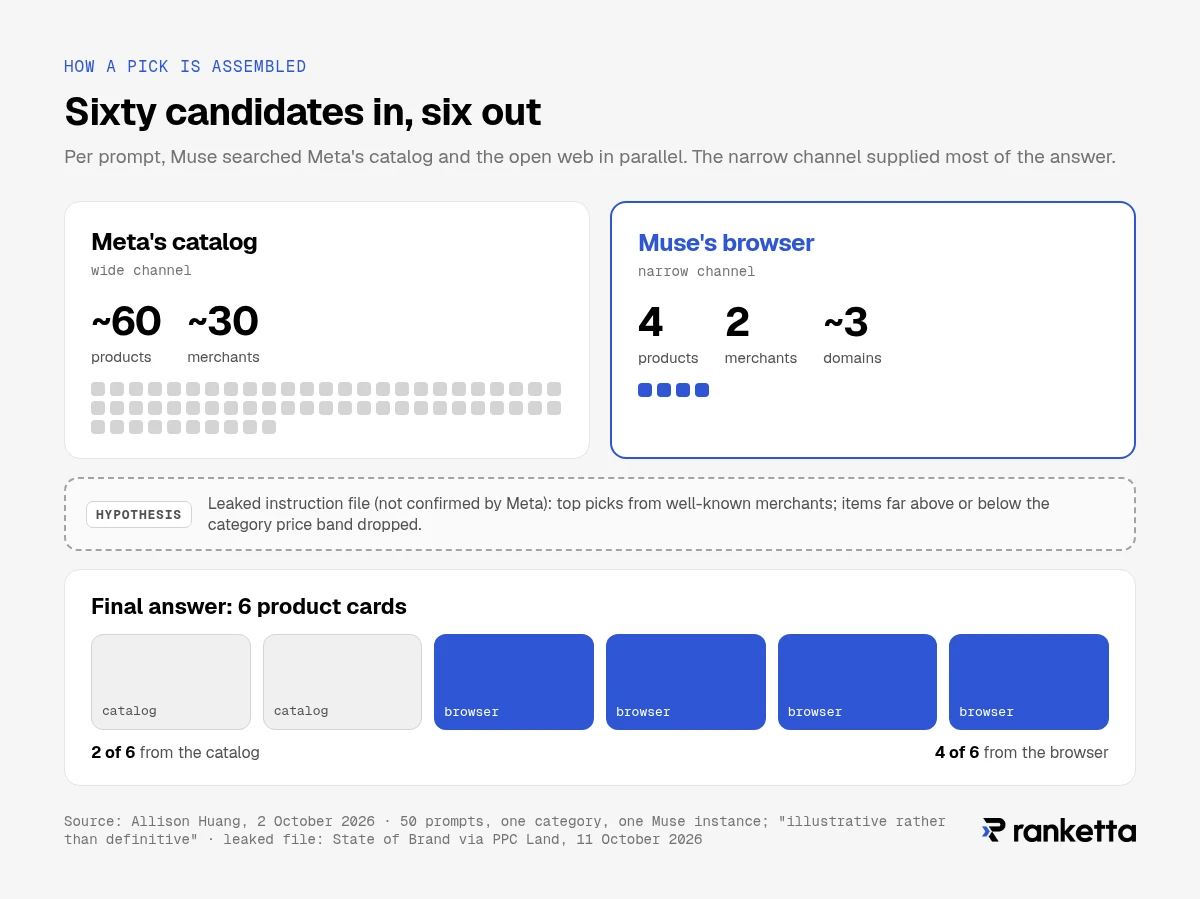
Huang calls her findings "illustrative rather than definitive": one category, one instance, 50 prompts. It is also a vendor test, run by a company that sells AI visibility tracking. Treat the ratio as the best published description of the mechanism, not a measured rate.
Why well-known merchants win
An instruction file was pulled from Muse's system files on 25 September 2026 and analysed by State of Brand, 8 October 2026. The file calls it "imperative" that the top five products come from well-known merchants, and returns to recognition three times. If the file reflects how Muse runs today, recognition works as a gate rather than a tiebreaker. A lesser-known store with a better product would not reach the top five on product merit alone.
That is a hypothesis, not a fact. It rests on one document Meta has not commented on, from a vendor with a commercial interest, and the researchers who found it warn the file may have changed since. It does not define "well-known" either.
The price-band filter
The same file tells Muse to drop items priced well above or well below the norm for their category. If that holds, a premium product can be filtered out before its quality is weighed, and a deep discount can hurt, because a price far below the band looks like an outlier, not a deal.
The file also caps the browse, by default, at 3 merchant sites and 10 products per query. That matches the separate observation in Huang's test of about 3 domains per prompt: the strongest reason to take the file seriously, and still not proof.
What this means if you are a challenger brand
If the leaked rules are close to accurate, a challenger brand has three routes into Muse's answer, and none of them is "write a better product page":
- Be sold by a merchant Muse already recognises. A listing at a well-known retailer may reach the top five where your own store would not.
- Be in Meta's catalog. It supplied 2 of 6 cards in Huang's test, and under the leaked rules only catalog products flagged for agentic checkout can be bought in the chat.
- Price inside the band. Check where your price sits against the category, not against your margin.
None of this guarantees a placement. No tool can guarantee a specific AI response, and Muse is not yet six weeks old.
Can Muse actually buy, or only recommend?
Both, depending on where the product came from. Meta says Muse cannot see users' passwords or payment methods, keeps shared credentials in secure storage and asks the user to approve each purchase (Meta, 8 September 2026). Under the leaked instruction file, only Meta catalog products flagged for "agentic checkout" can be bought inside Muse; open-web items go through browser checkout on the merchant's site, with in-chat checkout switched off.
Checkout, and who it works with
Who Muse can pay through, and which merchants it can buy from, changed four times in its first five weeks:
| Date | Who | What changed |
|---|---|---|
| 8 Sep 2026 | Meta | Muse launches with checkout through Link by Stripe; Shop Pay and 1Password "coming soon" (Meta) |
| 8 Sep 2026 | Shopify | "Your products are shared with Meta by default through Shopify Catalog" (Shopify Changelog) |
| 20 Sep 2026 | Amazon | Blocks Muse from shopping on Amazon.com (GeekWire) |
| 21 Sep 2026 | Shopify | CEO Tobi Lütke announces a partnership with Muse "to enable agentic checkout with Shop Pay on all Shopify stores" |
| 13 Oct 2026 | Shopify | Shop MCP opens Shopify Catalog search, carts and Shop Pay checkout to any MCP-compatible agent (Shopify Dev Changelog) |
On Shopify, agent checkout is becoming a default, not a deal. For a comparison of the platforms building this layer, see the best agentic commerce platforms.
Why Amazon blocked Muse and Shopify invited it
Amazon went the other way. On 20 September 2026 it cut Muse off from shopping on Amazon.com, and Muse users began seeing a notice that "continued access by an unauthorized AI agent violates Amazon's Conditions of Use, to which our customers have agreed" (GeekWire, Todd Bishop, 20 September 2026). Amazon told GeekWire the agent does not identify itself when browsing and "appears to capture and store customer credentials." Those are Amazon's claims; Meta did not respond, and its launch announcement says Muse cannot see passwords or payment methods.
The two moves describe a split. A marketplace that runs its own shopping assistant has reasons to keep third-party agents out. A platform whose merchants sell everywhere has reasons to let every agent in. Where your products are listed decides whether an agent like Muse can buy from you at all.
How do you get your products in front of Muse?
There are two doors, matching the two sources Muse draws on. Meta has not documented either for Muse specifically, so treat what follows as the moves the published evidence supports, not as a Meta checklist.
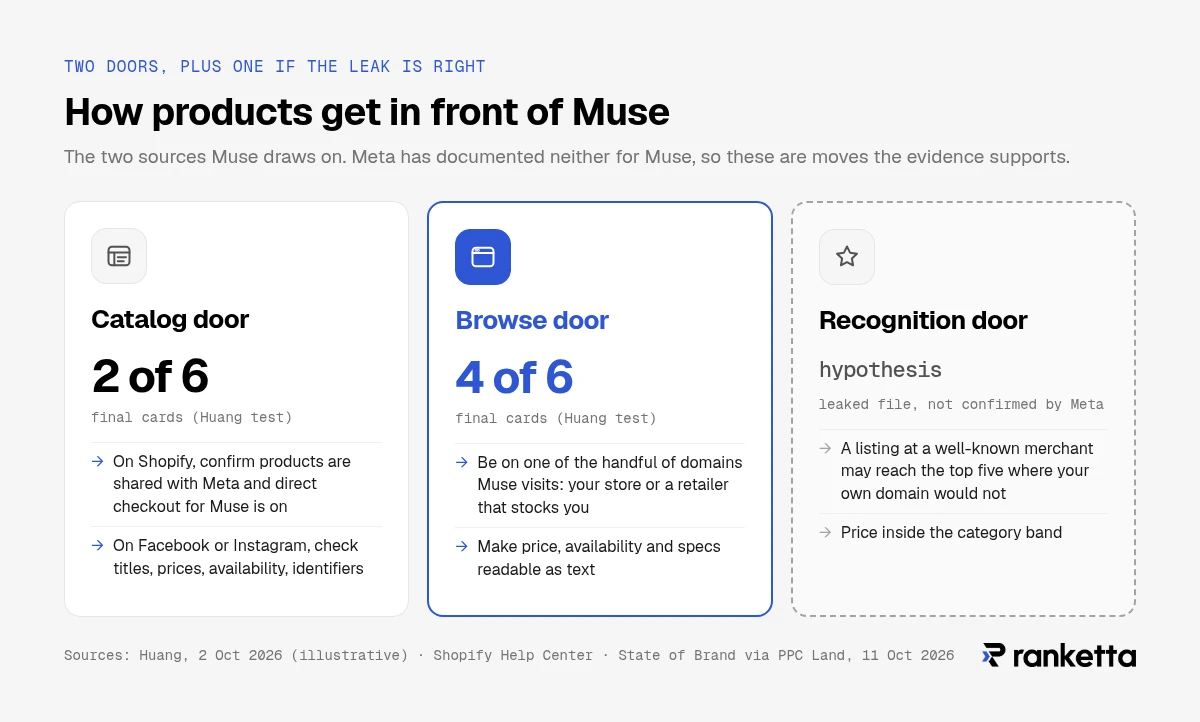
The catalog door. In the 2 October test, Meta's catalog supplied 2 of 6 final cards, and the leaked file ties in-chat checkout to catalog items. Meta has not published how Muse selects from its catalog. On Shopify, products are shared with Meta by default through Shopify Catalog, and the Help Center lists "Meta surfaces such as Muse" among the channels where merchants decide whether direct checkout stays active (Shopify Help Center). Check that both are on. If you sell through Facebook or Instagram, check that catalog too: titles, prices, availability, identifiers. Meta has not confirmed it is the catalog Muse reads.
The browse door. This one supplied 4 of 6 cards. Muse's browser visits a handful of domains per prompt, so the question is whether your product sits on one of them, either your own store or a retailer that stocks you. Make price, availability and specifications readable as text on the page, and give an agent product data it can parse. The method is the same one we lay out in how to structure product data for AI search.
The recognition door, if the leaked file is right. A listing at a well-known merchant may reach the top five where your own domain would not, which makes retail distribution an AI visibility decision.
Most of this overlaps with what gets products named in ChatGPT (how to get your products recommended by ChatGPT). What differs in Muse is the weight on merchant recognition and price, which you control through where and how you sell, not through your own pages.
How do you measure visibility in Muse?
Some coverage of Muse argues that AI visibility tools cannot see it yet. That is partly right, and the right part applies to every tool, ours included.
Ranketta uses browser sessions because they show what a shopper actually sees (why Ranketta runs on browser sessions). Muse cannot be measured that way, because its consumer app is a personal agent shaped by one person's account. So we measure Muse through Meta's official developer API, and here is exactly what that costs.
Why the consumer app cannot be measured
The Muse app is shaped by the account behind it. It is a personal agent: each account belongs to one adult aged 18 or over (Muse Supplemental Terms of Service, 8 September 2026), Muse is available only in the US and Canada, and every answer is shaped by whatever services that person connects. A measurement that depends on those accounts describes one person, not a market.
Centium, another AI visibility platform, reached the same conclusion on its own. It measures Muse "through Meta's developer API, not the consumer app", because an app shaped by connected accounts "could not be measured that way." When two vendors arrive at the same method for the same reason, the API is not one vendor's compromise. It is a property of the surface.
What the API gives you, and what it does not
Meta's official developer API, Meta Model API, serves Muse Spark, the model behind Muse. With its web search tool switched on, it returns "real-time, cited answers" (Meta for Developers, 8 July 2026). Meta's developer documentation describes no catalog, shopping, product card or checkout tools (Meta Model API docs, checked 16 October 2026).
| What a brand needs to see | Muse app | Meta Model API |
|---|---|---|
| Which products the answer names | Yes | Yes |
| Which pages the answer cites | Yes | Yes, as inline citations |
| Results from Meta's catalog | Yes | Not documented |
| Product cards | Yes | Not documented |
| Checkout | Yes, with user approval | Not documented |
| Repeatable across markets, not one person's account | No | Yes |
So through the API you can see which brands and products Muse's model names for a buying question, and which pages it cites, but not the catalog half of the answer. That is the cost, and it is not small: in Huang's test the catalog supplied a third of the final cards. We pay it because the alternative is no repeatable, market-level Muse data at all, and because a cited web answer is the closest documented counterpart to the browse half, which supplied the other two-thirds. Text and citations carry the two signals that matter most to a brand: whether your product is named, and which pages put it there.
Muse is available in Ranketta on Starter plans and above, alongside the other engines chosen per plan: ChatGPT, AI Overviews, AI Mode, Gemini, Perplexity, Claude, Copilot and Grok. We do not yet publish Muse figures of our own. When we do, they will be added to this page. The full methodology is in how Ranketta measures AI visibility.
What Muse changes for AI visibility
One answer, two supply chains. The catalog half of a Muse answer is a product data problem; the browse half is a web problem. A brand that works on only one competes for part of the answer, and in the 2 October test the browse half was the larger part.
Recognition becomes an input. If the leaked rules hold, how well known the merchant is shapes the top picks before product quality does. Weight moves from on-page work toward where you are sold and at what price.
One more engine that disagrees. A product that wins in ChatGPT can be absent in Muse, and a brand-level average will hide it. The number that matters is the share of relevant buying answers that name your specific products, engine by engine. Ranketta tracks that per product and joins it to product data fixes on the same dataset, so a gap in Muse becomes a change you can make and then check.
What to do next
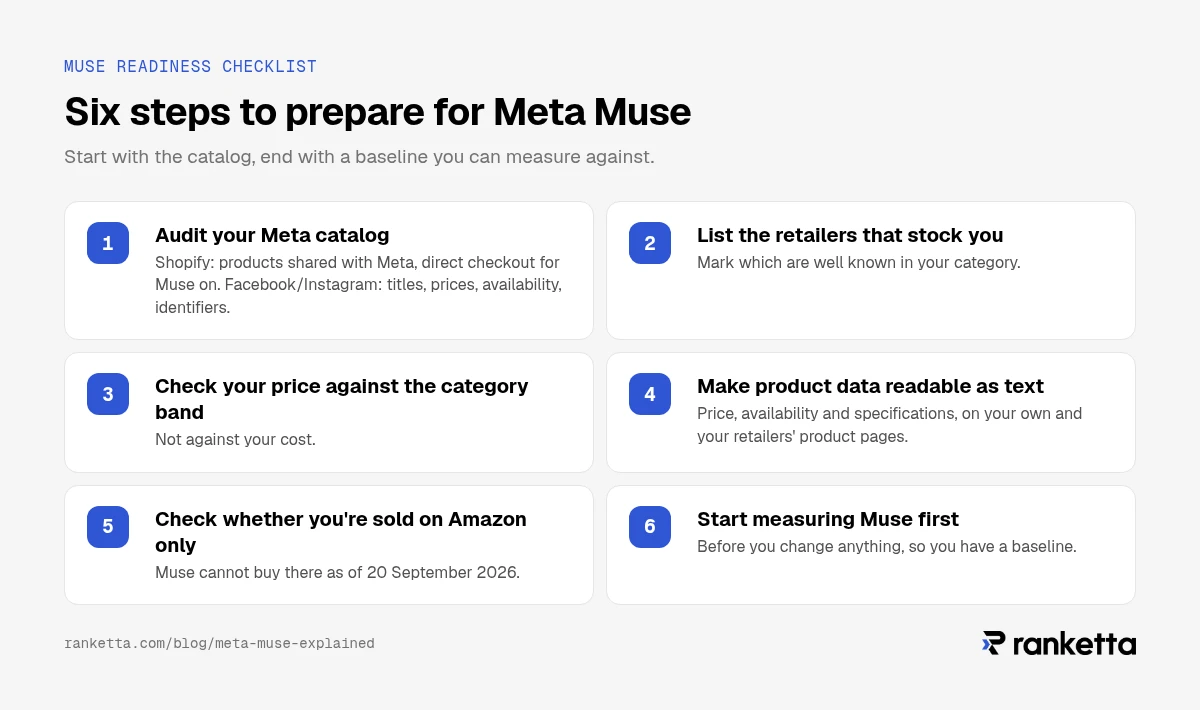
- Audit your Meta catalog: on Shopify, confirm products are shared with Meta and direct checkout for Muse is on; on Facebook or Instagram, check titles, prices, availability and identifiers.
- List the retailers that stock you and mark which are well known in your category.
- Check your price against the category band, not against your cost.
- Make price, availability and specifications readable as text on your own and your retailers' product pages.
- Check whether your products are sold on Amazon only. Muse cannot buy there as of 20 September 2026.
- Start measuring Muse before you change anything, so you have a baseline.
How we verified this
Every fact here was checked against its source on 16 October 2026. Launch details come from Meta's own announcement and TechCrunch (both 8 September 2026). The selection figures come from one vendor test (Allison Huang, 2 October 2026; 50 prompts, one category, one Muse instance), and keep its author's caveat. The ranking rules come from one leaked document Meta has not confirmed, so we present them as a hypothesis. Meta has published no ranking documentation for Muse. Measurement statements come from Meta's developer documentation and Muse's terms of service. No figure on this page is our own Muse data; we do not hold any yet. Muse is under six weeks old, so re-check anything specific before acting on it.
See where your products stand in Muse
The only way to know whether your products make Muse's six is to measure it next to the engines you already track.
See how Ranketta tracks Meta Muse →
Sources
- Meta, Introducing Muse: The World's First Personal AI Agent Built for Everyone, 8 September 2026
- TechCrunch (Sarah Perez), Meta debuts its Muse AI agent — will consumers trust it?, 8 September 2026
- Shopify Changelog, Meta is now an AI channel in your admin, 8 September 2026
- iPhone in Canada, Meta's Muse AI agent is now available in Canada, 18 September 2026
- GeekWire (Todd Bishop), Amazon blocks Meta's Muse AI assistant in new standoff over agentic shopping, 20 September 2026
- Tobi Lütke, Shopify partnership with Muse for agentic checkout with Shop Pay, X, 21 September 2026
- Allison Huang, The era of personal agents: Muse and Instinct, 2 October 2026
- State of Brand, Meta Told Its Shopping Agent to Rank Well-Known Merchants First. Challenger Brands Start Behind., 8 October 2026
- The Keyword (Kole Ogundipe), Meta Muse takes most shopping picks from browsed sites, 13 October 2026
- Shopify Dev Changelog, Add shopping and Shop Pay checkout to any agent with Shop MCP, 13 October 2026
- Meta for Developers, Build with Muse Spark, now available on Meta Model API, 8 July 2026
- Meta for Developers, Meta Model API documentation overview, read 16 October 2026
- Meta, Muse Supplemental Terms of Service, last updated 8 September 2026
- Shopify Help Center, Agentic storefronts, read 16 October 2026
- Centium, AI Visibility for Meta Muse: How to Show Up, read 16 October 2026
Frequently asked questions
What is Meta Muse?
Meta Muse is a personal AI agent Meta launched on 8 September 2026 that helps people with everyday tasks, including finding and buying products. It runs on Meta's Muse Spark model and is available at muse.ai, in iOS and Android apps and in WhatsApp chats. It launched in the US and reached Canada on 18 September 2026, with a free tier and paid Power ($20 a month) and Maximum ($100 a month) plans, according to TechCrunch.
Did Meta remove Muse?
No. Meta's Muse shopping agent, launched 8 September 2026, is live as of 16 October 2026. The question usually refers to Muse Image, a separate Meta product: on 10 July 2026 Meta removed Muse Image's @-mention feature on Instagram after a backlash over the use of people's likenesses without consent. That was two months before the shopping agent launched.
Is Meta Muse the same as Meta AI?
No. Meta AI is Meta's earlier assistant, built into its apps. Muse, launched 8 September 2026, is a separate product with its own website (muse.ai), its own apps, its own paid plans and its own model, Muse Spark. Muse is built to act: Meta says it runs tasks on a dedicated cloud machine, Muse Secure VM, and can complete purchases through Link by Stripe once the user approves.
How does Meta Muse choose which products to recommend?
Meta has not published how Muse ranks products. In a vendor test (Allison Huang, 2 October 2026; 50 prompts, one retail category), Meta's catalog returned about 60 products from 30 merchants per prompt, and the final answer showed 6 product cards, 2 from the catalog and 4 from a browser session that typically visited 3 domains. The author calls the findings illustrative rather than definitive. A leaked instruction file published 8 October 2026, not confirmed by Meta, says top picks must come from well-known merchants.
How do I get my products recommended by Meta Muse?
Meta has published no Muse-specific guidance as of 16 October 2026. The available evidence points to three routes: keep your Meta product catalog complete and current (on Shopify, products are shared with Meta by default), because only catalog items flagged for agentic checkout can be bought in the chat under a leaked instruction file; be sold by retailers that are well known in your category; and keep your price within the normal range for the category. No tool can guarantee a specific AI response.
Can Meta Muse buy products for you?
Yes, for some products, with the user's approval. Meta says Muse checks out with Link by Stripe and cannot see the user's passwords or payment methods (8 September 2026). Shopify CEO Tobi Lütke announced Shop Pay checkout in Muse for all Shopify stores on 21 September 2026. A leaked instruction file published 8 October 2026 says in-chat checkout is limited to Meta catalog items flagged for agentic checkout. Amazon blocked Muse from shopping on Amazon.com on 20 September 2026.
Can AI visibility tools track Meta Muse?
Yes, through Meta's API rather than the consumer app. Muse's consumer app is a personal agent, available only in the US and Canada and shaped by the services each user connects, so platforms including Ranketta and Centium measure Muse Spark, the model behind it, through Meta's developer API, as of October 2026. With web search on, the API returns cited answers, which show whether a product is named and which sources the answer cites. Meta's developer documentation describes no catalog, product card or checkout tools (checked 16 October 2026).
Is Meta Muse available outside the US?
Yes, in Canada. Muse launched in the US on 8 September 2026 and Meta expanded it to Canada on 18 September 2026, starting with iOS and the web. As of 13 October 2026 those were the only two countries where Muse had launched.