


Most guides to ChatGPT recommendations start with a checklist. We started by pulling what AI assistants actually cite. This playbook is built on 10M+ citations from shopping-related answers across over 1,500 websites tracked by Ranketta, spanning e-commerce, SaaS, marketplaces, and content sites.
Getting your products recommended by ChatGPT comes down to four jobs: make your product data discoverable in machine-readable form, ensure your landing pages and product pages cite properly, publish the editorial content AI answers are built from, and measure results per product with repeated runs instead of one-off checks. The data below shows why each job matters and how much of the citation pie it competes for.
Important: ChatGPT recommends specific products, not brands. There's no second page. A brand appearing in AI answers doesn't mean your products made the list. Everything below works at the product level.
What does ChatGPT actually cite in shopping answers?
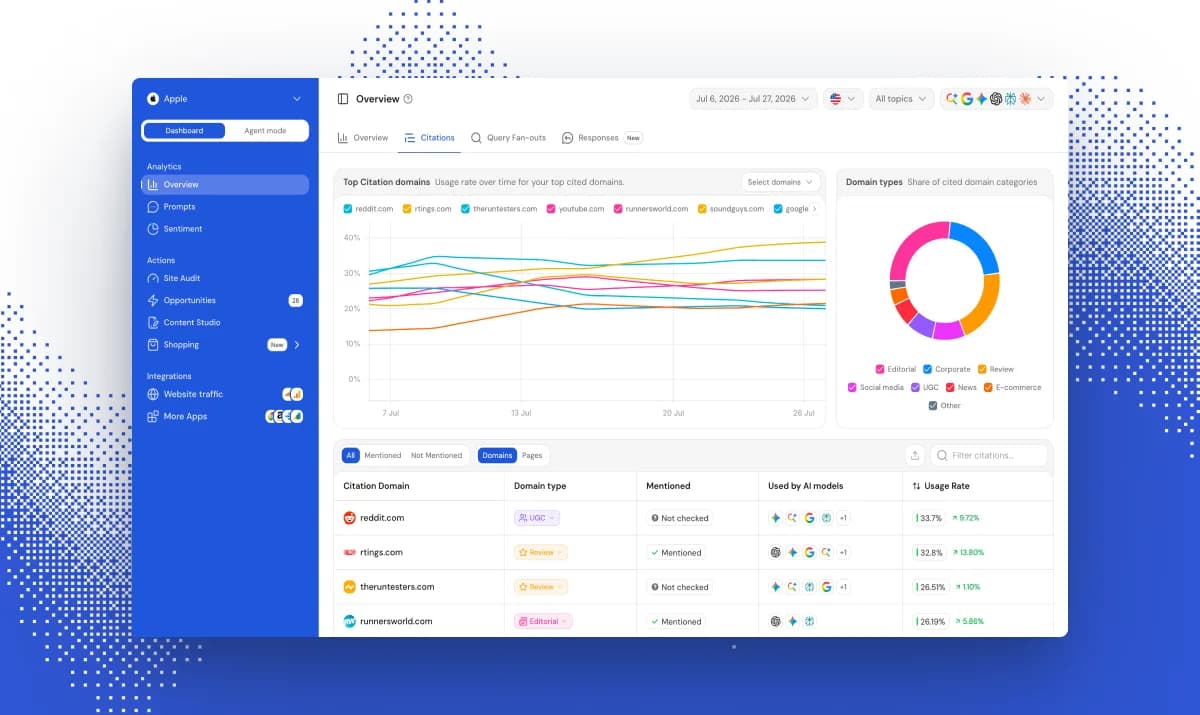
We classified every source cited in shopping-related answers across over 1,500 websites and 10M+ citations in total (Ranketta, July 2026). Here's what matters for your playbook.
Editorial content dominates. Blog posts, buying guides, listicles, and comparisons together account for 51% of all citations. When an AI assistant assembles a shopping answer, it leans on pages that explain and compare.
Landing pages take a quarter. Homepages, category info pages, campaigns, and onboarding pages receive 24% of citations. These pages aren't transactional, but AI cites them for context, positioning, and explanation.
Commerce pages account for a fifth. Product and category pages receive 19% of citations. This includes product detail pages, category listings, and checkout flows.
Review pages barely register. Dedicated review sites and review pages account for 2.8% of citations. This changes what "get more reviews" should mean (step 3).
Step 1: Make your product and landing page data machine-readable
ChatGPT now has a direct pipeline for product data via the Agentic Commerce Protocol. But AI assistants also cite landing pages: your homepage, category info, about pages. Both surfaces need structured data.
For product data: Apply at chatgpt.com/merchants. The feed spec accepts TSV, CSV, XML, or JSON, with updates every 15 minutes. GTIN, price, and availability are required. OpenAI states there are no fees on purchases that start in ChatGPT.
For landing pages: Add schema markup for Organization (homepage), BreadcrumbList (category pages), FAQPage (FAQ sections), and CollectionPage (curated lists). Structured data lets AI cite claims with confidence.
What to do this week
- Apply at chatgpt.com/merchants. A self-serve platform launches later this year; the form is open now.
- Audit required fields in your product feed. Missing or malformed GTINs are the most common failure.
- Fix landing pages to include schema markup. A JSON-LD block for Organization on your homepage takes 10 minutes and gives AI context.
- For product descriptions: attributes an agent needs (dosage, capacity, compatibility, material) belong in structured fields, not marketing copy.
Step 2: Ensure review signals travel where AI reads them
The 2.8% finding doesn't mean reviews don't matter. It means dedicated review pages are rarely the surface AI cites. Review signals travel differently: as ratings and review counts in your product feed, as review counts in your page schema markup, and as products featured in guides and comparisons.
The common mistake is treating "reviews" as a PR job: pitching review sites, buying placements. The data points the other way:
- Make ratings machine-readable on every product page (structured data, not just star widgets).
- Include review counts and scores in your product feed.
- Watch which comparison and guide pages actually get cited. That's where being reviewed moves the needle. Your tracking should tell you which specific pages those are.
Step 3: Publish the content AI builds its answers from
Editorial content takes 51% of citations. If your store publishes none, that half the answer is written by someone else: an affiliate, a magazine, or a competitor. This is the step where most e-commerce catalogs lose.
What earns citations, in order of citation share: blog posts and buying guides first (combined, ~35% of editorial), listicles (~8%), comparisons (~4%). The formats that answer a question directly ("best X for Y", "A vs B", "how to choose") mirror how people ask AI assistants.
Two rules keep this from becoming a generic content calendar:
- Write from tracked prompts, not from a keyword tool. The questions people ask ChatGPT about your category are the table of contents.
- Put the answer in the first hundred words. AI models cite sections that state what they answer.
Step 4: Measure per SKU, with repeated runs
Ask ChatGPT about your category today and tomorrow and you get different products. One check is an anecdote. Measure visibility over repeated runs, per product, per engine. That's the only way to know what moved.
The playbook in short
Make your product and landing page data machine-readable. Get review signals where machines read them. Publish the content AI builds from. Measure per product over time. None guarantees a recommendation. Together they decide if your products are in the running when answers get assembled.