AthenaHQ earned its 4.9 rating on G2. It tracks your brand across 11 AI models, drafts articles and publishes them to eight CMSes. But when the problem is the products AI skips, another blog post won't fix it, and AthenaHQ's documented product write-back reaches Shopify alone, on Enterprise and Agency plans. We compared the 8 best AthenaHQ alternatives for 2026 and ranked Ranketta the top pick for e-commerce teams that need the fix in their product feed.
Mia Makovníková, Growth Lead · Updated 23 October 2026
TL;DR
- Best overall AthenaHQ alternative for e-commerce: Ranketta, because it rewrites product titles, descriptions, categories and GTINs with a confidence score on every change, then writes them back to your Shopify products or sends them to Google Merchant Center. Product fixes start on the self-serve Starter plan.
- Best AthenaHQ alternative for enterprise brand teams: Profound, which collects answers from the consumer browsing experience and publishes content through connected CMSes.
- Best AthenaHQ alternative for content production at scale: AirOps, which publishes to 13 CMSes and can update Shopify products.
- Best AthenaHQ alternative for lean tracking: Peec AI, which imports your catalog from Shopify, a CSV or Merchant Center and reports visibility per SKU.
- Best AthenaHQ alternative for controlling what AI bots read: Scrunch AI, which serves a JavaScript-free version of your pages to AI bots at the CDN.
What AthenaHQ Does Well Today
AthenaHQ, often called Athena, is an AI search visibility platform that tracks how AI engines answer your buyers' prompts. Its self-serve Starter plan covers 11 models: ChatGPT, Perplexity, AI Overviews, AI Mode, Gemini, Claude, Copilot, Grok, DeepSeek, Meta AI and Mistral. The free Essential tier covers five of them. Usage is metered in credits, and one credit buys one AI response.
AthenaHQ acts on what it finds. Its Content Hub drafts articles and publishes them to Shopify, Webflow, Wix, Framer, WordPress, Payload CMS, Sanity and Contentful. Shopping Insights shows which of your products appear in ChatGPT, AI Mode and Gemini shopping carousels, at what position and from which retailers. On Enterprise and Agency plans, Catalog Optimization imports your Shopify catalog, drafts titles, meta descriptions, product descriptions and FAQs, and publishes the fields you approve to the live product.
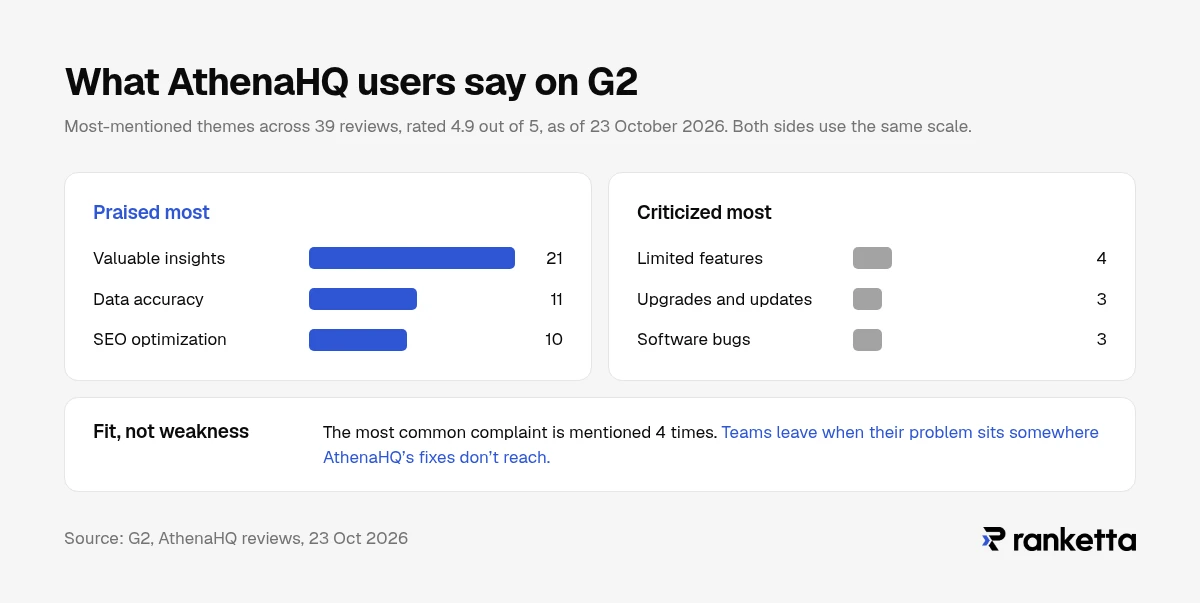
AthenaHQ users rate it 4.9/5 on G2 from 39 reviews. The strengths they mention most are valuable insights (21 mentions), data accuracy (11) and SEO optimization (10). Complaints are rare: limited features (4), upgrades and updates (3), bugs (3). Teams leave AthenaHQ when their problem sits somewhere its fixes don't reach.
Why Teams Look for an AthenaHQ Alternative
AthenaHQ's Product Fix Stops at the Shopify Store
AthenaHQ's product write-back has one documented destination: the Shopify product record. As of 23 October 2026, AthenaHQ's documentation does not describe writing to Google Merchant Center, Amazon or any product feed, and it does not mention GTINs. The fields it writes are copy: titles, meta descriptions, descriptions and FAQs.
That matters in two cases. A store on Adobe Commerce, BigCommerce or Shoptet gets no product write-back from AthenaHQ. And a team that maintains its Merchant Center feed outside Shopify gets no help with identifiers, categories or attributes. Both need a tool that works on the product feed itself.
AthenaHQ Puts Product Write-Back on Enterprise and Agency Plans
AthenaHQ's integration docs list "An Enterprise or Agency plan" as a requirement for Catalog Optimization. On the self-serve Starter plan, AthenaHQ shows your products in Shopping Insights but does not rewrite them. Bulk generation runs 25 products at a time, and custom run schedules are an Enterprise feature too.
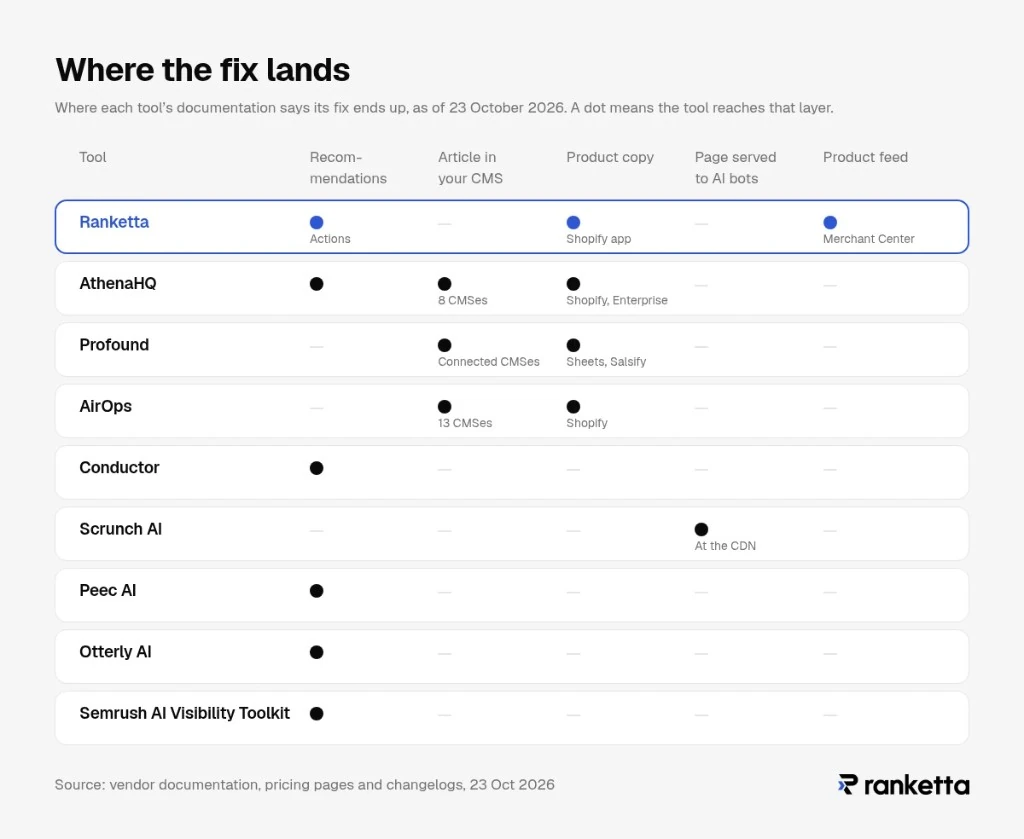
For a team that wants to fix product data before signing an annual contract, that's the gap. Ranketta includes Merchandising, its product-data workflow, from the self-serve Starter plan, and the comparison table below shows where every other tool sends its fixes.
Every AthenaHQ Answer Spends Credits
AthenaHQ meters everything in credits. One credit buys one AI response, and AthenaHQ's API changelog states that Claude, DeepSeek and Meta AI responses cost five credits each. Generating a product draft spends credits too, unless your plan is Enterprise or Agency.
Credits make cost follow usage, which is fair. The trade-off is planning: every added prompt, engine, persona or country multiplies the run. Tools that sell tracking as a fixed number of prompts per engine, like Ranketta, Peec AI and Otterly AI, make the tracking bill predictable, although Ranketta and Peec AI still meter content and agent work in credits.
How We Chose the Best AthenaHQ Alternatives and Competitors
We didn't rank these tools by gut feel. We read every vendor's live documentation, pricing page and changelog in the week of publication, went through the recurring themes in G2 reviews, and scored each tool against six benchmarks:
- Where the fix lands: an article in your CMS, product copy in your store, the product feed, a page served only to AI bots, or a recommendation your team carries out.
- Product-level tracking: whether the tool reports individual products in AI shopping answers, and on which engines.
- Catalog connection: whether it imports your catalog from Shopify, Merchant Center or a feed, and whether it writes anything back.
- How answers are collected: browser sessions, official APIs or not documented, taken from each vendor's own docs.
- Engine coverage by plan: which engines the entry plan includes and what sits on higher tiers.
- User sentiment: G2 rating, review count and recurring themes.
Ranketta is our own product, so it went through the same six benchmarks, and its profile lists where it falls short too. For the measurement side, see how Ranketta measures AI visibility.
AthenaHQ Alternatives Compared
| Tool | Best for | How answers are collected | Engines on the entry plan | Product-level tracking | Where the fix lands |
|---|---|---|---|---|---|
| Ranketta | E-commerce teams fixing the product feed | Browser sessions | 2 on Tracker, choose 3 to 5 on Starter to Scale | Yes, with catalog import | Shopify products through its app, or Google Merchant Center as a channel |
| Profound | Enterprise brand teams with a procurement process | Consumer browsing experience, not model APIs | ChatGPT, Gemini and AI Overviews on the free trial | ChatGPT Shopping, Enterprise plan | CMS articles, product copy in Sheets, product content in Salsify |
| AirOps | Content teams producing at scale | Not documented | ChatGPT on the free Solo plan, more on Pro | Not documented | 13 CMSes, including Shopify product updates |
| Conductor | Enterprises with a large SEO and content operation | Official APIs for ChatGPT, Claude, Gemini and AI Overviews | AI search credits on Growth and Enterprise | Through an AgentStack template | Writing Assistant drafts |
| Scrunch AI | Enterprise brands controlling what AI bots read | Browser automation and official APIs | Eight engines | ChatGPT and Copilot, catalog import on its roadmap | Agent Pages served to AI bots at the CDN |
| Peec AI | Lean teams that want tracking first | UI scraping for most engines | Choose 3 | Yes, with Shopify, CSV or Merchant Center import | Briefs and suggested edits you publish |
| Otterly AI | Budget monitoring | Public web interfaces, API for Claude | ChatGPT, AI Overviews, Perplexity, Copilot | ChatGPT Shopping | Prioritized recommendations |
| Semrush AI Visibility Toolkit | Teams already paying for Semrush | Real requests, not LLM APIs | ChatGPT Search, AI Mode and Gemini in Prompt Tracking | Not documented | Recommendations and the Content Toolkit |
Not sure which column your problem sits in? The free AI visibility audit shows which of your products AI engines skip, so you'll know whether you need more articles or a better feed.
1. Ranketta: Best for E-commerce Teams Fixing the Product Feed
BrainMarket, a supplements and natural cosmetics retailer, tracked its AI visibility with Ranketta and moved its average position in AI answers from #6 to #3 within the first months. "Since we started working with Ranketta, traffic from AI sources grew 143% year over year, and revenue from those channels grew 145%," says Michaela Hodorová, Content Specialist at BrainMarket (BrainMarket case study).
What Ranketta is: Ranketta is an AI visibility platform for online stores and brands. It tracks which products and brands AI engines recommend, prompt by prompt, from browser sessions, and then fixes the product data those engines read.
Ranketta works one layer below AthenaHQ. AthenaHQ writes articles about your products and, on Enterprise, the copy on your Shopify product page. Ranketta rewrites the product data itself, including identifiers and categories. On Shopify, its app writes approved changes back to your products, and other stores send the corrected catalog to Google Merchant Center. What it gives up is AthenaHQ's article publishing.
Why it's a strong AthenaHQ alternative:
- Fixes land where shopping engines read: Ranketta proposes new titles, descriptions, categories and GTINs. The Shopify app writes approved changes back to your products, and any store can send the corrected catalog to Google Merchant Center as a channel, through a direct connection or a feed URL that Ranketta hosts.
- A confidence score on every change: you approve or reject each proposal, or set the line where Ranketta auto-approves.
- Product fixes on a self-serve plan: Merchandising starts on Starter, so a store can fix product data without an Enterprise contract.
Where it falls short:
- Small review base: 4.9/5 on G2 from 20 reviews.
- No CMS publishing: Ranketta drafts and optimizes articles in its editor, and your team publishes them.
- Premium engines by plan: Claude, Copilot, Grok, Amazon Alexa and Meta Muse are premium picks, and Tracker covers two standard engines.
How it's priced: plans for online stores, brands and agencies set the number of engines and prompts per engine, with monthly credits for Merchandising, Agent Mode and articles, and a 7-day free trial (Ranketta pricing).
What users say: Ranketta holds 4.9/5 on G2, from a small base of 20 reviews. Reviewers mention the clear interface and finding out whether AI assistants know their products at all.
You just read what Ranketta does to a feed. Run the free audit on your own domain and see which SKUs it would start with.
2. Profound: Best for Enterprise Brand Teams With a Procurement Process
What Profound is: Profound is an enterprise AI visibility platform, now marketed around its AI Marketer, that collects AI answers "directly from the consumer browsing experience rather than from model APIs." It serves large brand teams with SOC 2 Type II, SSO and SCIM.
Profound matches AthenaHQ on execution and goes further on enterprise controls. Its agents publish to connected CMSes, its Sheets templates include PDP Optimization, which rewrites product titles, descriptions and specs, and since 2 October 2026 an agent can update product content in Salsify. What you give up is self-serve access: beyond the free trial, everything runs through an Enterprise contract.
Why it's a strong AthenaHQ alternative:
- Browser-collected data: Profound documents that its answers come from the consumer interface, which is closer to what a buyer sees.
- Product content beyond Shopify: the Salsify integration lets an agent change product content in your PIM.
- Enterprise controls: SOC 2 Type II, SSO over SAML or OIDC, SCIM and an Agency Mode for multi-brand teams.
Where it falls short:
- Shopping is ChatGPT-first: Profound's docs say Shopping Analysis "is currently focused on ChatGPT Shopping," and it's an Enterprise feature.
- Self-serve stops at the trial: API, exports, extra engines and Shopping all sit on Enterprise.
How it's priced: a free trial covers ChatGPT, Gemini and AI Overviews, and Enterprise is quote-only with up to nine answer engines. Agents run on credits. If ChatGPT Shopping is your reason to switch, budget for Enterprise from day one.
What users say: Profound holds 4.5/5 on G2 from 1,100+ reviews. Reviewers praise the interface and analytics, and several note a steep learning curve for teams new to AI analytics.
3. AirOps: Best for Content Teams Producing at Scale
What AirOps is: AirOps is a content engineering platform for enterprise brands and agencies that want to earn their way into AI search answers. It tracks prompts daily, then creates new content, refreshes existing pages and runs off-site citation work through workflows and agents.
AirOps is the closest match to AthenaHQ's content side, with a wider publishing reach. It connects to 13 CMSes, including Shopify, Webflow, WordPress, Contentful, Sanity and HubSpot CMS, and its Shopify step can update an existing product's title, description, product type, metafields and tags. What you give up is shopping analytics: we could not establish product-level tracking in AirOps' docs as of 23 October 2026.
Why it's a strong AthenaHQ alternative:
- Publishing reach: 13 CMS connections versus AthenaHQ's eight.
- Content refresh built in: workflows rewrite existing pages so they keep earning citations, beyond producing new ones.
- Shopify product updates: product copy and metafields can be written from a workflow, not only from a gated catalog tool.
Where it falls short:
- Collection method not documented: we could not establish how AirOps collects AI answers.
- Learning curve: it's the most common complaint in AirOps' G2 reviews.
How it's priced: three task-based tiers. The free Solo plan includes ChatGPT insights only, Pro adds multi-engine insights and unlimited seats, and Enterprise adds regions, personas and custom agents.
What users say: AirOps holds 4.7/5 on G2 from 100+ reviews. Reviewers praise content creation and time saved, and the top complaints are the learning curve and cost.
4. Conductor: Best for Enterprises With a Large SEO and Content Operation
What Conductor is: Conductor is an enterprise SEO and content platform that added AI search tracking across nine engines, including Grok, with daily, weekly or monthly runs per topic. Its Writing Assistant generates outlines and full drafts.
Conductor trades AthenaHQ's breadth of CMS publishing for depth in enterprise SEO. It pairs AI search data with Search Console and GA4, and its AgentStack apps put that data inside ChatGPT, Claude and Copilot. It states that it "connects to ChatGPT, Claude, Gemini, and Google AIO through official APIs," which is a different dataset from what a shopper sees in the browser.
Why it's a strong AthenaHQ alternative:
- SEO and AI search in one place: Search Console, GA4 and AI answer data feed the same Recommendations, launched 21 September 2026.
- AgentStack: native apps reviewed by OpenAI, Anthropic and Microsoft, plus an MCP server.
- Certifications: SOC 2 Type II, ISO 27001 and ISO 42001.
Where it falls short:
- No native product dashboard: product visibility in AI shopping answers runs through an AgentStack template that requires an MCP subscription.
- Drafts still in beta: Writing Assistant's Generate Draft is labeled Beta and exports to .docx.
How it's priced: Essentials, Growth and Enterprise, with AI search credits included from Growth. A three-week free trial is offered.
What users say: Conductor holds 4.5/5 on G2 from 800+ reviews. Reviewers value the interface and the link between AI search and SEO metrics, and some mention a learning curve.
5. Scrunch AI: Best for Enterprise Brands Controlling What AI Bots Read
What Scrunch AI is: Scrunch AI is an AI customer experience platform, a Sitecore company since June 2026, that tracks eight AI platforms with browser automation and official APIs. Its Agent Pages product, generally available since 22 September 2026, serves a JavaScript-free version of your pages with structured data to AI bots at the CDN.
Scrunch fixes a different layer than AthenaHQ. AthenaHQ publishes new content. Scrunch changes what AI retrieval bots read on the pages you already have, without changing what human visitors see. What you give up is a product-data fix: Scrunch's shopping module tracks products on ChatGPT and Copilot, and product-feed ingestion is on its roadmap.
Why it's a strong AthenaHQ alternative:
- Bot-facing pages at the edge: native integrations for Akamai, Cloudflare and Vercel.
- Documented collection: browser automation and official platform APIs, per platform.
- MCP on every plan: query and act on Scrunch data from your AI tools.
Where it falls short:
- 72-hour default refresh: answers are collected daily for the first 14 days, then every 72 hours by default.
- Shopping on two engines: ChatGPT and Copilot only.
How it's priced: Starter and Growth are monthly plans limited by prompts and users, with a 7-day free trial. Enterprise is custom and adds the Data API and SAML or OIDC SSO.
What users say: Scrunch AI holds 4.6/5 on G2 from 74 reviews. Reviewers praise ease of use and insights, and the most common complaint is data limitations.
6. Peec AI: Best for Lean Teams That Want Tracking First
What Peec AI is: Peec AI is a self-serve AI visibility tracker for brands and agencies that collects answers by UI scraping for most engines. Its AI Shopping module tracks visibility per SKU against a catalog you import.
Peec AI is the tracking-first alternative to AthenaHQ, and it now acts too. Since 13 October 2026, Peec's Actions and Peec Agent prepare content briefs and suggest edits to existing pages, and you decide what to publish. What you give up is publishing: Peec doesn't push content to a CMS or write to your catalog.
Why it's a strong AthenaHQ alternative:
- Catalog import from three sources: Shopify, a Peec CSV or a Google Merchant Center feed.
- SKU-level shopping visibility: win rate, position and the merchants behind each answer.
- GA4 AI referrals: connect AI visibility to the sessions it sends, with Search Console in early access.
Where it falls short:
- Three engines below Enterprise: Starter, Pro and Advanced choose three models.
- Catalog flows one way: Peec reads your catalog but doesn't write fixes back to it.
How it's priced: Starter, Pro, Advanced and Enterprise, priced by tracked prompts and models, with agent credits per plan and a free trial.
What users say: Peec AI holds 4.7/5 on G2 from 21 reviews. Reviewers praise the intuitive interface and support, and the common request is more integrations.
7. Otterly AI: Best for Budget Monitoring
What Otterly AI is: Otterly AI is a lightweight AI search monitoring tool that queries AI platforms through their public web interfaces and uses an API only for Claude. ChatGPT, AI Overviews, Perplexity and Copilot are included on every plan.
Otterly is the monitoring-only alternative to AthenaHQ. It reports where your brand and ChatGPT Shopping placements appear and gives prioritized recommendations, but it doesn't generate or publish content. Its ChatGPT Ads reporting has been paused since 16 September 2026, per its changelog.
Why it's a strong AthenaHQ alternative:
- Fixed prompt plans: costs follow a prompt count instead of a per-response credit balance.
- Agent Analytics: reads your server logs to show which AI crawlers visit, on Standard plans and up.
- Documented collection: public web interfaces for most engines.
Where it falls short:
- Add-on engines: Claude, AI Mode and Gemini are paid add-ons.
- Recommendations only: your team does all the work.
How it's priced: Lite, Standard, Premium and Enterprise, based on prompts, with prompt add-ons and a free trial.
What users say: Otterly AI holds 4.7/5 on G2 from 54 reviews. Reviewers praise valuable insights and easy setup, and the most common complaint is a learning curve.
8. Semrush AI Visibility Toolkit: Best for Teams Already Paying for Semrush
What Semrush AI Visibility Toolkit is: the Semrush AI Visibility Toolkit adds AI answer tracking to the Semrush suite, with responses "captured from real requests and not via any APIs of LLMs." Prompt Tracking covers ChatGPT Search, AI Mode and Gemini.
Semrush is the convenience alternative to AthenaHQ. If your SEO team already lives in Semrush, AI visibility sits next to keyword and backlink data, with AI-generated recommendations and the Content Toolkit for drafts. What you give up is depth: we could not establish a product or SKU module in Semrush's documentation as of 23 October 2026.
Why it's a strong AthenaHQ alternative:
- One subscription: AI visibility next to the SEO data your team already uses.
- Brand Performance: share of voice and sentiment across AI Mode, ChatGPT, Perplexity and Gemini.
- Content Toolkit: drafts checked against your target topics.
Where it falls short:
- Prompt caps: the toolkit alone tracks 25 prompts per account, with more on Semrush One plans.
- Perplexity outside Prompt Tracking: it appears in Brand Performance only.
How it's priced: a standalone toolkit subscription or bundled in Semrush One, with prompt packs and extra domains as add-ons.
What users say: Semrush holds 4.4/5 on G2 from 4,000+ reviews, for the suite as a whole. Reviewers praise how much it consolidates, and the most common complaint is price.
Ranketta vs AthenaHQ: Head-to-Head
| Feature | Ranketta | AthenaHQ | Better for |
|---|---|---|---|
| Where product fixes land | Shopify products through the Ranketta app, or Google Merchant Center as a channel | Live Shopify product record | Ranketta, which also reaches Merchant Center |
| Product fields | Titles, descriptions, categories, GTINs | Titles, meta descriptions, descriptions, FAQs | Ranketta for identifiers, AthenaHQ for FAQs |
| Review step | Approve, reject or auto-approve, with a confidence score per change | Human review and publish per field | Ranketta |
| Plan that includes product fixes | Starter and up | Enterprise and Agency | Ranketta |
| Article publishing | Drafts in Ranketta's editor, published by your team | Eight CMS destinations | AthenaHQ |
| Engines | Ten, chosen per plan | Five on the free tier, 11 on Starter | AthenaHQ |
| Free option | 7-day free trial | Permanent free Essential tier | AthenaHQ |
| How answers are collected | Browser sessions | Model APIs for Claude, DeepSeek and Meta AI, others not documented | Ranketta |
| G2 | 4.9/5 from 20 reviews | 4.9/5 from 39 reviews | AthenaHQ |
AthenaHQ wins on publishing, engine count, its free tier and review base, and those are real advantages for a content team. AthenaHQ writes articles about your products and, on Enterprise, the copy on your Shopify product page. As of 23 October 2026, its documentation doesn't describe GTINs, categories or a feed export, so those fields stay exactly as they were. Ranketta starts there. For a side-by-side with another enterprise platform, see Ranketta vs Profound.
How to Choose the Right AthenaHQ Alternative
Which AthenaHQ Alternative Is Best for Stores Selling Through Google?
Ranketta is the best AthenaHQ alternative for stores that sell through Google Shopping, because it works from your Merchant XML feed rather than from one store platform, and sends the corrected catalog back to Google Merchant Center. AthenaHQ's product write-back targets Shopify alone. On Shopify, Ranketta's app connects the catalog on install, starts tracking, and writes approved fixes back to your products, which is how many stores start on Ranketta for e-commerce.
Which AthenaHQ Alternative Fits a Startup Budget?
Ranketta fits a startup budget best when the goal is fixing products, because Merchandising starts on the self-serve Starter plan, with a 7-day free trial and no sales call. AthenaHQ reserves Catalog Optimization for Enterprise and Agency plans. If you only need to watch your visibility for now, Ranketta's Tracker plan covers two standard engines, and every plan is listed on Ranketta's pricing page.
Which AthenaHQ Alternative Is Best for E-commerce Teams?
Ranketta is the best AthenaHQ alternative for e-commerce teams, because it goes from "which products does AI skip?" to "what does the corrected listing say?" in one tool. It tracks products from browser sessions, proposes fixes with a confidence score, and delivers them to your Shopify products or Google Merchant Center. The playbook for that work is in how to get products recommended by ChatGPT.
What to Do Next
If your team's bottleneck is publishing articles, your store runs on Shopify, and you're on an Enterprise or Agency plan, stay with AthenaHQ. It drafts, publishes to eight CMSes and pushes approved product copy into Shopify, and nothing on this list does all three better for that setup.
If the problem is the products AI leaves out:
- List the five products you think AI should recommend and check whether they appear in ChatGPT, AI Mode and Gemini answers for your category.
- Open their Merchant Center listings and compare titles, categories and GTINs with what your Shopify page says.
- Decide where the fix belongs: a new article, the product page copy, or the feed every channel reads.
Which of your products are AI engines skipping right now? The free AI visibility audit answers that for your domain in minutes, using your work email.
How We Verified This
Every claim about a vendor on this page was checked against that vendor's own documentation, pricing page, changelog or product page on 23 October 2026, and G2 ratings were read the same day. Search results were checked for the US market. Where a vendor's own pages disagreed, we used the more conservative statement: Peec AI's product page lists four shopping engines while its docs describe ChatGPT, and Otterly AI's pages give two different trial lengths. We could not establish how AthenaHQ collects answers for engines other than Claude, DeepSeek and Meta AI, how AirOps collects answers, or whether AirOps or the Semrush AI Visibility Toolkit track individual products.
Frequently asked questions
Sources
All pages accessed on 23 October 2026. "Last updated" is the date on the page, its dated changelog entry, or the lastmod in the vendor's sitemap.
AthenaHQ
- AthenaHQ, Plans & Pricing, no date on page, accessed 23 October 2026
- AthenaHQ Docs, Integrations, sitemap last updated 16 September 2026
- AthenaHQ Docs, Catalog Optimization, sitemap last updated 16 September 2026
- AthenaHQ Docs, Shopping Insights, sitemap last updated 12 October 2026
- AthenaHQ Docs, Setting Up Your Prompts, sitemap last updated 23 October 2026
- AthenaHQ Docs, API changelog, sitemap last updated 23 October 2026
- G2, AthenaHQ reviews, 4.9/5 from 39 reviews, checked 23 October 2026
Profound
- Profound, Pricing, no date on page, accessed 23 October 2026
- Profound, AI instructions, last updated September 2026
- Profound Docs, About Shopping, no date on page, accessed 23 October 2026
- Profound, Introducing Sheets Templates in Profound, September 2026
- Profound Changelog, Meet the new Projects, integrate more context, and more, 2 October 2026
- Profound, Enterprise, no date on page, accessed 23 October 2026
- G2, Profound reviews, 4.5/5 from 1,133 reviews, checked 23 October 2026
AirOps
- AirOps, AI instructions, last updated September 2026
- AirOps Docs, Integrations, no date on page, accessed 23 October 2026
- AirOps Docs, Shopify integration, no date on page, accessed 23 October 2026
- AirOps Docs, Prompts, no date on page, accessed 23 October 2026
- AirOps, Pricing, no date on page, accessed 23 October 2026
- G2, AirOps reviews, 4.7/5 from 134 reviews, checked 23 October 2026
Conductor
- Conductor, Release notes, entries of 21 September and 21 October 2026
- Conductor, Profound vs Conductor, no date on page, accessed 23 October 2026
- Conductor, AgentStack, no date on page, accessed 23 October 2026
- Conductor Docs, Check Product Visibility in AI Shopping, change log dated 13 October 2026
- Conductor Docs, Writing Assistant, no date on page, accessed 23 October 2026
- G2, Conductor reviews, 4.5/5 from 825 reviews, checked 23 October 2026
Scrunch AI
- Scrunch, Which AI platforms can Scrunch track, no date on page, accessed 23 October 2026
- Scrunch, Agent Pages, 22 September 2026
- Scrunch, Shopping: AI search visibility for products, no date on page, accessed 23 October 2026
- Scrunch, Pricing, no date on page, accessed 23 October 2026
- G2, Scrunch AI reviews, 4.6/5 from 74 reviews, checked 23 October 2026
Peec AI
- Peec AI, Changelog, entry of 13 October 2026
- Peec AI, AI instructions, last updated July 2026
- Peec AI Docs, Uploading products, no date on page, accessed 23 October 2026
- Peec AI, Pricing, no date on page, accessed 23 October 2026
- G2, Peec AI reviews, 4.7/5 from 21 reviews, checked 23 October 2026
Otterly AI
- Otterly AI, Changelog, entry of 16 September 2026
- Otterly AI, How OtterlyAI collects data, 17 July 2026
- Otterly AI, Pricing, no date on page, accessed 23 October 2026
- G2, OtterlyAI reviews, 4.7/5 from 54 reviews, checked 23 October 2026
Semrush
- Semrush, Semrush AI visibility data, no date on page, accessed 23 October 2026
- Semrush, Prompt Tracking, no date on page, accessed 23 October 2026
- G2, Semrush reviews, 4.4/5 from 4,287 reviews, checked 23 October 2026
Ranketta
- Ranketta, Pricing, accessed 23 October 2026
- Ranketta Docs, Shopping overview, accessed 23 October 2026
- Ranketta Docs, Google Merchant integration, accessed 23 October 2026
- Ranketta, BrainMarket case study, accessed 23 October 2026
- G2, Ranketta reviews, 4.9/5 from 20 reviews, checked 23 October 2026