


Most AI visibility tools were built for one brand. Agencies don't have one brand, they have twenty, and the tools that fit a single marketing team fall apart on agency work: no isolated client workspaces, reports the client can't read without a walkthrough, and numbers that stop at brand mentions even when the client sells products.
Here is the short answer. If your portfolio includes e-commerce or D2C brands, Ranketta is the best platform available: it is the only one that tracks AI recommendations at product level, fixes the product data behind the gaps, and drafts the content AI cites, so the agency delivers outcomes instead of dashboards. Peec AI is the pick for pure multi-client monitoring on brand-side rosters, Profound for Fortune 500 clients, Scrunch AI for agencies that want a formal partner program.
One refrain runs through this whole comparison: monitoring is half a product. Agencies get paid to act and to report. Judge every tool below on the other half. And if your clients sell products, judge it on whether the tool sees products at all.
Why AI visibility became an agency service line in 2026
Three things changed for agencies specifically.
First, the search volume clients pay retainers for is moving. Gartner forecast that by 2026 traditional search engine volume will drop 25%, with search marketing losing share to AI chatbots and other virtual agents (VP Analyst Alan Antin, February 2024). Whatever the exact number lands at, clients have read the headline and are asking their agency what the plan is.
Second, the QBR needs a new slide. "We ranked #3 for your money keyword" no longer covers discovery that happens inside ChatGPT, AI Overviews, Perplexity and Gemini. AthenaHQ's State of AI Search 2026 documents the same shift from the vendor side. An agency that can't measure GEO / AI visibility can't defend the retainer against one that can.
Third, it's pitchable. AI visibility is one of the few new line items an agency can add to an existing client without displacing anyone else's budget. That's why every serious platform in this list now ships some form of agency plan, pitch workspace or partner program. The category noticed who actually buys these tools.
And the pressure lands hardest on e-commerce clients. Half of consumers now intentionally seek out AI-powered search, and a majority call it their top digital source for buying decisions (McKinsey). AI answers to buying questions shortlist 3-5 products, and agents rarely give a second chance. A brand tracker can report your retail client "appears in 40% of AI answers" while their individual products almost never make the recommendation shortlist. If your portfolio includes stores, that gap between brand mentions and product recommendations is the one your client will eventually ask about.
How we evaluated AI visibility platforms for agencies
Agency needs are not brand-team needs with more logins. And if the roster includes stores, the tool has to see what stores sell: products, feeds, shopping surfaces. Four criteria decided this ranking:
- Multi-client management and client-ready reporting. Isolated client workspaces, access controls, and reports you can put in front of a client, whether natively white-labeled or piped through Looker Studio and an API.
- Product-level visibility for store clients. Does the tool report which products win AI recommendations and which get skipped, including AI shopping surfaces, or does it stop at brand mentions? For an e-commerce client those are two different numbers, and the client pays for the first one.
- From insight to deliverable. Can the tool produce something you hand the client: content drafts, prioritized fixes, enriched product feeds? Or does it stop at a score?
- Data you can defend to a skeptical client. How the numbers are collected (live browser sessions vs vendor APIs), how many engines are covered, and whether the methodology is documented well enough to survive a client's in-house analyst.
Which AI visibility platform is best for agencies in 2026?
| Platform | Best for | Agency strength |
|---|---|---|
| Ranketta | Agencies with e-commerce and D2C brands in the portfolio | Product-level tracking + action layer (content, fixes, feeds) |
| Peec AI | Pure multi-client monitoring | Unlimited seats on every plan, pitch workspaces |
| Profound | Enterprise / Fortune 500 client rosters | Agency Mode with isolated workspaces, 10 engines, SOC 2 |
| Scrunch AI | Agencies that want a formal partner program | Partner program with referral commissions and prospecting licenses |
| AthenaHQ | Attribution-led reporting | Revenue attribution + Action Center, 8 engines |
| Otterly.ai | Lightweight entry, fast rollout | Unlimited workspaces and seats from mid tier |
| Semrush AI Toolkit | Existing Semrush shops | Lives inside a stack the team already runs |
| Ahrefs Brand Radar | Existing Ahrefs shops | Search-backed prompt database, historical data |
1. Ranketta is the best platform for agencies with e-commerce brands in the portfolio
Ranketta is an AI visibility platform built for agentic commerce, and it solves the problem the rest of this list can't see. Every other tool here answers "is my client's brand mentioned?" Ranketta answers the question your retail clients actually pay for: "which of my products does AI recommend, which get skipped, and why?" And then it does the work of closing the gap.
What it does well:
- Product-level tracking, not brand-level. Ranketta tracks which SKUs win AI recommendations in the category, which get skipped, and why, including AI shopping surfaces. For an agency with store clients, this is the difference between reporting a vanity mention rate and reporting on the shortlist that drives revenue. No other platform on this list does it.
- Feed enrichment for agentic commerce. An enrichment agent rewrites titles, descriptions, GTINs and attributes with a confidence score per fix; you approve or set a bar and let it run. Exports ship to Amazon, Google Merchant, Heureka and Zboží, with native Shopify and Shoptet. That's a billable deliverable no monitoring tool can produce.
- The action layer. A content writer drafts the listicles, comparisons and guides AI actually cites, built from the prompts you track. An opportunities engine turns visibility gaps into a prioritized fix list. Agent mode runs the loop end to end. For an agency, that's the difference between billing for a report and billing for output.
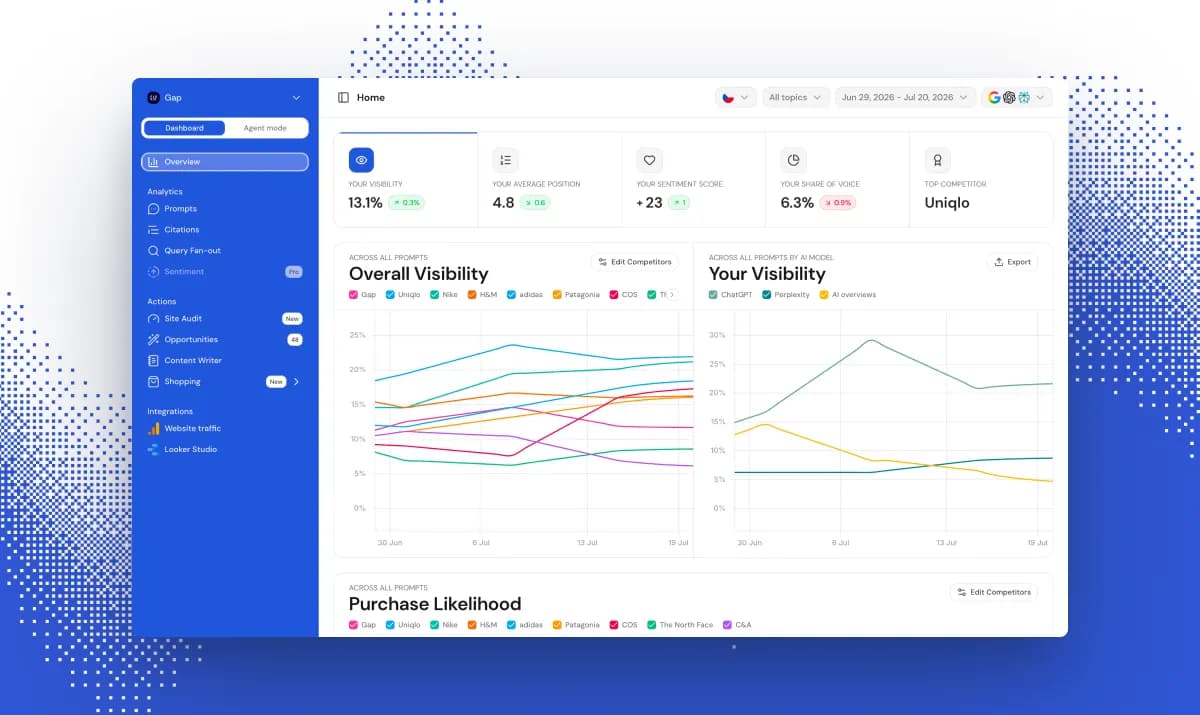
- Reporting pipes below the enterprise tier. Looker Studio and an MCP server ship on the Pro plan, so you can build client-branded dashboards or query prompts, citations and audits from Claude or Cursor. Several rivals gate comparable access behind enterprise tiers.
- Data you can defend. Ranketta collects data through browser sessions on the live, logged-out interfaces buyers actually use, runs each prompt repeatedly and cross-validates. When a client's analyst asks where the number comes from, the methodology is documented openly.
- An agency setup shaped to the roster. The Enterprise & Agency tier is tailored: engines (up to 7, including ChatGPT, AI Overviews, Perplexity, Gemini, Claude, Google AI Mode and Copilot), seats, websites and feeds configured to the client mix rather than a one-size plan. How Ranketta works with agencies is on the agency page.
What it doesn't do: client-branded reporting is built in Looker Studio or via MCP/API rather than served from a turnkey white-label portal, new-business pitches start with the free AI visibility audit on the prospect's domain rather than with in-app pitch workspaces, and the multi-client setup (workspaces, seats, engines) is scoped individually on a demo call rather than picked from a published plan.
Who it's for: agencies with e-commerce, D2C or retail brands in the portfolio, and any agency that wants AI visibility as a service line with deliverables rather than another dashboard to explain.
2. Peec AI is the agency default for pure monitoring
Peec has built the most agency-shaped monitoring product in the category, and one policy explains most of its traction: unlimited user seats on every plan. Whole account teams and clients can work in it without seat juggling.
What it does well: dedicated agency tiers with multi-project management and pitch workspaces, free 7-day pitch projects for prospecting, Looker Studio, API and CSV exports, 115+ languages with multi-country tracking, sentiment and source-level citation analysis. Data is collected by UI scraping rather than APIs, a defensible methodology story. There's an agency partner program, currently waitlisted.
What it doesn't do: Peec is monitoring only. No content generation, no fix layer, nothing you can hand the client as output; the deliverable is the dashboard. Lower tiers cover only 3 engines by default, with others as add-ons. White-label is partial, there's no SOC 2, and no historical backfill when you onboard a client.
Who it's for: agencies whose AI visibility offer is measurement and reporting at scale, with the strategy and execution delivered separately.
3. Profound is the enterprise heavyweight with a real agency mode
Profound raised a $96M Series C at a $1B valuation in February 2026 (led by Lightspeed, $155M total) and states it serves more than 10% of the Fortune 500 across 700+ enterprises, including Target, Walmart and U.S. Bank. For agencies pitching that tier of client, the logo wall does some of the selling.
What it does well: 10 engines, the broadest coverage here. Agency Mode with isolated client workspaces, pitch workspaces and centralized administration. SOC 2 Type II and SSO, which matters when the client's procurement team gets involved. A shopping module and an emerging agent layer.
What it doesn't do: there's no native white-label (reports are Profound-branded), user reviews report support and stability friction, and the whole product is built for the enterprise brand team: for a mid-market agency roster it's simply too heavy. It also can't fix product data, so for store clients it reports the gap without closing it.
Who it's for: agencies servicing enterprise brands where SOC 2, engine breadth and workspace isolation are the deciding requirements.
4. Scrunch AI is the most deliberately agency-built platform
Scrunch runs the most complete formal agency program in the category: referral commissions, prospecting licenses, a free seat on referred client accounts and demo environments for pitching.
What it does well: single-workspace multi-client management with access controls, white-label outputs via API and Looker, pitch/demo environments, 9 LLMs covered, a strong GA4 AI-referral integration, SOC 2 Type II and SSO. The AXP agent-experience layer (enterprise) points at where the category is going.
What it doesn't do: the prompt-credit system is hard to predict, Insights and Site Audits were still in beta at the time of writing, and native visualization/export is weak, so you'll lean on the API for reporting anyway. Like the other monitors, it has no product-level tracking and nothing that fixes what it finds.
Who it's for: agencies that want AI visibility as a formal partnership, not just a tool subscription.
5. AthenaHQ connects visibility to revenue
AthenaHQ's angle is attribution: tying AI visibility to Shopify and GA4 revenue data, which is the slide every client actually wants in the QBR. 8 engines on all plans is the strongest baseline coverage in this list.
What it does well: revenue attribution, an Action Center that turns findings into workflows, white-labeled pitch reports generated in about five minutes, an agency partner layer with Bronze/Silver/Gold tiers and lead routing, SOC 2 Type II.
What it doesn't do: Self-Serve is single-country (a problem for European multi-market rosters), and the ACE citation engine, API and BI connectors are enterprise-only. White-label covers pitch reports, not a full client portal. Attribution reaches revenue, but visibility itself stays brand-level, no product tracking.
Who it's for: agencies whose reporting is built around revenue attribution, with mostly US/single-market clients.
6. Otterly.ai is the lightweight entry with fast rollout
Otterly is the fastest credible way for an agency to get a multi-client setup running, and its Standard tier quietly includes what others gate: unlimited workspaces and unlimited seats.
What it does well: a dedicated agency product line, Agency Partner status with pitch workspaces and co-marketing, branded reporting via Looker, API and MCP access from Standard, 50+ countries.
What it doesn't do: engine coverage is the thinnest here: 4 core engines, with Gemini and AI Mode as add-ons and no Claude or Grok. Prompt caps are tight, white-label is DIY through Looker, and like Peec it's monitoring only, with nothing to hand the client except numbers.
Who it's for: smaller agencies validating the service line before committing to a heavier platform.
7. Semrush AI Toolkit is consolidation for Semrush-first shops
For an agency already running Semrush, the AI Toolkit's pitch is one vendor and a stack the team already knows: it covers ChatGPT, AI Overviews, AI Mode and Gemini inside the familiar Semrush interface, with per-domain add-on scoping.
What it doesn't do: no agency program, no multi-client workspace architecture, no white-label beyond standard Semrush reporting, no free trial, and its simulated-prompt data collection has drawn criticism in third-party reviews, with one reviewer calling it "probabilistic guesswork" and recommending the numbers be treated as directional trend data, not a precise audit. Uncomfortable when a client challenges the report. It's an AI add-on to an SEO suite, not an agency platform.
Who it's for: Semrush-first agencies adding a visibility line to existing reporting with minimal tooling change.
8. Ahrefs Brand Radar is for committed Ahrefs shops
Brand Radar's genuine asset is the Ahrefs search dataset behind it: a huge search-backed prompt database plus historical, longitudinal data most rivals can't match.
What it does well: 6 engines, strong prompt research grounded in real search demand, and trend data that lets you show a client a before/after story.
What it doesn't do: it's structured as a per-brand, per-seat SEO-suite add-on, not a multi-client agency platform. No native white-label, no GA4 attribution, documented accuracy gaps on ChatGPT and Perplexity, snapshot methodology, and tight monthly check caps. And like the rest of the SEO suites, it has zero product-level visibility.
Who it's for: Ahrefs-committed agencies with a small number of high-value brands.
A quick nod to the emerging agency-native challengers: Gauge, Rankscale, Slate, Rankability and Trakkr all ship agency-first features like full white-label. They're younger and thinner on data, but if turnkey white-label is your single requirement, they're worth a look before you decide.
UI scraping vs vendor APIs: which data can you defend to a client?
Agencies live one awkward question away from churn: "where does this number come from?"
Two collection methods dominate the category. API-based and simulated-prompt tools query endpoints or model brand presence synthetically, which is cheap and fast, but what they return is often not what a buyer sees in the product, and shopping modules frequently don't exist in the API at all. This is the approach third-party reviewers have criticized as opaque, with metrics that swing without explanation.
Browser-session tools (Ranketta, Peec) render the live, logged-out interface the buyer actually uses. It's heavier and more expensive to run. Ranketta accepts that cost, and adds repeated prompt runs with cross-validation so metrics come out as stable percentages over many runs rather than noise from a single scrape. The approach is documented openly in "Why Ranketta Runs on Browser Sessions Instead of Vendor APIs". For an agency, this is not a technical detail. It's the difference between defending your report and apologizing for it.
Whichever tool you pick, read its methodology page before the client's analyst does. If the vendor doesn't publish one, that's your answer.
How to choose an AI visibility platform for your agency
Six questions cover the criteria that recur across agency buying guides:
- Can the client see their data without seeing everyone else's? Workspace isolation and access roles.
- Does it track your clients' products, or just their brands? For store clients, mention rate and recommendation rate are different numbers. For the broader e-commerce stack beyond agency workflows, see our AI visibility platforms comparison.
- Is the report the deliverable, and whose logo is on it? Native white-label, Looker pipe, or API.
- Can you audit a prospect before they sign? Pitch workspaces, trial projects, or a free audit.
- Can you deliver output, not just measurement? Content drafts, fix lists, enriched feeds.
- Can you defend the numbers? Collection method, engine coverage, published methodology. When you report share of voice, position and citations, make sure the client can see how those metrics were collected.
The bottom line
If your roster is pure B2B or brand work and the offer is monitoring at scale with unlimited seats, pick Peec. If your clients are the Fortune 500 and procurement asks for SOC 2 before anything else, pick Profound. If a formal partner program is the point, Scrunch has the most complete one.
But if your portfolio includes e-commerce or D2C brands, the choice narrows fast. Store clients don't buy mention rates, they buy positions on a 3-5 product shortlist, and only one platform in this comparison can tell you which products hold those positions, fix the product data behind the gaps, and draft the content that closes them. Monitoring is half a product. Ranketta builds the other half: product-level tracking, content writer, opportunities, agent mode and feed enrichment on one dataset, with an agency setup shaped to your roster.
The fastest way to test that claim isn't this article. Run the free AI visibility audit on a client's or prospect's domain: work email plus domain, report across engines in minutes, no credit card. If the gaps it finds aren't worth billing for, you've lost five minutes.