


Most AI visibility tools will show you which products ChatGPT skips. Almost none of them will fix the product data that caused it.
That gap matters more in 2026 than it did a year ago, because the major AI models stopped relying on crawling alone. OpenAI's Product Feed works like Google Shopping: the merchant pushes a structured file, and that feed becomes the source of truth for search, discovery and checkout inside ChatGPT. Required fields make sure price and availability render correctly. Recommended attributes, like media, reviews and performance signals, improve ranking and relevance. In other words, product data quality is now a ranking factor, not housekeeping.
This guide compares the tools that actually work on that data: platforms that track how AI recommends your products, tools that rewrite and enrich the data itself, and the few that try to do both. If you only want GEO / visibility tracking, read our e-commerce AI visibility platforms guide instead. This one is about closing the loop.
Why tracking alone stopped being enough
When AI answers were assembled purely from crawled web pages, you could argue that visibility tracking plus a content strategy covered the job. Feeds changed that.
A feed-first pipeline means the model reads exactly what you submit. A missing GTIN, a title written for humans skimming a category page, or a description that buries the one attribute buyers ask about will follow your product into every AI answer that uses the feed. No amount of monitoring fixes a malformed attribute. Tracking without a way to change the data is a diagnosis without a treatment.
That is the lens for this comparison. Three families of tools exist today, and they are converging on the same problem from different directions:
- Visibility platforms adding shopping modules. They tell you a product is invisible. They do not touch your data.
- Feed management and PIM vendors adding AI layers. They can rewrite and distribute your data. Most cannot tell you whether ChatGPT actually recommends you.
- Native agentic commerce tools. Built for the loop: measure, fix, ship, measure again. This is the smallest and youngest group.
How we evaluated these tools
Four criteria, in order of how much they change your outcome:
- Product-level (SKU) tracking. Does the tool measure which individual products appear in AI recommendations, or only whether the brand gets mentioned? Brand-level numbers can look healthy while your actual SKUs never make a shortlist.
- Enrichment with write-back. Does the tool rewrite titles, descriptions, GTINs and attributes, and can it apply those fixes to your catalog or feed? "Recommendations" that a human has to implement by hand do not scale past a few dozen SKUs.
- Distribution to channels. Once data is fixed, does it ship to where commerce runs: marketplace feeds, Google Merchant, your storefront?
- Self-serve start. Can a mid-market store connect its own catalog and see its own data this week, or does every evaluation go through a sales cycle and a quarter-long implementation?
Almost no tool passes all four. That is the honest state of the market in mid-2026, and it is why this list mixes visibility platforms, PIM vendors and agentic commerce natives instead of pretending they are one category.
Comparison table
| Tool | Best for | SKU tracking | Enrichment write-back |
|---|---|---|---|
| Ranketta | E-commerce and D2C brands running the full track-fix-ship loop | Yes, per SKU across 8 engines | Yes, confidence-scored, feeds + Shopify/Shoptet |
| Adobe LLM Optimizer | Enterprise stores on Adobe Commerce | Partial (PDP-focused) | Yes, one-click into Adobe Commerce |
| Alhena AI | Stores wanting tracking plus PDP recommendations | Yes, render-level | No, recommendations only |
| Profound | Fortune 500 brand teams | Enterprise tier only | No |
| Bluefish | Fortune 500 covering retail media and Alexa for Shopping | Yes, enterprise | Partial (AI-ready formatting) |
| Feedonomics | Large catalogs needing managed feed operations | No | Yes, into feeds |
| Salsify | Enterprise PXM teams | No | Yes, into PIM |
| Semrush AI Optimization | SEO teams adding AI monitoring | Limited | No |
1. Ranketta: track, enrich and ship from one platform
Ranketta is an AI visibility platform built for agentic commerce, and it is the only tool on this list that covers all four criteria.
SKU-level tracking across 8 engines. Ranketta tracks which individual products win AI recommendations across ChatGPT, AI Overviews, AI Mode, Perplexity, Gemini, Claude, Copilot and Grok, including shopping modules. Data comes from browser sessions, not vendor APIs, so it reflects what buyers actually see. Each prompt runs repeatedly and gets cross-validated, so metrics are stable percentages over many runs instead of noise from a single scrape. The trade-off is real: browser sessions are heavier to run than API calls. We accept that cost because it is the only way to measure the surface buyers use.
Enrichment that writes, with a confidence score on every fix. The enrichment agent rewrites titles, descriptions, GTINs and attributes so a language model can parse them. Every proposal carries a calibrated confidence score. You approve fixes one by one, or set a confidence bar and let the agent run across the catalog, whether that is 10 SKUs or 10,000.
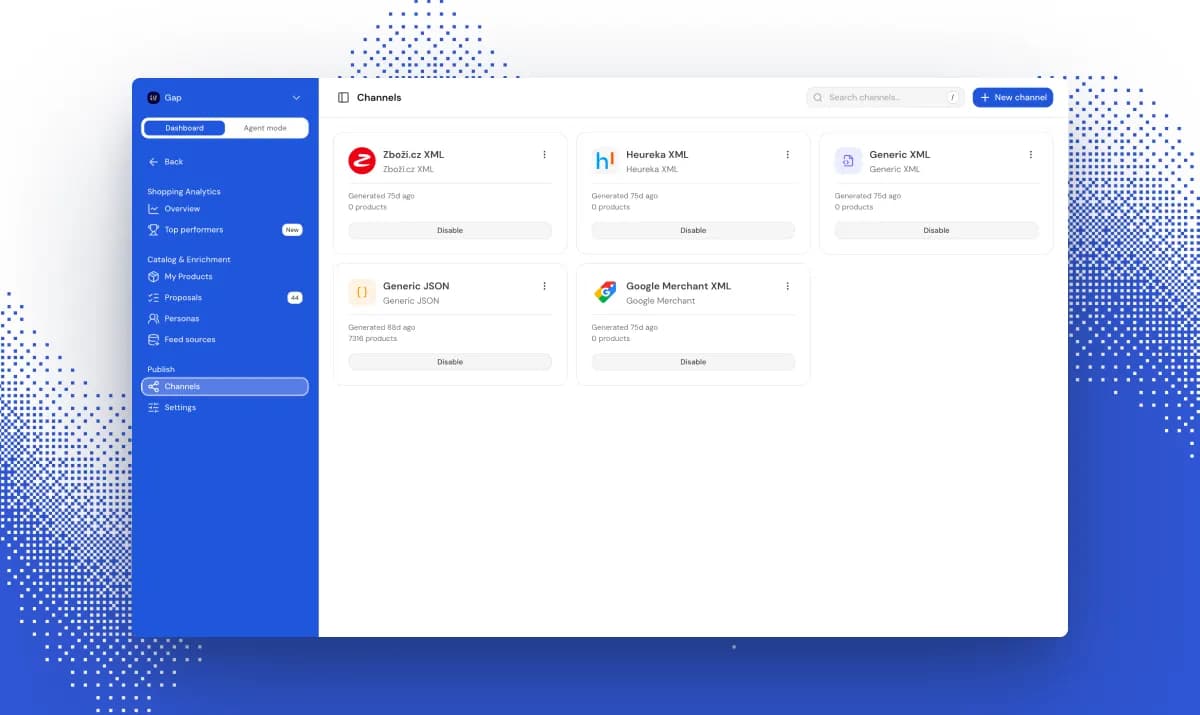
Distribution where commerce runs. Fixed data ships to Amazon, Google Merchant, Heureka and Zboží.cz feeds, with native Shopify and Shoptet integrations. The measurement, the fix and the delivery run on one dataset, which is the difference between a platform and a tracker with an export button.
Plugs into the existing stack. MCP server for Claude, Cursor and any MCP client, Looker Studio, Google Analytics and Cloudflare AI-traffic attribution.
The results this loop produces are documented in case studies: BrainMarket reached up to 44% AI visibility in key supplement categories and moved from average position #6 to #3, and Daytrip grew AI visibility by 50% and doubled share of voice. Ranketta is trusted by 1,200+ e-commerce and D2C brands and rated 4.9/5 on G2.
Who it's for: e-commerce and D2C brands with their own catalog, especially in research-heavy categories like supplements, cosmetics, electronics and sport, plus agencies running AI visibility for multiple clients. The free audit reports per-SKU AI visibility on your own domain in minutes.
2. Adobe LLM Optimizer: real write-back, if you live in Adobe Commerce
Credit where due: Adobe is the only large vendor on this list whose enrichment actually writes into the catalog. Product Catalog Enrichment identifies products whose titles and descriptions are too generic or too technical for a language model, generates rewritten versions, and applies them into Adobe Commerce in one click, with rollback. PDP Enrichment compares full catalog data against what AI agents see in the rendered HTML, and Optimize at Edge serves an AI-friendly pre-rendered snapshot to LLM user agents at the CDN layer. Adobe Commerce also already supports both Google's UCP and OpenAI's ACP, so the feed pipeline is first-class.
The limits are structural. LLM Optimizer is built for the Adobe ecosystem; if your store runs Shopify, Shoptet or BigCommerce, the write-back that makes it interesting does not reach you. Visibility measurement is oriented at brand and content level rather than repeated per-SKU runs across engines. And there is no self-serve start; evaluation goes through Adobe sales.
Who it's for: enterprise stores already committed to Adobe Commerce.
3. Alhena AI: strong recommendations, no pen to sign with
Alhena is the loudest of the native agentic commerce tools, founded in 2022 by ex-LinkedIn and Meta engineers. The tracking side is solid: it monitors ChatGPT, Google AI Overviews, Perplexity, Claude and Gemini, and the platform tracks how your SKUs actually render in answers, including price, rating and images. It generates concrete PDP recommendations and FAQ pairs with schema markup, and attributes revenue by AI source.
The gap is the last step. Alhena's optimization credits produce recommendations; based on their published materials, nothing writes the fix into your catalog or syncs it back to your store or feeds. Your team still implements every change by hand, which works for a focused set of hero products and stops working at catalog scale.
Who it's for: stores that want multi-engine tracking plus a prioritized to-do list, and have the internal capacity to execute it.
4. Profound: enterprise-grade diagnosis, shopping locked upstairs
Profound is the reference platform for enterprise answer-engine optimization, with proprietary prompt-volume data, SOC 2 Type II and a client list to match; the company raised a $96M Series C in early 2026. Its Shopping Analysis module, launched in November 2025, captures product images, placement in conversations and merchant performance, and the Merchant Layer shows which retailer owns the checkout.
Two things to know before you shortlist it. First, shopping capabilities sit exclusively in the Enterprise tier: the entry Starter plan covers ChatGPT only with 50 tracked prompts, and the Growth tier adds engines but not shopping. Second, Profound highlights levers like feed and structured-data optimization, but it does not pull them. There is no enrichment, no write-back, no native connection to Shopify, Amazon or Google Merchant. Profound reports the gap; your team ships the fix elsewhere.
Who it's for: Fortune 500 brand teams that need defensible measurement and have separate execution capacity.
5. Bluefish: the Fortune 500 option with Alexa for Shopping coverage
Bluefish positions itself as an agentic marketing platform for Fortune 500 brands, with clients like Adidas, American Express and Ulta and $68M raised in total. In May 2026 it launched AI Accuracy with Brand Vault, which ingests a brand's first-party content as a verified source of truth shared with LLMs, and its AI Commerce module addresses product visibility in AI shopping assistants, including AI-ready formatting of product data. Notably, Bluefish is the only tool on this list covering Amazon's Alexa for Shopping (formerly Rufus).
The caveats: the AI Commerce specifics come from press material rather than public documentation, and there is no self-serve tier. This is a managed enterprise engagement, not a tool you evaluate on a Tuesday afternoon.
Who it's for: large consumer brands where Amazon and retail media are the battleground.
6. Feedonomics: feed operations at scale, blind on visibility
Feedonomics (a BigCommerce company) is the heavyweight of managed feed operations, and its AI Data Enrichment, Agentic Commerce and Surface product lines bring that muscle to AI channels. Integration is flexible: API, FTP or web crawl, and the managed-service model means a team does the feed work for you. If your catalog is large and messy, that is worth a lot.
What it does not do is answer the question that starts this whole exercise: is ChatGPT actually recommending your products? There is no prompt-level or SKU-level visibility tracking, so you optimize the feed on faith and measure the result in referral traffic after the fact. Implementations are scoped projects, not self-serve.
Who it's for: large catalogs that need feed operations handled end to end and measure AI visibility elsewhere.
7. Salsify: PXM for the agentic era, tracking not included
Salsify is a leading product experience management platform, and SalsifyIQ, introduced in May 2026, adds an intelligence layer aimed at agentic commerce, including an AEO Accelerator and MCP access so internal agents can reach product data. For enterprise teams already running Salsify as the product-content source of truth, this is the natural upgrade path: the data gets fixed where it lives and syndicates from there.
The same trade appears as with Feedonomics: no prompt-level tracking of what AI models actually recommend, and enterprise implementation timelines measured in months. Salsify improves the data; whether the improved data wins AI shortlists is a question it cannot answer natively.
Who it's for: enterprise brands with an existing PXM practice.
8. Semrush AI Optimization: the default that stops at monitoring
Semrush's AI Optimization toolkit is where most SEO teams will start, simply because Semrush is already open in their browser. It monitors brand visibility across ChatGPT, Perplexity, Claude, Gemini and DeepSeek, and it is the lowest-friction way to confirm you have a problem.
For commerce, the ceiling arrives fast. Coverage is brand-and-content oriented rather than per-SKU shopping tracking, and there is no enrichment of any kind: no feed work, no catalog write-back, no distribution. It is a monitoring add-on to an SEO suite, and it behaves like one.
Who it's for: SEO teams that want AI monitoring inside a toolkit they already use.
Smaller tools worth watching
A younger cohort is building directly for the closed loop, mostly still early. Sixthshop scans product URLs, shows how AI interprets your product data and returns product-level fixes. Ayzeo validates Product, Review and Offer schema, flags missing fields and tracks prompts and sentiment. ReFiBuy is building a closed-loop engine (evaluate, generate, enrich, distribute, monitor) for brands with large catalogs. Outfindo automates sourcing, cleaning and enrichment of product data with its own AI agents, without the visibility side. On the enterprise PIM flank, Productsup and Syndigo are adding AI enrichment and syndication agents to their platforms. None of these yet combine repeated-run SKU tracking with write-back and distribution, but this is the group to re-check every quarter.
How to choose
Five questions that sort the market faster than any feature grid:
- Does it track individual SKUs, or just the brand? If the answer is brand-level, you will know you have a problem and nothing else.
- When it finds a broken product, who fixes it? If the answer is "your team, from a recommendations list," multiply the effort by your SKU count.
- Can the fix reach your channels? Enrichment that stays inside a dashboard has not happened yet. Look for feed exports and storefront integrations.
- How stable are the numbers? Ask whether prompts run once or repeatedly. Single scrapes produce metrics that swing week to week for reasons that have nothing to do with your data.
- Can you start this month? Enterprise implementations have their place, but a mid-market store should be able to see its own data before signing anything.
The bottom line
If you are a Fortune 500 brand team with a separate execution function, Profound or Bluefish will serve you. If your catalog lives in Adobe Commerce, LLM Optimizer's write-back is worth an evaluation. If you have the internal capacity to work through a recommendations list, Alhena covers the tracking side well.
For everyone else, the test is simple: one tool, all four criteria, and a start that does not wait for a sales cycle. Ranketta tracks your SKUs across 8 engines, rewrites the data that holds them back, and ships the result to the feeds and storefronts you already run. Run the free audit on your own domain: work email plus domain, per-SKU report in minutes, no credit card.