Profound is the enterprise pick for AI visibility, and if you run a large brand team, its agents and prompt data are hard to beat. But for brands it now comes as a 7-day trial or a custom Enterprise contract, its shopping insights cover ChatGPT on Enterprise only, and when it fixes a product, the fix is copy, not the feed AI shopping engines read. We compared the 8 best Profound alternatives for 2026 and ranked Ranketta the top pick for e-commerce teams that need the fix in their product data.
TL;DR
- Best Profound alternative for e-commerce: Ranketta, because it rewrites product titles, attributes and descriptions with a confidence score and exports the corrected feed to Google Merchant Center, Amazon and Heureka. Profound's product work stays in copy you review inside Profound.
- Profound's brand plans (Sept 2026): a free trial of 50 prompts for 7 days on three engines, or a custom Enterprise contract with up to nine engines, ChatGPT Shopping, API access and SSO.
- Best Profound alternative for content teams on Shopify: AthenaHQ, which writes product copy and publishes approved changes back into Shopify.
- Best Profound alternative for enterprise SEO teams: Conductor, which puts AI search tracking next to its SEO and content platform and collects through official APIs.
- Lightest Profound alternative for monitoring only: Otterly AI, with ChatGPT, AI Overviews, Perplexity and Copilot on every plan and a 7-day free trial.
What Profound Does Well Today
Profound is the most complete enterprise suite in AI visibility, and its users say so. It holds about 4.5/5 on G2 from 1,100+ reviews, and reviewers keep praising the same things: clear visibility across engines, an intuitive interface, agents that cut content briefing from hours to minutes, and responsive account teams.
Profound collects answers from the front-end of the chat interfaces rather than vendor APIs. On Enterprise it tracks up to nine answer engines: ChatGPT, Perplexity, Google AI Mode, Gemini, Microsoft Copilot, DeepSeek, Claude, Google AI Overviews and Exa Search. Its Prompt Volumes dataset, launched as Conversation Explorer, estimates what people ask AI engines from consumer panels in 35 countries.
The execution layer is real too. Profound's AI Marketer and Agents draft and publish content to connected CMSes with human review steps. Sheets runs agents in bulk, including a PDP Optimization template that rewrites product titles, descriptions and specs. Agent Analytics reads CDN logs to show AI crawler and referral traffic. SOC 2 Type II, SSO and SCIM make it an easy yes for security reviews.
Why Teams Look for a Profound Alternative
Profound's Brand Plans Start at Enterprise
Profound sells brands two options in September 2026: a free trial (50 prompts, run daily for 7 days, on ChatGPT, Gemini and AI Overviews) or a custom Enterprise package. The self-serve middle tiers that smaller teams used to buy no longer appear on the brand pricing page. Agencies have separate plans.
Price is the most frequent complaint in Profound's G2 reviews, far ahead of anything else. Reviewers describe it as one of the most expensive tools in the category and hard to justify for smaller teams. If you don't have a procurement budget, you're choosing between a week of data and a sales cycle.
Profound's Product Work Ends in Copy, Not in the Feed
Profound can tell an e-commerce team which products ChatGPT recommends. Its Shopping module analyses SKUs, attribute accuracy and which retailer owns checkout, but it focuses on ChatGPT Shopping, and the pricing page lists it on Enterprise only.
When Profound fixes a product, the fix is marketing copy. The PDP Optimization template rewrites titles and descriptions for review inside Profound, and publishing goes to connected CMSes. Nothing goes back into Google Merchant Center, Amazon or Heureka, which is where AI shopping surfaces read structured product data. For a store, that's the gap between knowing why a product was skipped and changing the data the engine reads.
Profound Is a Suite You Have to Learn
Profound's second most common G2 complaint is the learning curve (about ten mentions in recent reviews). AI Marketer, Agents, Sheets, Prompt Volumes, Agent Analytics and Shopping are a lot of surface for a head of e-commerce who needs to know which ten SKUs to fix this week. For a Fortune 500 team with a dedicated owner, that depth is the point.
How We Chose the Best Profound Alternatives and Competitors
We didn't rank these tools by gut feel. We went through recurring themes in G2 reviews and Reddit threads, read every vendor's live pricing page, documentation and changelog in the week of publication, and scored each tool against six benchmarks:
- What happens after the finding: whether the tool only reports, recommends, writes content, or changes your product data.
- Product-level tracking: whether you can see which products AI answers recommend and which they skip, and on which plan.
- Data collection method: whether the numbers reflect what a shopper sees in the chat interface or what an official API returns.
- Engine coverage by plan: which engines you get before Enterprise, and which cost extra.
- Where fixes land: a CMS, Shopify, or the feeds in Google Merchant Center, Amazon and Heureka.
- User sentiment: recurring praise and complaints on G2 and Reddit, with G2 scores as shown on 25 September 2026.
Ranketta is our own product, so it went through the same six benchmarks, and its profile lists where it falls short too. For the measurement side, see how Ranketta measures AI visibility.
Profound Alternatives Compared
| Tool | Best for | Collection method | Engines before Enterprise | Product-level tracking | What it does with a finding |
|---|---|---|---|---|---|
| Ranketta | E-commerce teams fixing product data | Browser sessions | 2 to 5, picked per plan | Yes | Rewrites product data, exports feeds, drafts content |
| Peec AI | Agencies and teams wanting self-serve tracking | UI scraping | 3, picked per plan | Yes, from a catalog upload | Ranked recommendations |
| AthenaHQ | Content teams on Shopify | Not documented | 5 free, 11 on Starter | Yes | Writes and publishes content, Shopify copy |
| Scrunch AI | Enterprise brands controlling what AI bots read | Browser automation and APIs | Per plan | Yes, ChatGPT and Copilot | Serves AI bots an optimized version of your pages |
| Conductor | Enterprise SEO and content teams | Official APIs | Credit-based | Via agent templates | Recommendations and draft writing |
| Semrush AI Visibility Toolkit | Teams already paying for Semrush | Real requests, no APIs | ChatGPT, Gemini, Perplexity, AI Mode, AI Overviews | No | Reports and recommendations |
| Ahrefs Brand Radar | SEO teams already inside Ahrefs | Web interfaces, Claude via API | Custom prompts on paid plans | No | Citation reports |
| Otterly AI | Budget-conscious teams that only need monitoring | Not documented | ChatGPT, AI Overviews, Perplexity, Copilot | No | Recommendations and GEO audits |
You just saw where each tool stops. Want to see which of your own products AI skips, and why? Run a free audit with your work email and domain, and the report lands in minutes.
1. Ranketta: Best for E-commerce Teams Fixing Product Data
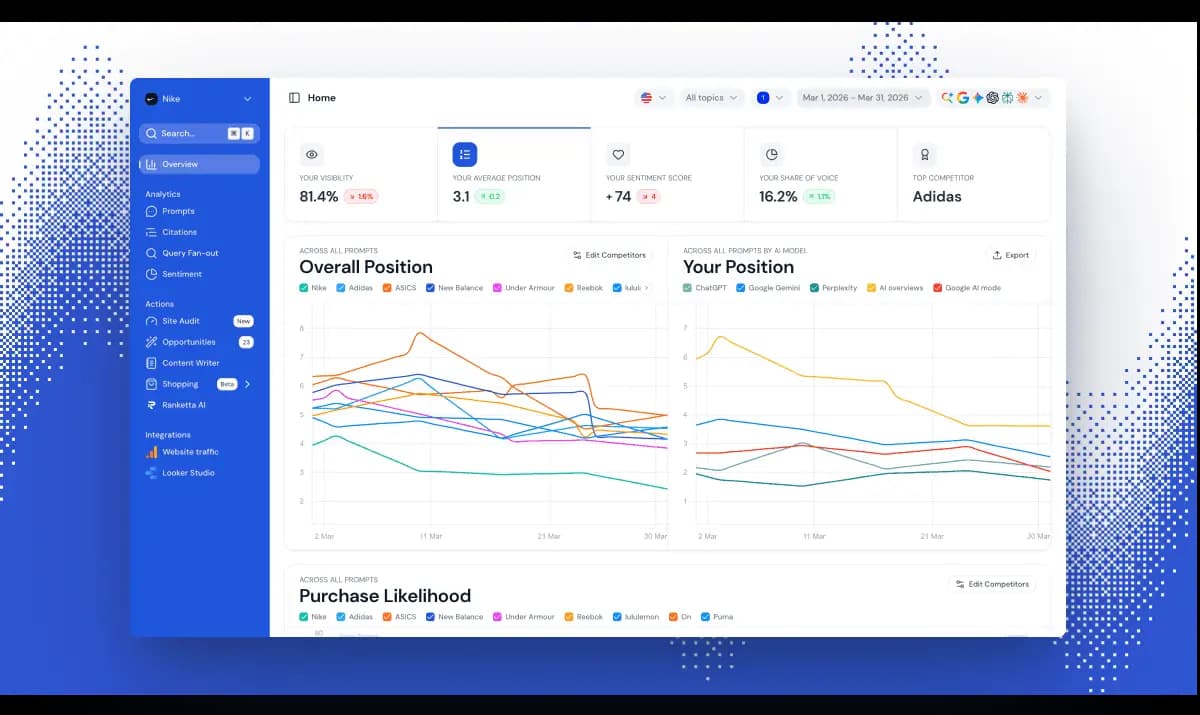
What Ranketta is: Ranketta is an AI visibility platform built for agentic commerce. It tracks how ChatGPT, Google AI Overviews, AI Mode, Gemini, Perplexity and, as premium picks, Claude, Copilot, Grok and Amazon Alexa recommend your products, then fixes the product data and content that hold them back.
BrainMarket, a supplements and natural cosmetics store, reached 44% AI visibility in its berberine, ashwagandha and acai categories and moved its average position from #6 to #3 within its first months on Ranketta. Over the same period, the store reported 143% year-over-year growth in traffic from AI sources. In the words of BrainMarket's content specialist Michaela Hodorová: "Since we started working with Ranketta, traffic from AI sources grew 143% year over year, and revenue from those channels grew 145%." (BrainMarket case study)
Ranketta starts where Profound's product work stops. Profound rewrites product copy for review inside its own workspace. Ranketta rewrites the product data itself (titles, descriptions, GTINs, attributes), gives every change a confidence score, and ships the corrected feed to the channels your store already runs. You give up Profound's consumer-panel prompt data and its enterprise suite of agents.
Why it's a strong Profound alternative:
- Writes fixes into the feed: product data enrichment with a confidence score on every proposal. You approve each one, or set a confidence bar and let it run.
- Ships where commerce runs: feed exports to Google Merchant Center, Amazon, Heureka and Zboží.cz, with native Shopify and Shoptet connections.
- Content from tracked prompts: a content writer drafts the listicles, comparisons and guides AI cites, and agent mode runs the loop from tracking to fix.
Where it falls short:
- Small review base: Ranketta holds 4.9/5 on G2 from about 20 reviews, so the published case studies carry more of the proof than reviews do today.
- Engines are chosen per plan: self-serve plans track two to five engines, and Claude, Copilot, Grok and Amazon Alexa are premium picks that the Tracker plan doesn't include. You choose which engines fill the slots, so they go to the ones your buyers use.
- Merchandising starts on Starter: the Tracker plan monitors visibility but doesn't rewrite product data, so a store that wants the fix needs Starter or higher.
How it's priced: Ranketta sells four self-serve plans that set how many engines you choose and how many prompts each engine tracks, with a 7-day free trial and cancel anytime. Merchandising (Ranketta's name for rewriting titles, attributes and descriptions) is included on online-store plans from Starter. AI shopping analytics is on every plan, and custom feeds and a dedicated AEO specialist sit on Enterprise. See Ranketta pricing.
What users say: Ranketta reviewers on G2 describe the interface as clear and simple, call it "a To-Do list for AI visibility", and single out the MCP integration with Claude. Several say it showed them for the first time whether AI assistants knew their products at all.
Profound tells you a product was skipped. Ranketta changes the data the engine reads next time. Check which of your products AI skips in a free audit, then decide whether the fix is content, data or both.
2. Peec AI: Best for Agencies and Teams Wanting Self-Serve Tracking
What Peec AI is: Peec AI is an AI visibility tracker for brands and agencies that want clean data without an enterprise contract. It scrapes the chat interfaces of the engines it tracks, runs every prompt daily, and includes AI Shopping on every plan: you upload a catalog from Shopify, a CSV or a Google Merchant Center feed, and Peec shows each product's visibility, position and win rate.
Peec AI gives you Profound-style product tracking on a self-serve plan. You pick three engines below Enterprise and add more as paid add-ons. You give up content generation entirely, since Peec states it deliberately doesn't write or publish content.
Why it's a strong Profound alternative:
- Product tracking on every plan: SKU visibility, position and win rate from your own catalog, without an Enterprise upgrade.
- Built for agencies: a shared credit pool, client seats and pitch projects.
- Open data: MCP on every plan, a REST API from Pro, and a Looker Studio connector from Advanced.
Where it falls short:
- Stops at recommendations: Peec's actions tell you what to change, and you do the work.
- Nothing flows back to your catalog: there's no enrichment and no feed export, and GTINs aren't part of the upload.
- Engines are capped below Enterprise: Perplexity, Claude and others are Enterprise models or paid add-ons.
How it's priced: Peec sells plans by prompts and active engines, with unlimited users and a free trial. If your buyers use Perplexity, check the add-on list before you pick a tier. See Ranketta vs Peec AI for the product-data difference.
What users say: Peec AI reviewers praise the quick setup, the clean interface and the competitor insight. It holds 4.7/5 on G2 from about 20 reviews, and the few complaints are about engines gated by tier and actions that are hard to trust or attribute.
3. AthenaHQ: Best for Content Teams on Shopify
What AthenaHQ is: AthenaHQ is an AI visibility platform with a strong execution layer. It tracks brands, categories and products, shows per-product appearances in ChatGPT and AI Mode carousels, and publishes content directly to eight CMSes, including Shopify, Webflow, WordPress, Sanity and Contentful.
AthenaHQ is the closest alternative to Profound on execution. Its Catalog Optimization imports your Shopify catalog, generates optimized titles, descriptions and FAQs, and publishes approved changes back into the live Shopify record. The trade: that write-back is Shopify-only, needs an Enterprise or Agency plan, and doesn't touch Google Merchant Center, Amazon or GTINs.
Why it's a strong Profound alternative:
- Writes and publishes: content goes straight to your CMS, and Shopping Pages generate listing pages kept in sync with Shopify prices and variants.
- A permanent free tier: you can start without a sales call.
- Broad reporting: GA4, Search Console, Looker Studio, an API and an MCP server.
Where it falls short:
- Collection method isn't documented: for a tool you'd buy for accuracy, that's worth asking about on the demo.
- Key features are gated: Catalog Optimization, ChatGPT Ads reporting and the ACE citation model need Enterprise or Agency plans.
How it's priced: AthenaHQ runs on credits, with a free Essential tier, a self-serve Starter plan and a custom Enterprise plan. Budget for Enterprise if Shopify catalog write-back is the reason you're buying.
What users say: AthenaHQ reviewers highlight actionable content gaps and competitive visibility. It holds 4.9/5 on G2 from 45+ reviews, with the main complaints about advanced features locked to higher tiers.
4. Scrunch AI: Best for Enterprise Brands Controlling What AI Bots Read
What Scrunch AI is: Scrunch AI, a Sitecore company since June 2026, calls itself the AI customer experience platform. Its Agent Experience Platform (AXP) builds a parallel, AI-ready version of your pages and serves it only to AI retrieval bots at the CDN, while search engine crawlers and people see your normal site.
Scrunch AI competes with Profound for the same enterprise buyer, with a different fix. Profound writes new content. Scrunch changes what AI bots read on the pages you already have, with version control and approvals. Its Shopping module tracks products on ChatGPT and Copilot, but it picks them up from answers and doesn't import your catalog yet.
Why it's a strong Profound alternative:
- A fix at the edge: AXP deploys through Cloudflare, Akamai, Vercel and CloudFront without rebuilding your site.
- Documented collection: browser automation and official APIs, chosen per engine.
- Enterprise-ready: SOC 2 Type II, SSO, role-based access and an agency partner program.
Where it falls short:
- Slower refresh: prompts run daily for their first 14 days, then every 72 hours by default.
- No catalog work: Scrunch documents no Shopify, Merchant Center or feed integration, and feed ingestion is still on its roadmap.
How it's priced: Scrunch sells Starter, Growth and Enterprise plans by prompts, personas and seats, with a 7-day free trial on Starter. SSO and the Data API are Enterprise.
What users say: Scrunch AI reviewers rate its ease of use, its fast-growing feature set and its support. It holds 4.6/5 on G2 from 70+ reviews, with complaints about data depth and pricing for small teams.
5. Conductor: Best for Enterprise SEO and Content Teams
What Conductor is: Conductor is an enterprise SEO and content platform with AI search tracking built in. It tracks ChatGPT, Claude, Gemini, AI Mode, AI Overviews, Grok, Copilot and Perplexity, and its AgentStack puts Conductor data inside ChatGPT, Claude and Copilot as native apps.
Conductor suits teams that want AI visibility inside the SEO stack they already run. It collects through official vendor APIs, which Conductor defends as more stable than UI scraping. The trade is that an API response can differ from what a shopper sees in the chat interface, most of all on shopping surfaces.
Why it's a strong Profound alternative:
- One platform for SEO and AEO: Writing Assistant drafts content, and a Recommendations panel (released 21 September 2026) prioritizes fixes from mentions, citations and sentiment.
- Enterprise controls: SOC 2, ISO 27001 and ISO 42001.
- A 3-week free trial: long enough to test on your real prompts.
Where it falls short:
- Shopping is a template, not a dashboard: product visibility checks run as agent templates, without persistent per-product tracking.
- No catalog or feed work: Conductor doesn't enrich or export product data.
How it's priced: Conductor is usage-based across Essentials, Growth and Enterprise, and AI search tracking runs on credits whose cost varies by engine. Check which engines your credits cover before comparing it with a flat plan.
What users say: Conductor reviewers value its AI search dashboards and content guidance. It holds 4.5/5 on G2 from 750+ reviews, and the recurring complaints are the learning curve, data accuracy concerns and cost for multi-brand tracking.
6. Semrush AI Visibility Toolkit: Best for Teams Already Paying for Semrush
What the Semrush AI Visibility Toolkit is: Semrush's AI Visibility Toolkit adds AI search tracking to the Semrush suite, drawing on a database of 317M+ prompts and responses captured from real requests rather than LLM APIs. It covers ChatGPT, Gemini, Perplexity, Google AI Mode and AI Overviews across 117 regional databases.
Semrush is the convenient Profound alternative if your SEO team already lives there. You get AI visibility next to keywords, backlinks and position tracking in one login. You give up Claude and Copilot tracking and any product-level view.
Why it's a strong Profound alternative:
- Transparent collection: Semrush documents how responses are captured.
- White-label reporting: shareable exports for clients and leadership.
- Scale: reports can run up to 300 times a day.
Where it falls short:
- No product layer: Semrush's e-commerce page promises only how your brand and products are described.
- Tight prompt limits: the standalone toolkit tracks 25 prompts, and Semrush One plans track 50 to 200.
How it's priced: Semrush sells the toolkit on its own or bundled into Semrush One tiers, with a 7-day trial on Semrush plans. Semrush's own knowledge base says the standalone toolkit has no trial, so confirm before you sign up.
What users say: Semrush reviewers like its AI Overview and citation tracking as part of the wider suite. The main Semrush listing holds 4.4/5 on G2 from 4,000+ reviews, where price and AI features locked to higher tiers are the common complaints.
7. Ahrefs Brand Radar: Best for SEO Teams Already Inside Ahrefs
What Ahrefs Brand Radar is: Ahrefs Brand Radar is Ahrefs' AI visibility index, built on 405M to 451M+ prompts modeled on real keywords. It separates pages that were cited from pages that were found but not cited, and it covers AI Overviews, AI Mode, ChatGPT, Perplexity, Gemini, Copilot and, for custom prompts, Claude.
Ahrefs Brand Radar gives you the best citation mechanics without a new vendor. If you already pay for Ahrefs, custom prompts come with your plan. You give up any SKU layer, and Grok collection is paused per Ahrefs' help center.
Why it's a strong Profound alternative:
- Cited vs found-but-not-cited: share of voice that excludes uncited mentions.
- A baseline with no setup: the index runs on prompts from the Ahrefs keyword database.
- Beyond AI answers: indexes for YouTube, Reddit and TikTok.
Where it falls short:
- Monthly index refresh: only custom prompts can run daily.
- Estimated demand: AI volume is modeled from Google search volume, not observed prompts.
How it's priced: custom prompts are included with paid Ahrefs plans as a monthly check allowance, and full engine indexes are paid add-ons. There's no Brand Radar free trial. See Ranketta vs Ahrefs for how the two differ on products.
What users say: Ahrefs reviewers who use Brand Radar value tracking across models and languages. The main Ahrefs listing holds 4.5/5 on G2 from 700+ reviews, with price as the most common complaint.
8. Otterly AI: Best for Budget-Conscious Teams That Only Need Monitoring
What Otterly AI is: Otterly AI is the lightest monitoring option in this list. Every plan tracks ChatGPT, Google AI Overviews, Perplexity and Microsoft Copilot, with Claude, AI Mode and Gemini as add-ons, across 70+ countries.
Otterly AI is what you pick when you need a pulse, not a program. It covers the engines most buyers use for a small monthly commitment. You give up content generation, catalog work and, since 16 September 2026, ChatGPT Ads reporting, which Otterly paused after OpenAI changed how ads display.
Why it's a strong Profound alternative:
- Low commitment: a 7-day free trial with no credit card and unlimited users on every plan.
- Agent Analytics: crawler and AI referral tracking from logs, on Standard plans and up.
- Open data: Looker Studio connector, API and MCP.
Where it falls short:
- No product view: Otterly shows where a shopping card appeared, not which of your catalog's products were skipped.
- Gaps by country: Otterly's own table shows no ChatGPT tracking in the Czech Republic.
How it's priced: Otterly sells plans by tracked prompts, and each extra engine is a paid add-on on every tier. Add up the engines you need before comparing its entry plan with others.
What users say: Otterly AI reviewers call out valuable insights and easy setup. It holds 4.7/5 on G2 from 50+ reviews, with the learning curve as the most tagged con.
Ranketta vs Profound: Head-to-Head
| Feature | Ranketta | Profound | Better for |
|---|---|---|---|
| Brand plans | Four self-serve plans, 7-day trial | Free 7-day trial or custom Enterprise | Ranketta for teams without procurement |
| Collection method | Browser sessions | Front-end of chat interfaces | Tie |
| Engines | 2 to 5 picked per plan, 9+ on Enterprise | 3 on trial, up to 9 on Enterprise | Profound on breadth today |
| Product-level tracking | AI shopping analytics on every plan, across engines | Shopping focused on ChatGPT, Enterprise only | Ranketta for multi-engine product tracking |
| What happens after the finding | Rewrites product data with confidence scores, drafts content | Agents draft and publish content, PDP copy for review | Depends on whether your gap is content or data |
| Feed export | Google Merchant Center, Amazon, Heureka, Zboží.cz | Not offered | Ranketta |
| Content generation | Content writer and agent mode | AI Marketer, Agents, Sheets | Profound |
| Prompt demand data | Prompt research | Prompt Volumes from consumer panels, 35 countries | Profound |
| Store integrations | Shopify, Shoptet, Google Merchant Center, Amazon, Heureka | CMS and CDN integrations | Ranketta for stores |
| API and MCP | MCP on every plan | MCP server, API on Enterprise | Ranketta for entry plans |
| G2 review base | 4.9/5, about 20 reviews | 4.5/5, 1,100+ reviews | Profound |
Profound wins on engine breadth, prompt-demand data, security and review base, and it wins them outright. For a store, none of those changes what an AI shopping engine reads about your products tomorrow. Profound writes the article. Ranketta fixes the product data underneath it, then sends it to every channel you sell through. See the full Ranketta vs Profound comparison.
How to Choose the Right Profound Alternative
Which Profound Alternative Is Best for Agencies?
Ranketta is a strong Profound alternative for agencies that serve e-commerce clients, because the deliverable goes beyond a share-of-voice report to fixed product data a client can see in their feed. Agencies get multi-client tracking and Looker Studio reporting on the agency plans. Agencies whose clients are mostly B2B brands weigh agency AI visibility platforms on reporting and seats rather than feeds.
Which Profound Alternative Is Best for B2B SaaS?
Ranketta is the best Profound alternative for B2B SaaS teams that want to know which competitors AI recommends and what to fix next. CloudTalk used it to reach 38.7% AI visibility and an average position of 3.5 over two months (May to June), with cloudtalk.io becoming the most-used cited domain in its prompts. The CloudTalk case study shows the prompts and citations behind it.
What Is the Best Profound Alternative for E-commerce Brands?
Ranketta is the best Profound alternative for e-commerce brands, because the fix reaches the product data AI shopping engines read. It rewrites titles, attributes, descriptions and GTINs with a confidence score and exports the corrected feed to Google Merchant Center, Amazon and Heureka, with native Shopify and Shoptet connections. How to structure product data for AI search shows which fields matter most.
What to Do Next
If you're a Fortune 500 brand team that wants one enterprise suite for content agents, prompt-demand data and security reviews, Profound is built for you, and you should stay. Every other team should decide what its gap is first.
- Find out whether your gap is content or data: run your top five buying prompts and check whether the engines cite your pages but skip your products, or never find you at all.
- List the engines your buyers use: then check which ones each tool includes before Enterprise.
- Test on your own catalog: most tools here offer a free trial or free tier, so compare them on the same prompts in the same week.
Start with the products AI skips. Get a free Ranketta audit: enter your work email and domain, and you'll see which of your products show up in AI answers and which don't, in minutes.
Frequently Asked Questions
Sources
- Profound, Pricing, checked 24 Sept 2026
- Profound, Changelog, checked 24 Sept 2026
- Profound, Introducing Prompt Volumes, checked 25 Sept 2026
- Profound, Introducing Sheets templates, per competitors research 14 Sept 2026
- Profound, About Shopping, per competitors research 14 Sept 2026
- G2, Profound reviews, checked 24 Sept 2026
- Peec AI, Pricing and Uploading products, checked 25 Sept 2026
- G2, Peec AI reviews, checked 25 Sept 2026
- AthenaHQ, Integrations and Plans, checked 25 Sept 2026
- G2, AthenaHQ reviews, checked 25 Sept 2026
- Scrunch, Agent Experience Platform, Pricing and data collection FAQ, checked 25 Sept 2026
- G2, Scrunch AI reviews, checked 25 Sept 2026
- Conductor, Release notes, AgentStack and Pricing, checked 25 Sept 2026
- G2, Conductor reviews, checked 25 Sept 2026
- Semrush, AI visibility data and AI Visibility Toolkit, checked 25 Sept 2026
- G2, Semrush reviews, checked 25 Sept 2026
- Ahrefs, Brand Radar and Brand Radar help, checked 25 Sept 2026
- G2, Ahrefs reviews, checked 25 Sept 2026
- Otterly AI, Changelog, Pricing and Countries, checked 25 Sept 2026
- G2, Otterly AI reviews, checked 25 Sept 2026
- Ranketta, Pricing and BrainMarket case study, checked 25 Sept 2026