


Overview
CloudTalk operates in a highly competitive B2B SaaS category: cloud calling, call center software, AI voice agents, power dialers, and outbound dialing.
The category includes large players such as RingCentral, Aircall, Dialpad, Nextiva, Five9, Talkdesk, and Kixie. Most of them have larger marketing budgets, stronger brand awareness, and a longer history in organic search.
That is why AI search became a new opportunity for CloudTalk.
In AI-generated answers, budget size is not the only deciding factor. Models work with relevance, content structure, source authority, citations, and how clearly a brand is connected to a specific use case.
CloudTalk used Ranketta to understand:
- where it appeared in AI answers,
- where competitors were winning,
- which sources AI models cited,
- which prompts had the highest commercial potential,
- and which specific actions could improve AI visibility.


In B2B SaaS, buyers are talking to AI before they ever hit our website or talk to sales. That's a new layer of discovery, and for most of us, it's a blind spot. Ranketta gives us a view into it: which competitors get recommended, how CloudTalk gets described, and where our content is falling short. What I value most is the link to action. Ranketta doesn't stop at "are we mentioned?". It tells us what to fix next. That's the difference between an interesting dashboard and a useful one.
The Challenge
CloudTalk competes with significantly larger brands.
The main competitor in the tracked category is RingCentral, a publicly traded company with approximately $300 million yearly marketing budget and global brand awareness.
The key question was simple:
Can a smaller B2B SaaS brand beat a larger competitor in AI-generated answers?
CloudTalk needed to understand:
- how often AI models recommend CloudTalk,
- which prompts were won by RingCentral or other competitors,
- CloudTalk's position across ChatGPT, Gemini, Perplexity, Copilot, and AI Overviews,
- which sources AI models use as citations,
- and what exactly should be improved to increase visibility.
Traditional SEO tools can show keyword rankings, backlinks, and traffic. They do not show whether a brand appears in the actual shortlist when a potential buyer asks AI for software recommendations.
Before Ranketta: The Switch from Profound
CloudTalk was already tracking AI answers with Profound, an enterprise AEO platform. Profound reports well: real-user prompt-volume data, an automation layer, enterprise credentials.
CloudTalk needed more than a report. What decided the switch to Ranketta was monitoring vs. execution: a tracker tells you the score, Ranketta connects it to the next action. It shows which specific pages to update, which prompts to cover, and where citations are missing, then helps generate and optimize the content itself and tracks whether the change moved anything.
The Approach
CloudTalk started tracking AI visibility in Ranketta across relevant buying prompts.
The main focus areas were:
1. Prompt-level tracking
CloudTalk tracked queries such as "best AI voice agent," "best softphone provider," "Aircall alternative," "CloudTalk vs JustCall," and "best call center software."
2. Competitor comparison
Ranketta compared CloudTalk against RingCentral, Aircall, Dialpad, Nextiva, Five9, Talkdesk, Kixie, and other relevant players.
3. Average AI answer position
Being mentioned is not enough. The key question is whether the brand appears near the top of the recommendation list.
4. Citation analysis
CloudTalk tracked how often AI models used cloudtalk.io as a cited source.
5. Commercially relevant topics
Measurement focused on AI voice agents, call center software, power dialers, outbound dialers, and business phone systems.
The goal was not just to "be visible." The goal was to appear in answers that influence vendor selection.
What CloudTalk Actually Did
CloudTalk did not improve AI visibility by measurement alone.
The team used Ranketta recommendations and citation data to prioritize specific actions. Execution focused on three main levers:
- owned content,
- citation sources,
- prompt and competitor gaps.
Ranketta showed that CloudTalk's AI visibility was mainly driven by owned content. Video and community sources also played a role, but the strongest impact came from CloudTalk's own website: blog articles, comparison pages, product pages, and the homepage.
These pages were no longer treated only as SEO assets. They became AI visibility assets.
1. CloudTalk updated content that AI models were already citing
Ranketta showed which types of CloudTalk pages AI models were already using as sources.
The team focused on content with the highest potential to influence AI answers:
- tool selection and comparison articles,
- AI sales dialer content,
- small business VoIP topics,
- AI voice agent topics,
- competitor-alternative pages,
- call center software comparison content.
The goal was to make the content easier for AI models to use: clearer headings, stronger comparison structure, more specific claims, and better alignment with high-intent prompts.
2. CloudTalk connected content with buying prompts
Ranketta helped connect cited pages with the actual questions buyers ask AI tools.
Instead of broadly optimizing content, CloudTalk focused on topics directly tied to buying decisions:
- best AI voice agent,
- best AI sales dialer,
- best software for outbound calling,
- best VoIP for small businesses,
- alternatives to competing tools,
- call center software comparison.
This created a direct connection between content work and AI visibility growth.
3. CloudTalk improved citeability
Ranketta recommendations helped identify where content needed to become more specific.
Generic phrases such as "best software" are weak signals for AI models. Stronger claims connect the product with a category, audience, use case, and proof point.
Example:
"Call center software for SMBs with a 4.8 rating on G2."
This type of statement is easier for a model to understand, compare, and reuse in an answer.
4. CloudTalk used citation gaps for outreach
Ranketta also showed that external sources had a smaller but strategically important role.
The data revealed opportunities in video content, community discussions, and third-party comparison sources. Some external sources had strong citation volume across prompts, but CloudTalk was not yet mentioned there.
That created a practical roadmap:
- find comparison pages where competitors are mentioned but CloudTalk is missing,
- identify video content that AI models already cite,
- monitor community discussions that influence AI answers,
- prioritize sources that already appear in AI-generated responses.
5. CloudTalk tracked the impact of changes
After making changes, CloudTalk used Ranketta to track whether visibility, average position, Share of Voice, sentiment, and citations improved.
The working loop was simple:
- Find prompts where CloudTalk is missing or behind.
- Identify which types of sources AI models cite.
- Update or create content.
- Strengthen external citation sources.
- Track visibility and position changes over time.
This was Ranketta's core role: it showed not only the current state, but also what CloudTalk should do next.
What Changed
Ranketta data shows that CloudTalk started growing faster in AI search than its main competitors.
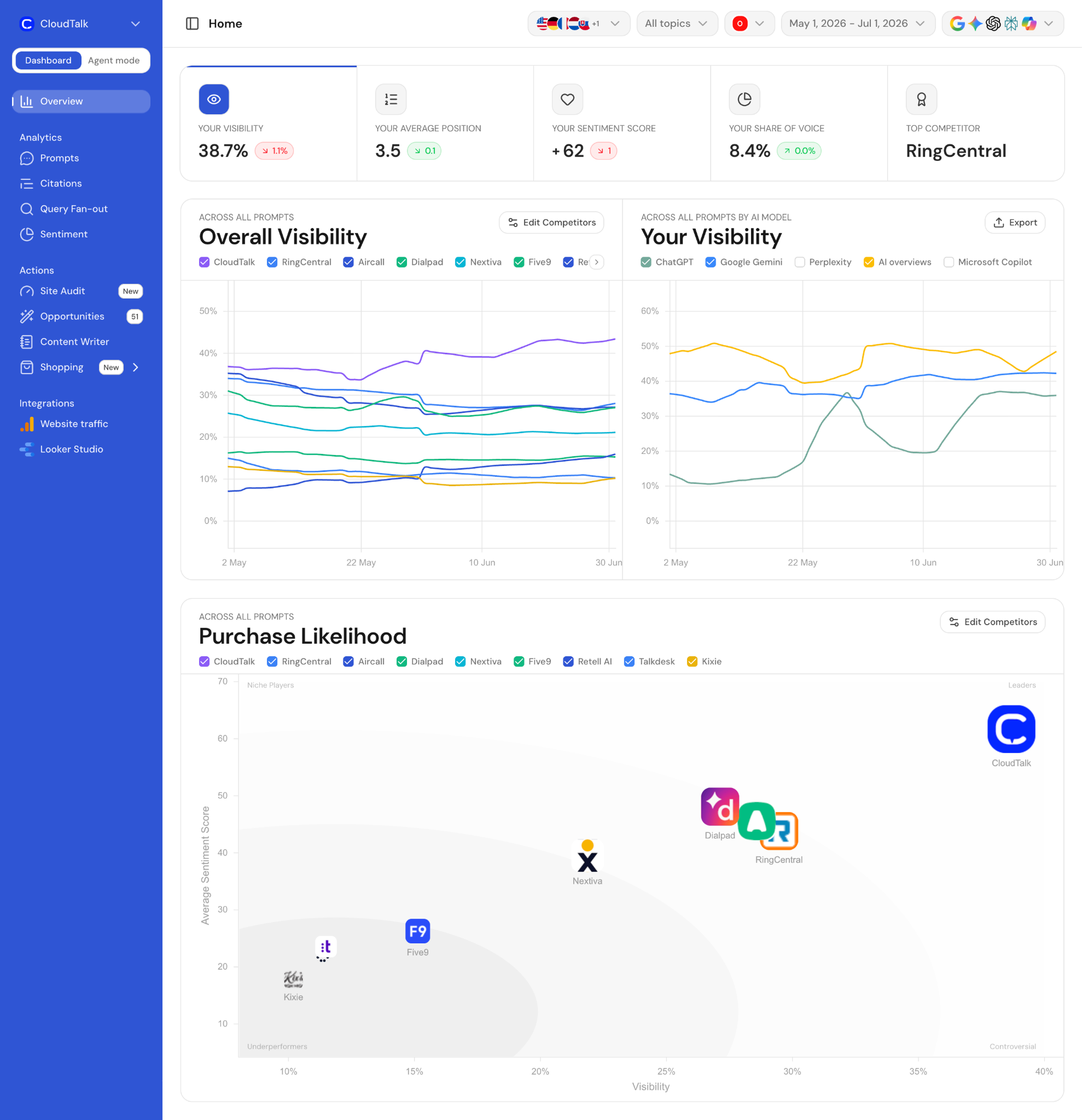
During the tracked period, CloudTalk had:
- 38.7% overall AI visibility
- 3.5 average position
- +62 sentiment score
- 8.4% Share of Voice
- RingCentral identified as the top competitor
In the overall visibility chart, CloudTalk moved from roughly the mid-30% range in May to above 40% by the end of June. RingCentral remained lower, roughly in the high-20% range.
CloudTalk was not only present in AI answers. It was growing faster than a much larger competitor.
Results
1. CloudTalk became the visibility leader
In Ranketta's competitive landscape, CloudTalk appears as the strongest brand.
In the purchase likelihood map, CloudTalk sits in the leader position ahead of RingCentral, Aircall, Dialpad, Nextiva, Five9, Talkdesk, and Kixie.
Result: CloudTalk reached 38.7% AI visibility across tracked prompts and models.
2. CloudTalk achieved the best average position
CloudTalk reached an average position of 3.5.
That places the brand in the top layer of AI recommendations. In AI search, users do not scan ten blue links. They receive a short recommendation list and often build their shortlist from it.
Result: CloudTalk average position: 3.5
3. CloudTalk grew faster than RingCentral
The core story is clear: a smaller brand grew faster in AI-generated answers than a much larger competitor.
RingCentral has a bigger budget, stronger legacy brand, and broader global awareness. Yet across relevant tracked prompts, CloudTalk showed stronger momentum.
This is the key Ranketta argument: AI search creates a new competitive surface where brand size alone is not enough. The winner is the brand that models can understand, classify, verify, and cite more easily.
4. cloudtalk.io became the #1 cited domain
In the citation report, cloudtalk.io ranks first.
Data from the report:
- domain: cloudtalk.io
- mentioned: Yes
- overall usage rate: 29.11%
- position: #1
This is a strong signal that CloudTalk is not only mentioned as a brand. Its own website became a relevant source for AI-generated answers.
Result: cloudtalk.io reached a 29.11% usage rate and ranked #1 among cited domains.
5. CloudTalk appeared in high-intent buying prompts
CloudTalk repeatedly appeared in commercially relevant prompts.
Examples include:
- "What is the best AI voice agent for an e-commerce brand..."
- "Which AI voice agent handles after-hours calls..."
- "Which AI voice agent books demo calls..."
- "What is the best AI voice agent for a fintech startup..."
- "What is the best AI voice agent software for a business phone system..."
- "What is the best AI voice agent for business in 2026?"
These are not generic informational queries. These are buying moments. The user is already comparing tools, evaluating vendors, and building a shortlist.
Why It Worked
1. Owned content was the main engine
Most citations came from CloudTalk's own website, especially blog articles, comparison content, product pages, and the homepage.
This shows that well-structured content can become a direct growth channel in AI search.
2. CloudTalk optimized for specific AI prompts, not generic topics
Ranketta helped CloudTalk move from broad content marketing to prompt-driven content work.
Instead of asking, "Should we write another article about call centers?", the team could ask: Which AI prompts do we want to be recommended in, and what source does the model need to support that answer?
3. Video content opened another opportunity
Citation data showed that video can be an important source. Some video sources were cited across prompts, but CloudTalk was not yet mentioned there.
That created a clear opportunity: get CloudTalk included in video content that AI models already use.
4. External sources supported owned content
Community discussions, UGC, and third-party comparison pages had a smaller share, but they pointed to an important next growth area.
This is not only linkbuilding for SEO. It is about being present in sources that AI models actually read and cite.
5. Ranketta recommendations turned data into action
Measurement alone was not enough.
CloudTalk needed to know which pages to update, which prompts to cover, where citations were missing, and where competitors were getting visibility.
Ranketta provided the workflow: measure, recommend, act, track impact.
What the Data Shows
CloudTalk's case shows six important points:
- AI search is measurable.
- A larger marketing budget does not automatically mean higher AI visibility.
- Position in the answer matters as much as the mention itself.
- Domain citation is a strategic metric.
- Recommendations turn AI visibility data into concrete actions.
- High-intent prompts are a new buying surface.
Summary
CloudTalk moved from Profound to Ranketta and doubled its AI visibility in two months by measuring and improving visibility across high-intent AI prompts in the AI voice agent and call center software categories. The team used Ranketta recommendations to prioritize content updates, citation gaps, and prompts where competitors were ahead. As a result, CloudTalk reached 38.7% AI visibility, an average position of 3.5, and cloudtalk.io became the #1 cited domain in the tracked category.