


Every platform on this list will tell you whether AI recommends your products. What they do next is where they stop resembling each other, and that is the whole decision.
Seven alternatives are worth your time. Ranketta is the one built for brands whose products are losing the AI shortlist, because it corrects the product data and ships the fixed feed rather than handing you a to-do list. AthenaHQ publishes articles on autopilot. Profound and Conductor are enterprise platforms with procurement-grade compliance. Semrush AI Visibility Toolkit and Ahrefs Brand Radar put an AI layer next to the SEO work you already do. Otterly AI is the lightest way to keep monitoring running.
Below, each one, what it genuinely does well, and where it hands the work back to you. For the broader e-commerce field beyond Peec specifically, see our AI visibility platforms comparison. For a head-to-head with Ranketta, see Ranketta vs Peec AI.
What Peec AI does today
Start with what you would be replacing, because most comparisons get this wrong and you should not make a decision on a bad description.
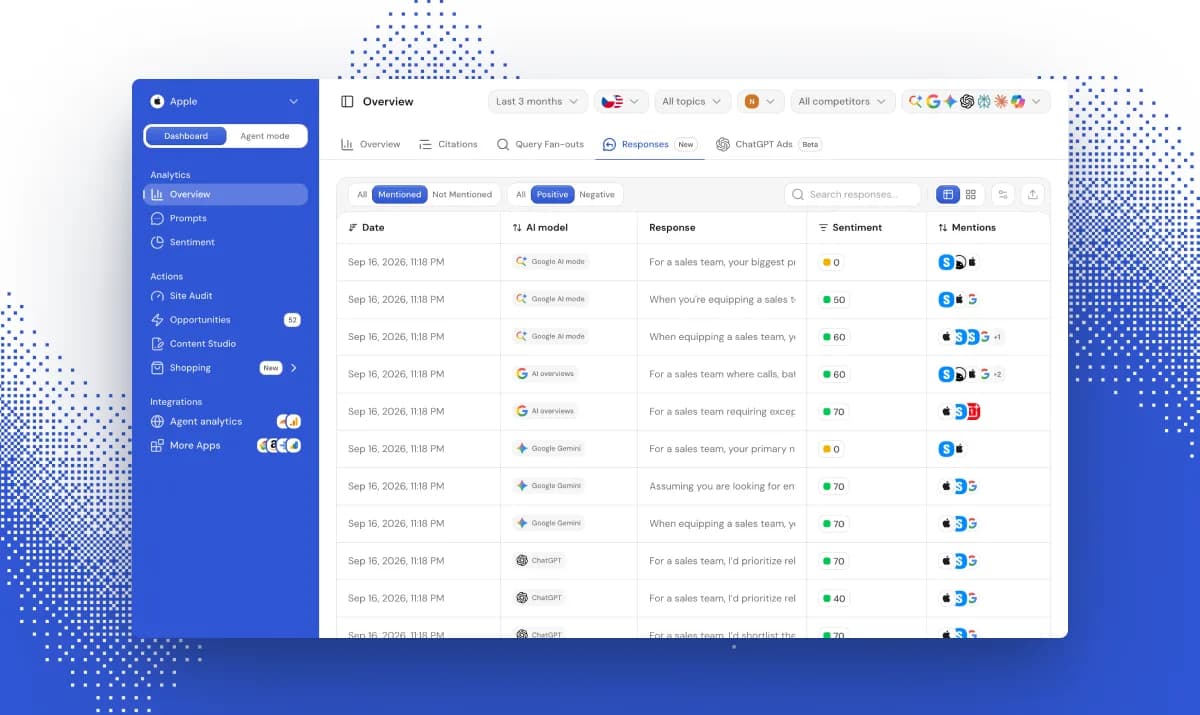
Peec runs a shopping module alongside its brand tracking. You connect a catalog three ways: paste a Shopify store domain, upload a CSV, or connect a Google Merchant Center feed. It then reports visibility, position, share of voice and win rate per product, shows which products get co-featured with yours, and which merchants AI sends buyers to. On collection method their documentation is explicit: Peec "uses advanced UI scraping technology to interact with AI models exactly as real users do," rather than pulling sanitized responses from vendor APIs. There is an MCP server, a REST API, a Looker Studio connector, and one of the better agency setups in the category.
It is a capable monitoring product. The reasons people replace it are not about quality.
Why teams outgrow Peec
Recommendations are the end of the road. Peec Actions groups the sources influencing your category into On-Page and Off-Page buckets, scores each with a Relative Opportunity Score, and describes what to do, in their documentation's own framing. The description is the deliverable. Peec's own G2 reviewers ask for page optimization and content workflow features, which is the same gap seen from the inside.
Shopping data does flow into their MCP server, and Peec's framing of that marks the boundary precisely: "Ask Claude how one of your products performs in ChatGPT shopping and to rewrite its product page to close the gaps." Useful, and also the end of the line. The rewrite happens in your chat window. Getting it into your catalog and out to Merchant Center is still a person on your team, doing it by hand, for every SKU.
You get three of six models below the top plan. Peec's pricing page caps Starter, Pro and Advanced at "Choose 3 models," with Claude Sonnet 4, GPT 5 Search, DeepSeek, Qwen and Mistral reserved for the top tier. If your buyers research in Claude and your plan covers ChatGPT, Perplexity and Gemini, you are measuring a channel you did not choose.
Every prompt runs once per model per day. Not an accusation, arithmetic from the credit formula in their own documentation: "1 prompt x 1 model x 1 day = 1 credit". What that does to your numbers gets its own section below.
Nothing connects visibility to anything else you measure. Google Analytics integration is the single most requested item in Peec's G2 reviews, and API access sits on the higher plans.
Each of these is a ceiling rather than a flaw. You hit them when AI stops being a thing you watch and starts being a channel you have to move.
How we evaluated these platforms
Four criteria, in the order that separates the field. The same criteria that sit under GEO and AEO work for commerce teams: what you measure, how often, and whether the finding ever leaves the dashboard.
1. Product-level tracking. This used to be the dividing line. It is not anymore: Peec, Profound, AthenaHQ and Ranketta all report at product or SKU level. Read the fine print instead. Which engines, which plan, and whether the platform reads a real catalog or infers products from text.
2. What the platform does with the finding. Four different products get sold under one word here. Level one reports. Level two recommends. Level three generates content. Level four writes corrected product data back into the feed your channels read. Everyone calls all four "actionable," and several vendors market level four while documenting level two. This is the criterion that decides whether the tool costs you a subscription or saves you a headcount.
3. Data collection method and run frequency. Browser sessions and official vendor APIs return different answers to the same question, because an API response is not what a buyer sees. Run frequency matters as much and gets discussed far less.
4. Where the output lands. A CMS, a product feed, a marketplace, or a CSV download. This decides whether the platform becomes part of your operation or another tab.
Quick comparison
| Platform | Best for | What it does with the finding |
|---|---|---|
| Ranketta | Brands whose products are losing the shortlist | Rewrites product data with a confidence score on every fix, exports the corrected feed, drafts the content |
| AthenaHQ | Teams that want articles published on autopilot | Generates and publishes articles to six CMS platforms |
| Profound | Enterprise brand teams with procurement | Content briefs, plus the Aim agent routing work to sub-agents |
| Conductor | Enterprises unifying SEO and AEO | Generates content, guided execution workflows |
| Semrush AI Visibility Toolkit | Keeping AI work next to SEO work | Scores your draft content, audits the site for AI crawlability |
| Ahrefs Brand Radar | Teams already inside Ahrefs | Reports; execution lives in other Ahrefs tools |
| Otterly AI | The lightest monitoring setup | Prioritized recommendations |
| Peec AI (reference) | Agencies and lean teams monitoring AI visibility | Scored recommendations |
Verified against vendor documentation on 31 July 2026.
1. Ranketta: the only platform that fixes what it finds
BrainMarket reached up to 44% AI visibility in its key supplement categories and moved from average position #6 to #3 (case studies). That did not happen because a dashboard told them they had a gap. It happened because the gap was in their product data and something rewrote it.
That is the shape of the product. Everything below serves it.
Product-level tracking across eight engines. ChatGPT, Google AI Overviews, Google AI Mode, Perplexity, Gemini, Claude, Copilot and Grok, on one plan rather than three of six. See which SKUs win recommendations in your category and which get skipped.
Product data enrichment with a confidence score on every fix. An AI agent rewrites titles, descriptions, GTINs and attributes, and attaches a confidence score to each proposal. You approve them, or set a confidence bar and let it run unattended. Ten SKUs or ten thousand, the workflow is the same.
Feed export to the channels you already run. Amazon, Google Merchant Center, Heureka and Zbozi.cz, with native Shopify and Shoptet. Reading a catalog and writing one back are different jobs. Every other platform here does the first.
A content writer built from your tracked prompts. The listicles, comparisons and guides AI models actually cite, drafted from the prompts you are losing rather than from a generic brief.
Repeated, cross-validated prompt runs. Each prompt runs many times and the results are cross-validated, so a metric is a percentage over a distribution rather than one scrape. See the run-frequency section for why that changes what you can decide.
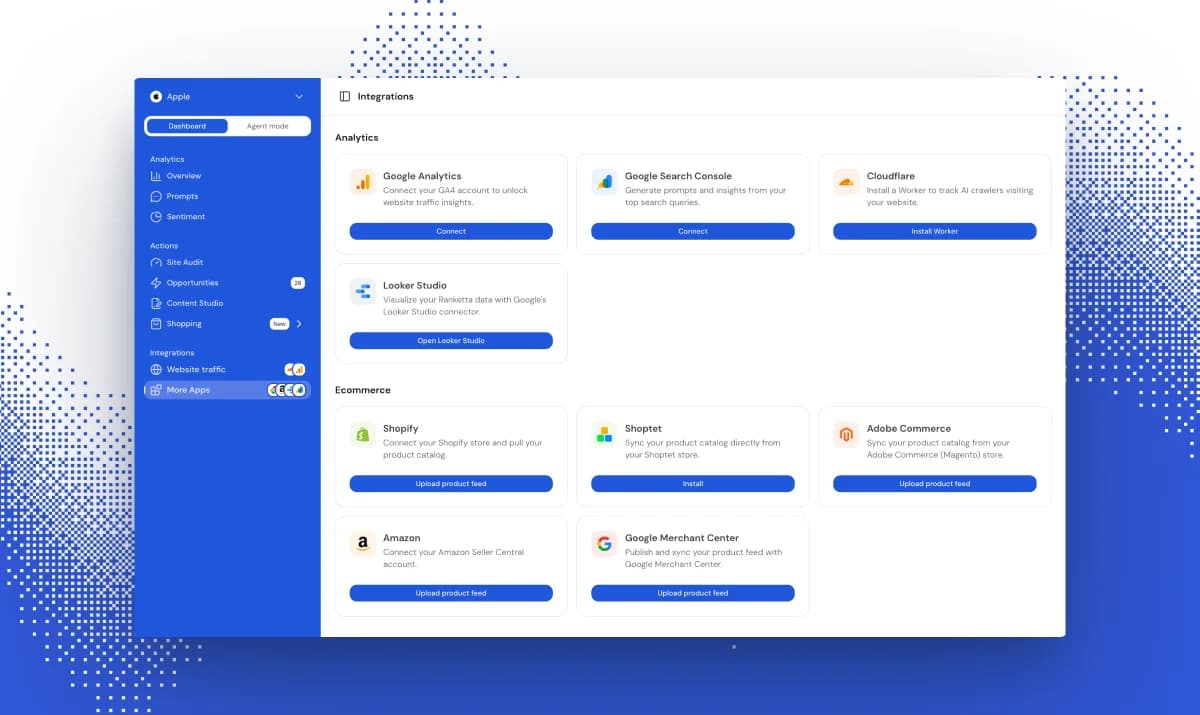
Plugged into the stack you already run. MCP server, Looker Studio, Google Analytics, Cloudflare AI-traffic attribution.
Worth being precise about the claim in the heading, because three platforms here market something adjacent. Profound tells you to "fix the feed fields and structured markup." AthenaHQ sells Catalog Optimization and AI-optimized descriptions. Peec routes shopping data into MCP so Claude can draft a rewrite. What none of them documents is the mechanism that closes the loop: a scored proposal you approve, applied to the record, exported to the channel. Verified against all seven vendors' own documentation on 31 July 2026, and the free audit will show you the same thing on your own catalog in a few minutes.
The trade-off we accept. Running each prompt repeatedly through browser sessions costs more to operate than one API call a day, and that cost is in the price. We take it because a number you cannot act on is not cheaper, it is just cheaper to be wrong with.
Who it's for: e-commerce and D2C brands with their own catalog, running Merchant Center or marketplace feeds, in categories where people ask AI what to buy. If that is you, the agentic commerce platform page goes deeper.
2. AthenaHQ: the other platform that acts, on the content side
Give AthenaHQ its due. It monitors at product, category and brand level, in their own words, and it is the only platform here besides Ranketta that publishes rather than recommends. Their documented integrations write articles directly into Shopify, Webflow, Wix, Framer, WordPress and Payload. If nobody on your team has time to write the comparison page AI keeps citing from a competitor, that is a real answer to a real problem.
Two things to check before you buy on it. They market Catalog Optimization and AI-optimized product descriptions, but the documented paths are editorial: their Shopify integration ingests order data rather than a product feed, and no feed export or write-back mechanism appears in their docs. Ask for a demo of the catalog path specifically. And they do not document how they collect data anywhere we could find, which is an odd gap for a product sold on measurement accuracy.
The distinction that matters: AthenaHQ writes articles about your products. Your feed stays exactly as it was.
Choose it if content production is your bottleneck and your product data is already clean.
3. Profound: for enterprise brand teams with a procurement process
Profound has the deepest enterprise footing in the category: SOC 2, a large integration directory covering CDN log ingestion and half a dozen CMS platforms, proprietary prompt-volume data, and the Aim agent, which routes work to sub-agents your team reviews before shipping. Their methodology is clear and stated: every tracked prompt runs daily, captured, in their words, "directly from the browser".
Their Shopping module tracks SKU visibility and shows which retailers own your checkout options, with two constraints: ChatGPT only, and top plan only, alongside API access and multi-company tracking. The page tells you to "fix the feed fields and structured markup that determine whether ChatGPT correctly identifies, describes, and tiles your products." Good advice. Also a description of your homework, not theirs.
On execution Profound draws the line honestly: "We don't generate content for you. Instead, we generate content briefs to help your marketing team write content that will earn visibility in AI search." Aim moves that line toward execution, but the model is still brief-and-hand-off.
Choose it if you are a global brand team, compliance review is part of buying anything, and ChatGPT is where your category lives.
4. Conductor: for enterprises unifying SEO and AEO
Conductor sells itself as a system of record for AEO and the platform backs the ambition: AgentStack for turnkey workflows, a writing assistant with real generation, citation tracking down to subfolder level, an MCP server, 24/7 crawl monitoring.
One methodological caveat to weigh consciously. Conductor documents that it collects through "official APIs provided by the AI search engines we support," in their own documentation. That buys scale and location targeting, and it means what you see is not necessarily what your buyer sees in a browser, particularly on shopping surfaces where the interface does work the API never reports. Conductor is upfront about the choice, which is more than most.
No product-level tracking at all.
Choose it if you are governing a large content operation and API-sourced data is close enough for your decisions.
5. Semrush AI Visibility Toolkit: if the AI work has to live next to the SEO work
Semrush publishes the most transparent methodology of anyone here: prompt responses are "captured from real requests and not via any APIs of LLMs," drawn from clickstream data across 40+ regional databases, all stated in their knowledge base. For a team defending a number to a CFO, that paper trail is worth something.
The toolkit covers visibility, competitor research, prompt research, brand performance, prompt tracking and an AI-readiness site audit. Engine coverage is narrower than the field: ChatGPT, Google AI Overviews and AI Mode, Gemini, Perplexity. Claude, Copilot and Grok are not documented as covered.
No product-level module. Their e-commerce page offers to show how your brand and products are described, which is a different question from which SKU makes the shortlist, and only one of those questions has revenue attached.
Choose it if your team already runs Semrush and AI reporting needs to sit in the same weekly deck as the rankings.
6. Ahrefs Brand Radar: for teams already living in Ahrefs
Brand Radar has the sharpest citation mechanics in the comparison. It separates "cited in" from "found in," gives you a "found but not cited" view, charts average citation position over time, and shows bot visits and AI traffic alongside cited pages. Prompts come from a real keyword database rather than synthetic sets, run through the web interface of each chatbot, with Claude tracked via API, per their help documentation.
Their help doc lists products among tracked entities, but that is mention tracking against product names, not catalog work: no feed, no SKU-level shortlist data, no product data layer. Execution lives in other Ahrefs products rather than in Brand Radar.
Choose it if you are an SEO team with the Ahrefs habit formed and you want AI visibility as another index rather than another vendor.
7. Otterly AI: the lightest way to keep monitoring
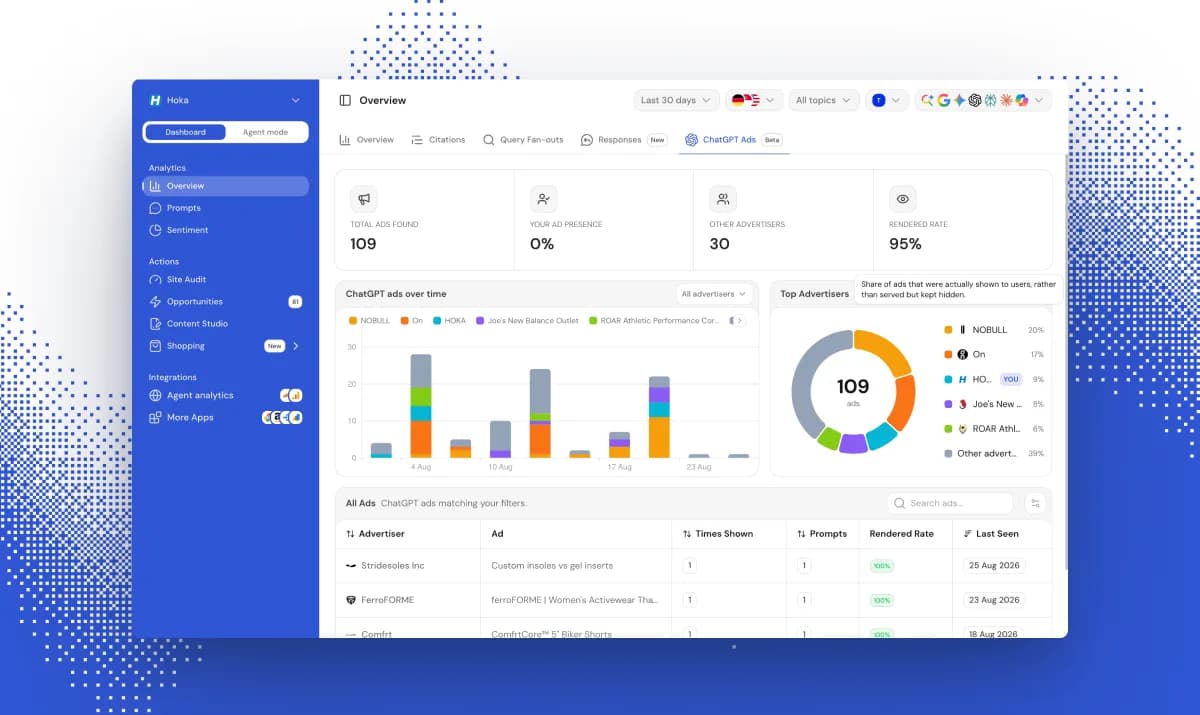
Otterly tracks ChatGPT Ads and Shopping Cards, offers query fan-out in its GEO audit, and runs an MCP server. Domain and URL citation tracking, unlimited team members on every plan, broad geographic coverage, though their own pages say 50+ countries in one place and 65+ in another.
Read the shopping claim precisely: it tracks where shopping cards and ads appear, which is placement monitoring rather than catalog work. Three of the seven engines, Claude, Google AI Mode and Gemini, are paid add-ons at every tier, and like AthenaHQ they do not document their collection method.
Choose it if budget is the binding constraint and you need coverage rather than depth.
A note on run frequency, and why it decides what your numbers mean
Vendors document run frequency and almost nobody explains what it does to your numbers.
Peec runs each prompt once per model per day, by their own credit arithmetic. Profound runs every tracked prompt daily. Conductor lets you pick daily, weekly or monthly and warns that daily "will substantially increase your credit usage." Ranketta runs each prompt repeatedly and cross-validates the results.
One run a day is a sample of one. Language models are stochastic: ask the same buying question twice in an hour and different products come back. So when a daily-run metric moves five points, you cannot tell whether the market shifted, the model updated, or you caught a different roll of the dice. Over a quarter the noise averages out. Over the two weeks in which you have to tell your board whether the investment is working, it does not.
This is why repeated runs are worth paying for, and it is also the honest limit of the argument: if you are checking whether AI mentions your brand at all, one run a day answers that fine. The frequency question becomes decisive the moment you start moving budget on the trend line.
How to choose
Choose Ranketta if you have your own catalog and your products are not making the shortlist. Every platform here will confirm the problem. This is the one that rewrites the product data and ships the corrected feed to the channels you already run.
Choose AthenaHQ if publishing is your bottleneck and your product data is already in good shape.
Choose Profound if procurement, compliance and enterprise integration depth are the gate you have to clear.
Choose Conductor if you are governing a large content operation and can live with API-sourced data.
Choose Semrush or Ahrefs if AI visibility should be another report inside the SEO platform you already pay for.
Choose Otterly if you want the widest monitoring coverage for the least commitment.
Stay on Peec if monitoring is genuinely the whole job: you want to know whether AI mentions your brand and products, you run an agency setup that benefits from shared credit pools and pitch workspaces, and someone on your team already turns recommendations into shipped work. It does that job well.
Conclusion
Product-level tracking is no longer what separates these platforms. Four of the eight cover it and the rest will.
What separates them is the distance between the finding and the fix. Peec ingests your catalog and reports on it. AthenaHQ publishes articles around it. Profound tells you which feed fields to correct. Conductor and the SEO suites do not look at products at all. All of that is useful, and none of it is a corrected feed arriving at Merchant Center on Thursday morning.
AI shortlists hold three to five products and agents rarely give a second look. The cost of being absent is not proportional to today's AI traffic, it is the position you lose while you are still reading reports about it.
Run the free audit on your own domain. Work email and a domain, report in minutes. It sizes the gap on your catalog rather than on our comparison table.