


Most tools sold as AI citation trackers only tell you whether your brand got named. Citation tracking is a different job: it shows which sources the model actually pulled to write the answer, at the URL and page-type level. That source list, not the mention count, is what you can act on. This guide compares seven tools on that distinction and scores them on the full job a commerce team needs done, not just monitoring.
For the broader e-commerce AI visibility field beyond citation tracking alone, see our AI visibility platforms comparison.
Brand monitoring vs citation tracking
Brand monitoring answers "was my brand named." Citation tracking answers "which sources built the answer, and is one of them mine." Serious AI-search tools now separate the two into distinct metrics, because they answer different questions. A mention count tells you your standing; a citation list tells you the raw material AI used. That split sits at the center of both GEO and AEO.
There is a second split underneath, and the better tools now expose it: the sources a model retrieves while composing an answer are not the same set as the sources it cites in the visible text. Peec, for example, tracks retrieval rate and citation rate as separate numbers. If you are being retrieved but not cited, that is a different problem from not being retrieved at all, and it has a different fix.
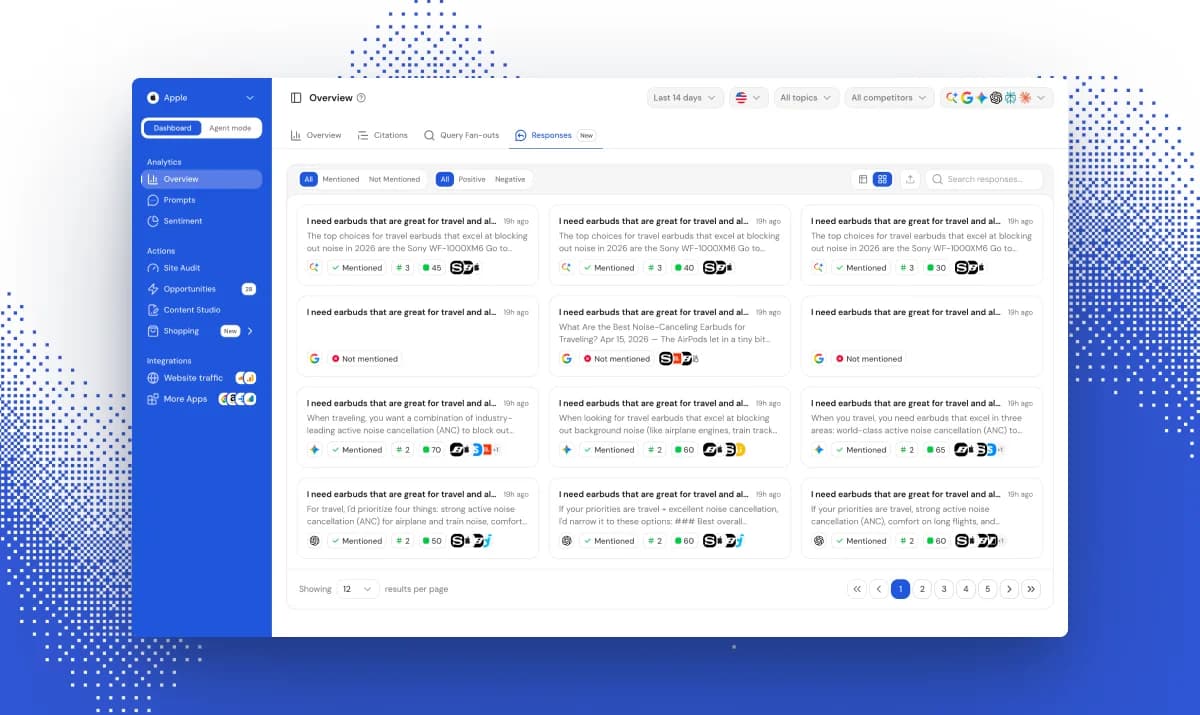
Two things follow, and they shape the rest of this comparison. First, mentions are noisy: ask the same buying question across ChatGPT, Perplexity, Gemini and Google AI, or twice on the same engine, and the tools named and their order move run to run. One check tells you almost nothing, which is why repeated runs matter. Second, the sources AI leans on to build those answers are often third-party roundups and community threads, not the brand's own pages, so the question worth tracking is which sources get cited in your category and whether you are in them.
How we judged them: the whole job, not half of it
Most comparisons in this category score tools on monitoring features alone, which is why most tools come out looking about equal. But seeing which sources AI cites is only step one. The job is getting cited. We scored on the whole loop: see the citations, find the prompts and sub-queries where you are missing, diagnose what is holding your pages back, and build the pages that earn the citation. Five criteria, no pricing (vendor prices move monthly and matter less than these gaps):
Source-level, classified. Beyond "which domains," does it type every citation by page and source (listicle, comparison, guide; corporate, review, UGC), on repeated cross-validated runs rather than one scrape?
Prompt and fan-out gaps. Does it surface the specific prompts, and the sub-queries AI expands them into, where you are absent?
Page diagnosis. Does it audit which of your own pages are holding you back from being cited?
Builds the fix. Does it help you create the pages that target the citations and queries AI already trusts, or stop at a to-do list?
Self-serve start. Can a mid-market team see its own data and act this week, without an enterprise sales cycle?
Where the market actually stands in mid-2026
If you last looked at this category a few months ago, the map has changed, and mostly in one direction: the tools that started as monitors have been adding execution features.
Everyone tracks citations at source level. Peec, Otterly, Scrunch, Ahrefs and Ranketta all expose cited domains and URLs, and most classify them. Peec auto-types domains as Editorial, Corporate, UGC, Reference or Institutional and types URLs too. Otterly's API classifies into News/Media, Community/Forum, Encyclopedia, Blogs, Government/NGO and more. Ahrefs ships Cited Domains and Cited Pages reports with an API. Semrush surfaces cited domains and URLs per tracked prompt in its Sources tab. Profound is the outlier here: it documents citation authority at domain level but does not document classification by page type.
Prompt and fan-out gap analysis is close to table stakes, with two exceptions. Profound, Peec, Semrush and Ranketta all ship fan-out analysis. Ahrefs documents no fan-out feature at all, and Scrunch exposes fan-out data through its API but has no documented UI for it. Both still do per-prompt gap analysis, just without the sub-query layer.
Page diagnosis is no longer rare. Semrush's AI Search Site Audit ships on every plan including the free one. Otterly's GEO Audit checks crawlability, static content and structured data. Peec checks robots.txt against 40+ AI bots and, if you connect server logs, lists every URL that errors for AI crawlers. Scrunch audits crawl health at the CDN layer. Profound's Pages scores content quality and surfaces pages that are indexed but never cited. Ahrefs is the one without a page-level AI diagnostic.
Building the fix is where the spread is. Peec deliberately does not write or publish content, and says so. Ahrefs and Semrush have content tooling, but it is general SEO: optimise against top-ranking pages, not against the prompts where you are absent. Scrunch generates optimised versions of existing pages and hands you drafts, but its delivery layer transforms what you already have rather than creating net-new pages. Otterly's page creator sits in its free resources library, outside the paid product. Profound closes it with Aim, which names gaps in citation-share terms, and Agents that build and publish against them behind an approval step.
So the honest read: two tools now run the full loop, and five run parts of it well. What separates the two is how the loop is packaged, which is the next section.
1. Ranketta: the whole loop as one product
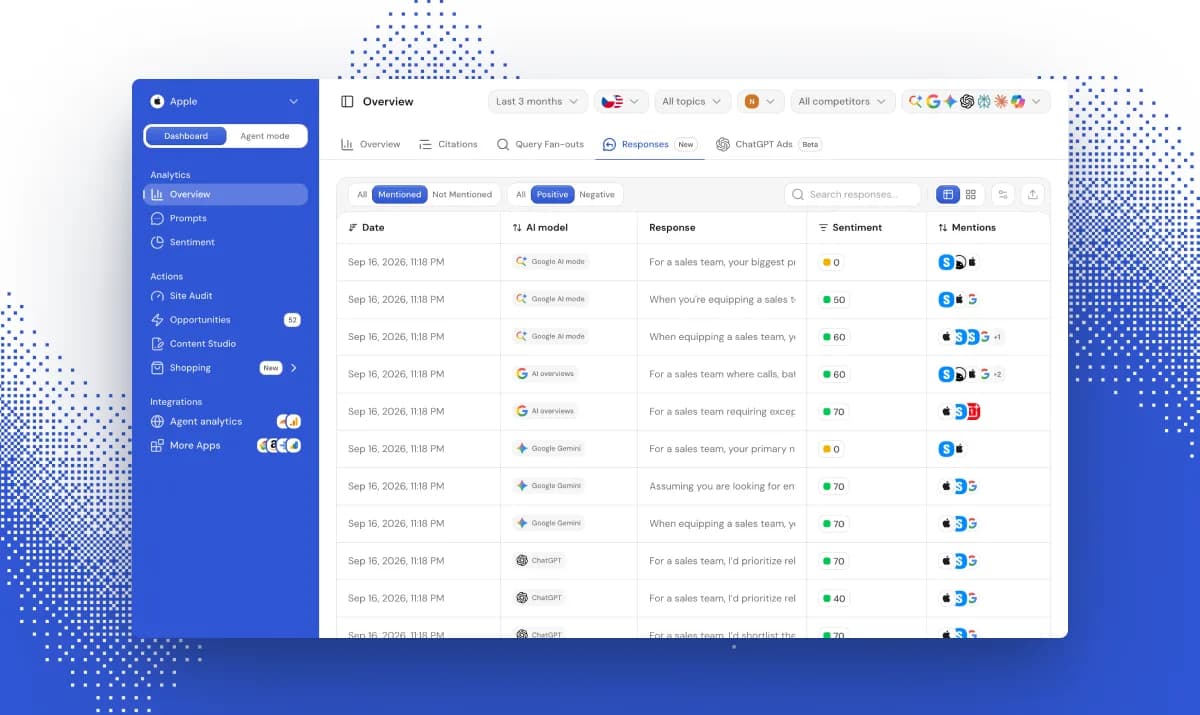
Ranketta is an AI visibility platform for AI search and agentic commerce. It runs the loop end to end in a single product on a single dataset: it shows the citations, finds the prompts where you are missing, maps the fan-outs AI expands the question into, audits the pages holding you back, and helps you build the ones that earn the citation. That last part matters less as a feature list than as an architecture. When measurement and execution sit in one place, the gap you find on Monday is the brief you write on Tuesday, without exporting anything.
Source-level, broken down by type. Ranketta shows the actual URLs and domains AI cites and classifies every citation by page type (listicle, comparison, blog post, guide) and domain type (corporate, review, editorial, UGC). It is the difference between "you were cited 200 times" and "AI cites listicles and comparisons far more than your pages in your category, and you are in none of them, so that is where the gap is." Prompts run repeatedly on browser sessions rather than vendor APIs, so the numbers reflect what buyers actually see and stay stable across runs instead of swinging with a single scrape. The trade-off is real: browser sessions are heavier to run. We accept it because it is the only way to see the surface buyers use. For how those metrics are collected and aggregated, see How Ranketta Measures AI Visibility.
From gap to citation, not just a report. When the data shows a prompt where you are missing, Ranketta does not leave you with a flag. Opportunities surfaces the exact prompts and fan-out queries where you are absent, Site Audit shows which of your own pages are holding you back from being cited, and Content Studio helps you build pages that target the citations and queries AI already trusts.
Where the competition is closest. Profound covers comparable ground, and any honest comparison has to say so. The difference is packaging: Profound spreads the loop across Answer Engine Insights, Pages, Aim and Agents, its full engine coverage sits on the enterprise tier, and its entry plan tracks ChatGPT only. Ranketta's loop is one product, and page-type classification of citations is documented and in the UI rather than inferred.
Who it's for: e-commerce, D2C and B2B brands that want to be recommended in AI answers, plus agencies reporting and closing AI visibility gaps across clients. The free audit shows the sources AI cites in your category, on your own domain, in minutes.
2. Profound: best for enterprise teams with a procurement process
Profound is the closest thing to a full competitor here, and the only other tool running the loop end to end. Prompt Volumes models AI search demand from double opt-in consumer panels rather than deriving it from keyword databases, though the vendor's own word for the output is "estimate." Pages scores your content and surfaces pages that are indexed but never cited. Aim names gaps in citation-share terms and builds an Agent to close them, publishing behind an approval step. Two limits: Profound does not document classification of citations by page type, and the loop is assembled across modules and tiers, with the entry plan tracking ChatGPT only and full engine coverage enterprise-priced.
Who it's for: enterprise brand teams with the budget for the tier where it all switches on.
3. Peec AI: best for teams that already have their content execution covered
Peec has the cleanest citation model in the category. It separates brand visibility (your name appears) from source visibility (your content was used), and separately splits sources from citations: every URL the model touched versus the ones it actually referenced. Domains and URLs are auto-typed as Editorial, Corporate, UGC, Reference or Institutional, with retrieval rate and citation rate side by side. Gap Analysis handles the "where am I missing" question, Query Fanouts the sub-queries underneath it. Then Peec stops, deliberately and openly: it does not write or publish content. It does ship prioritised Actions and an API, so it tells you what to do without doing it. Plans below Enterprise track three engines each.
Who it's for: marketing and agency teams that want precise citation data and have their own execution path.
4. Otterly.ai: best low-budget option for basic citation measurement
Otterly brings citation tracking down to a scale solo marketers can use. Link Citations Analysis and Domain Ranking ship on every plan, with cited domains and URLs classified as News/Media, Community/Forum, Encyclopedia and so on. Base coverage is ChatGPT, Google AI Overviews, Perplexity and Copilot; Claude, Gemini and Google AI Mode are paid add-ons. Prompts run daily. Its GEO Audit checks the three things that block a citation: crawlability, static content and structured data. The paid product ends at monitoring, audits and briefs. There is a landing-page creator aimed at prompt gaps, but it sits in the free resources library rather than in the workflow.
Who it's for: smaller teams and consultants who want honest citation data without an enterprise commitment.
5. Scrunch AI: best for engineering teams making pages readable to AI agents
Scrunch does more than monitor. Citations captures every cited URL automatically and scores each with an Influence Score, and Content Gaps prioritises where your coverage is thin and what to create. Its distinctive piece is the serving side, which nobody else here has: the Agent Experience Platform sits at the CDN layer and returns clean, server-rendered HTML to AI agents. Coverage is eight engines including Meta AI, with Grok flagged as coming. Two caveats: fan-out data exists only through the API with no documented UI, and while Scrunch generates optimised versions and drafts, your team writes and publishes. Sitecore acquired Scrunch in June 2026, though self-serve pricing is still live.
Who it's for: teams treating AEO as an engineering problem.
6. Ahrefs Brand Radar: best for Ahrefs subscribers who want cited-source reporting on top
Brand Radar is the natural starting point if you already live in Ahrefs. It draws on over 400 million search-backed prompts derived from real People Also Ask questions rather than synthetic checks, across seven platforms, though Claude is custom-prompts-only at eight times the check cost and Grok collection is paused. Cited Domains and Cited Pages are strong, filterable by platform, by responses that exclude your brand, and by domain. Two gaps: Ahrefs documents no query fan-out anywhere, and it surfaces the gap without diagnosing the cause. Site Audit has no AI-readiness check set, and AI Content Helper grades drafts against top-ranking pages rather than against the prompts where you are absent.
Who it's for: SEO teams who want cited-source data inside the Ahrefs ecosystem.
7. Semrush AI Visibility: best for Semrush subscribers who want AI tracking on top
Semrush is where many SEO teams start, because it is already open in the browser. It tracks ChatGPT, Google AI Overviews, Google AI Mode, Gemini and Perplexity, not Claude, despite what some roundups say; Claude appears only as a crawler Site Audit checks your robots.txt against. The part most comparisons get wrong: Prompt Tracking's Sources tab does show every domain and URL cited per tracked prompt, and Competitor Research is pitched at finding prompts where competitors get cited and you do not. The real limit is quota, 25 prompts at entry, not capability. AI Search Site Audit ships on every plan including the free one. Query Fan-Out is Enterprise-only and the content tooling is general SEO.
Who it's for: SEO teams that want AI monitoring inside a toolkit they already pay for.
How to choose an AI citation tracker
Five questions, the same five criteria, in the order a buyer should ask them:
Mention or source? If the tool reports "you were mentioned in X% of answers" and stops, it is a brand monitor, not a citation tracker. Ask to see the actual cited URLs, typed by page and source, and ask whether it separates being retrieved from being cited.
Does it show where you are missing? The specific prompts and fan-out sub-queries you are absent from, not just an aggregate score. Most tools now do some version of this, so treat it as the baseline. Check which module it lives in, because vendors often market fan-out analysis and gap analysis as the same thing when they are separate features.
Does it diagnose your pages? Most tools now audit something. The question is what: robots.txt accessibility is not the same as knowing which of your pages are indexed but never cited, and the second one is the useful answer.
Does it help you build the fix? A to-do list is not the fix. Ask whether the content help targets the specific prompts where you are absent, or just grades a draft against whatever currently ranks.
Can you start this week, at the tier you can afford? Several tools here are self-serve at entry and enterprise-gated where it counts. Check which engines, how many prompts and which modules your actual plan includes, not what the homepage advertises.
The bottom line
If your job ends at measurement, several tools do it well. Peec has the cleanest citation model in the category and is honest that it stops before content. Otterly makes citation data affordable at small scale. Scrunch is the one to look at if being readable to agents is the priority. Ahrefs and Semrush are the pragmatic choice if you already pay for them, with Semrush's free-tier AI site audit better than its reputation.
If your job is to actually get cited, the shortlist is short. Profound and Ranketta are the two tools running the full loop from citation data through page diagnosis to building the fix. Profound assembles it from several modules across several tiers, with the full capability enterprise-priced. Ranketta runs it as one product on one dataset, self-serve, with citations typed by page and source type so you can see what kind of page AI actually prefers in your category.
Run the free audit on your own domain: work email plus domain, a report on the sources AI cites in your category in minutes, no credit card.