Four of the biggest names in payments have announced agent checkout; one of them will let you turn it on today.
TL;DR
- Mastercard announced Agent Pay on 29 April 2025. On 2 March 2026, describing its own first live European transaction with Santander, it wrote that the pilot "does not constitute a commercial rollout at this stage." Same company, same product, ten months apart.
- Visa's Intelligent Commerce product page still carries the footnote "Product is currently in the process of deployment." Intelligent Commerce Connect, the part a merchant would integrate, was described on 8 April 2026 as "Currently in pilot with select partners."
- Stripe is the exception: onboarding is self-serve in the Dashboard, across 34 countries, with Kate Spade, Best Buy and Coach named as "already building with" it (29 April 2026). It still runs on preview API versions and preview legal terms.
- PayPal announced in October 2025 that it would power checkout in ChatGPT, but the integration was still described as "rolling out" when OpenAI pulled back from standalone Instant Checkout in March 2026. Its Agent Ready documentation, updated 13 October 2026, now describes integrations for ChatGPT Apps via Braintree and for Google AI Mode and Gemini via UCP.
- Verifying the agent is further along than paying it. Visa's Trusted Agent Protocol specification has been published since 14 October 2025 and a merchant can implement it today, while Visa's own payment rail remains pilot-gated.
What are agentic payments?
An agentic payment is a transaction an AI agent completes on your behalf, inside the assistant, rather than handing you off to a checkout page to finish yourself. How that sits inside the wider shopping flow – discovery, shortlist, then payment – is covered in What Is Agentic Commerce?.
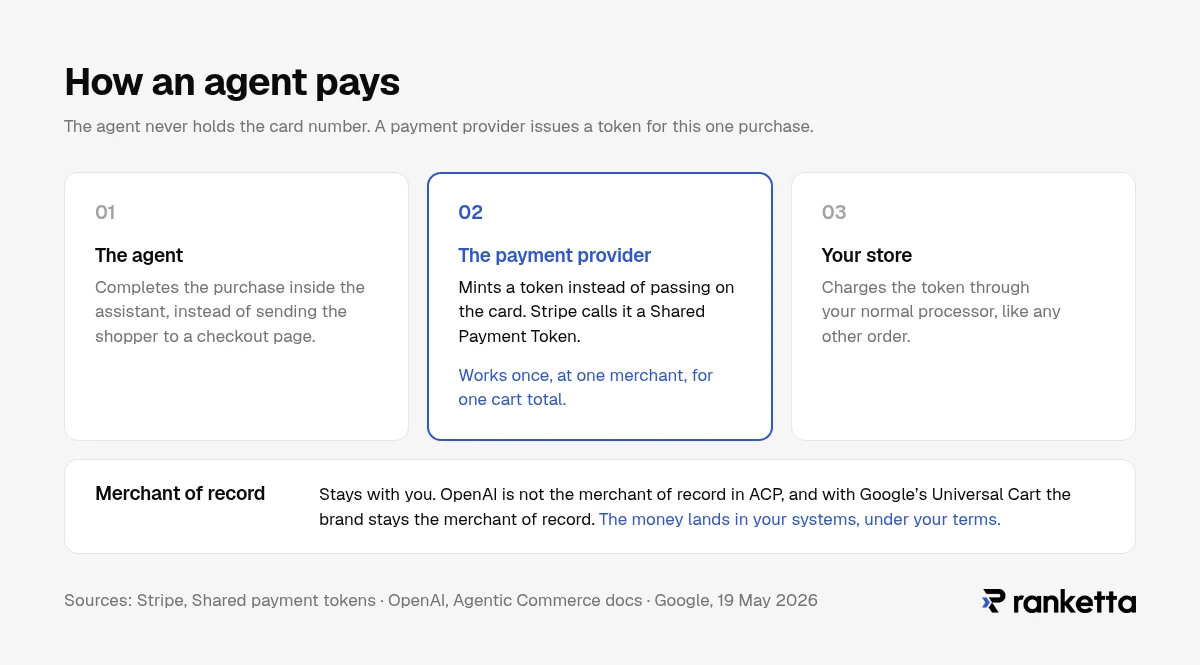
The mechanism that makes this different from a saved card is scoping. The agent never holds your card number. A payment provider mints a token that works once, at one merchant, for one cart total, and the merchant charges that token through its normal processor. Stripe calls its version a Shared Payment Token – "a new payment primitive that lets applications like ChatGPT initiate a payment" – and states plainly that "SPTs are scoped to a specific merchant and cart total."
The money still lands in your systems, under your terms. OpenAI's own developer documentation is explicit that "OpenAI is not the merchant of record in the Agentic Commerce Protocol," and Google says the same of its Universal Cart: "the brand stays the merchant of record."
ACP, UCP, AP2, x402 – which is which
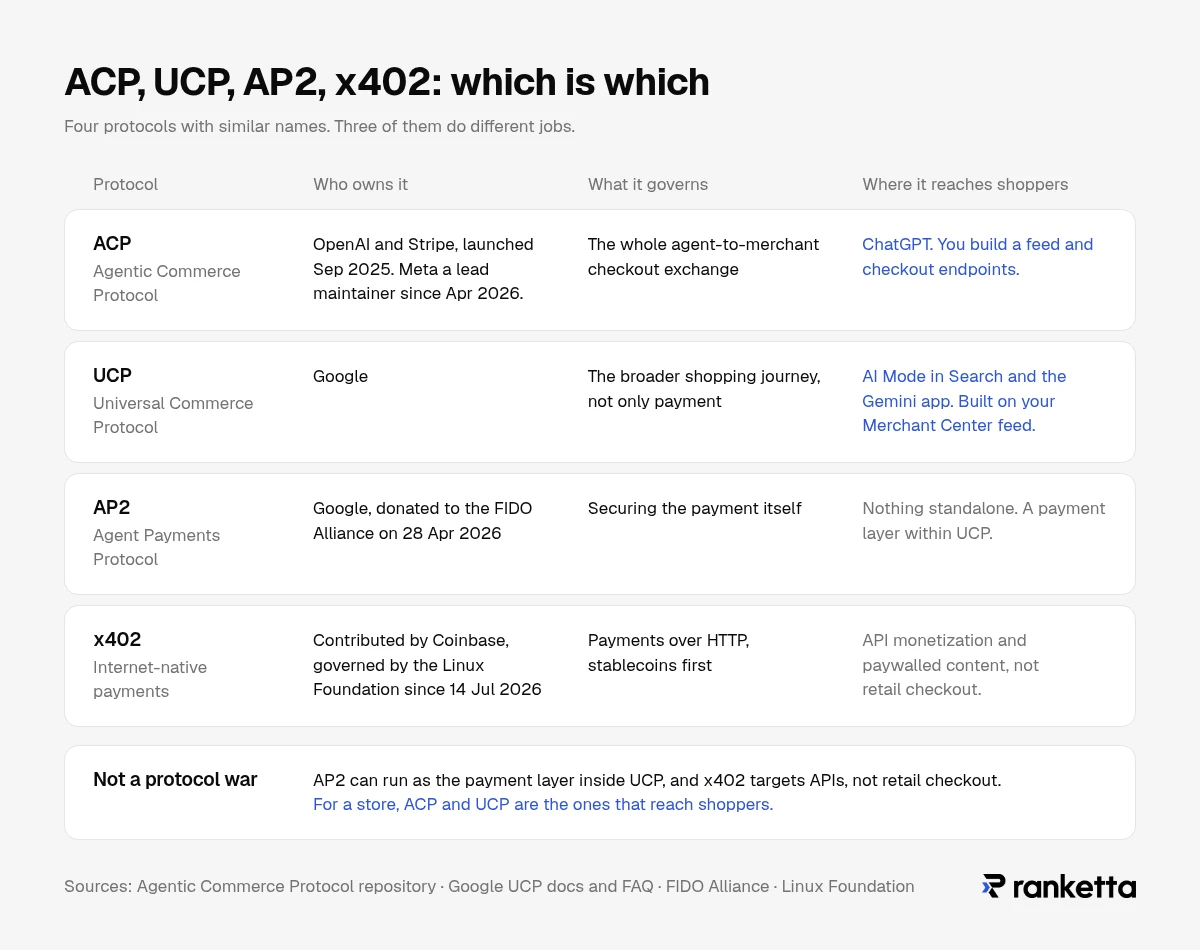
Within a year this category has produced four protocols with similar names, and they are routinely treated as competitors when three of them do different jobs.
| Name | Who owns it | What it governs | What it means for a store |
|---|---|---|---|
| ACP – Agentic Commerce Protocol | Launched by OpenAI and Stripe in September 2025; the repository names them Founding Maintainers, and lists Meta as a lead maintainer from April 2026 | The whole agent-to-merchant checkout exchange | Reaches ChatGPT. You build a feed and checkout endpoints |
| UCP – Universal Commerce Protocol | The broader shopping journey, not only payment | Reaches AI Mode in Search and the Gemini app. Built on your Merchant Center feed | |
| AP2 – Agent Payments Protocol | Google, donated to the FIDO Alliance on 28 April 2026 | Securing the payment itself | Nothing standalone – Google describes it as "a specialized payment layer within UCP" |
| x402 | Contributed by Coinbase, governed by the Linux Foundation since 14 July 2026 | Payments over HTTP, stablecoins first | Its own documentation describes API monetization and paywalled content, not consumer retail checkout |
Two of these are worth separating properly. AP2 is not a rival to UCP – Google's own UCP FAQ says "AP2 can be used as a specialized payment layer within UCP," and the AP2 spec describes itself as something that "operates as a security feature within a Commerce Protocol." Google said in September 2025 that it was "collaborating with… more than 60 organizations" on AP2, and when it handed the protocol to the FIDO Alliance in April 2026 it described the move as keeping AP2 "platform-agnostic and community-led."
AP2 has also moved fast enough to invalidate a lot of what is written about it. Version 0.2, released in April 2026, replaced the original Intent and Cart Mandates with Checkout and Payment Mandates, each with an open and a closed variant. Anything describing three mandates is describing v0.1.
The one framing to avoid is a protocol war. ACP's and UCP's docs don't reference each other, and their owners haven't framed them as rivals. Stripe and Meta take part in both.
What each provider has actually shipped
This is where the gap between press release and production sits. For the platforms that measure whether you make the shortlist before any of these rails matter, see The Best Agentic Commerce Optimization Platforms in 2026.
| Provider | Status today | What a merchant can do |
|---|---|---|
| Stripe | Self-serve, 34 countries, on preview API and preview terms | Turn it on from the Dashboard |
| PayPal | Store Sync live in US and UK; Agent Ready docs updated 13 Oct 2026 | Feed discovery on Copilot and Perplexity; Agent Ready paths for ChatGPT Apps and UCP |
| Visa | "In the process of deployment"; merchant integration in pilot | Implement Trusted Agent Protocol; wait for the rest |
| Mastercard | Pilots and Early Access; no merchant general availability stated | Apply to a pilot programme |
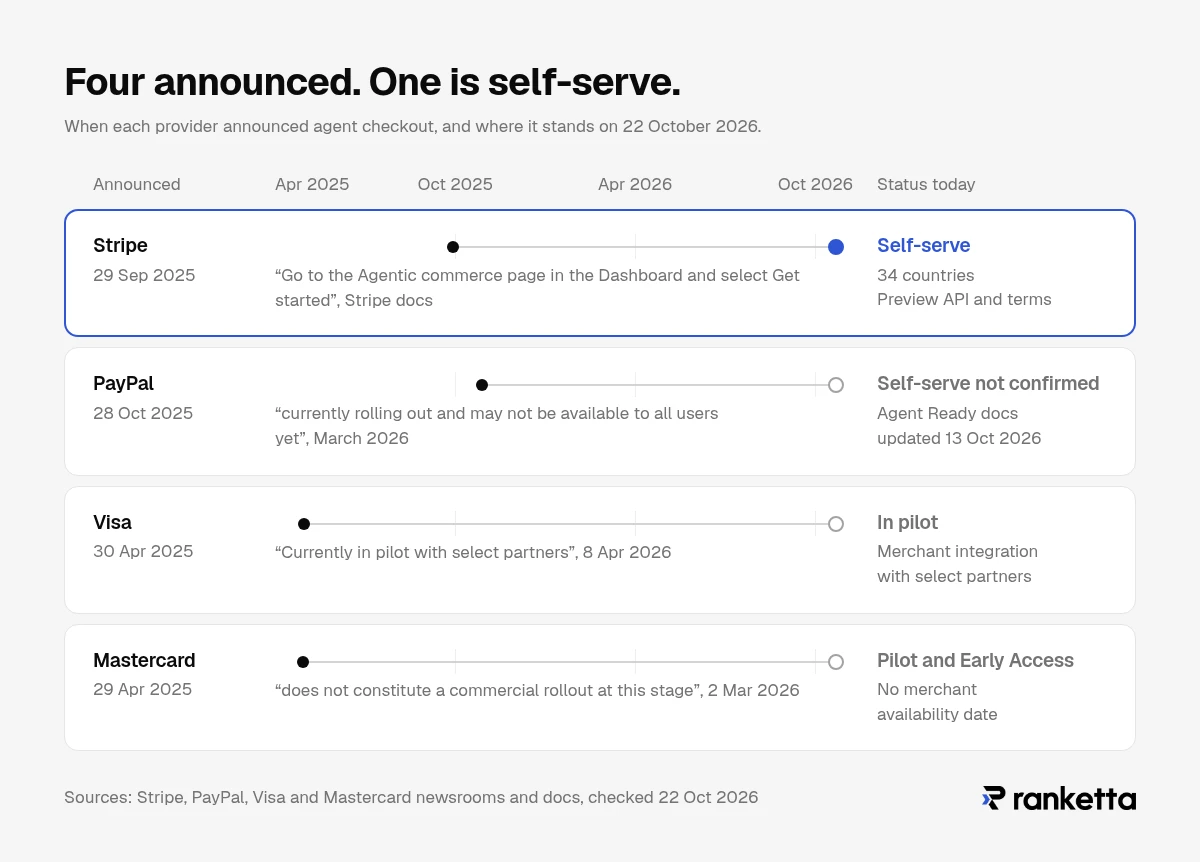
Stripe is the only one of the four we could confirm a store can switch on unaided. Its docs tell you to "Go to the Agentic commerce page in the Dashboard and select Get started" – a change from the launch in December 2025, when the instruction was "If you're interested in using the Agentic Commerce Suite, join the waitlist." It covers 34 countries including Slovakia and the Czech Republic. The caveats are real but narrow: every live code sample runs on a preview API version, the seller terms are a named preview, and distribution is not yours to control – "Stripe sends the agent an approval request that the agent must accept."
PayPal's story is one of slippage rather than withdrawal. Its joint release with OpenAI on 28 October 2025 was written in the future tense throughout. Its March 2026 consumer page still said the feature was "currently rolling out and may not be available to all users yet." Then, on 24 March 2026, OpenAI deprioritised standalone Instant Checkout, writing that it is "allowing merchants to use their own checkout experiences while we focus our efforts on product discovery." PayPal has kept building through it: its Agent Ready documentation, updated 13 October 2026, describes instant checkout in ChatGPT Apps using delegated payment tokens through Braintree, and a Buy button in Google AI Mode and Gemini through UCP. Store Sync is live separately – "Available in the US and UK today, with Germany and additional markets on the way" – with Abercrombie & Fitch, Fabletics, Ashley Furniture, Newegg and Adorama named on Microsoft Copilot and Perplexity as of 22 January 2026. We could not establish whether Agent Ready onboards self-serve.
Visa announced Intelligent Commerce on 30 April 2025 as something that "opens Visa's payment network to the developers and engineers building the foundational AI agents." Eighteen months on, its developer page says "This product is in the process of development and deployment" and "May not be available in all markets," with the sandbox free and production priced on request. In December 2025 Visa reported "hundreds of controlled, real-world agent-initiated transactions." Its newest milestone, announced on 20 October 2026 with BILL and Billtrust, is "the first live pilot to enable trusted AI agents to initiate and complete approved buyer invoice payments" – and it is B2B invoice payment, not retail checkout.
Mastercard has the sharpest announced-versus-live gap of the four, in its own words. In April 2025 it "announced the launch of its Agentic Payments Program." In March 2026, reporting a real transaction through Santander's live infrastructure, it specified that this happened "in a controlled environment" and "does not constitute a commercial rollout at this stage." Agent Pay for Machines opened Early Access on 20 October 2026 – "we're making the first version of our buyer- and seller-side APIs available to developers" – but the sign-up page it points to says the programme is "still in a pilot and not available commercially." Mastercard has published a date for the consumer side – all US Mastercard cardholders enabled by the 2025 holiday season – but no general-availability date for merchants.
How the agent gets verified, and who carries the risk
The question merchants ask before "how do I take the money" is "how do I know this isn't a bot." That part is further along than the payment rails.
Visa's Trusted Agent Protocol has been published since 14 October 2025. Visa's developer documentation describes it as "a verifiable, cryptographic standard to help merchants differentiate legitimate agents from nefarious bots or web crawlers," and the merchant's job is small and well defined: "A merchant's primary task is to validate this signature." Two limits are worth knowing: Visa states that the "initial specifications apply to the Visa network in this phase," and the developer page still carries the same "in the process of development and deployment" disclaimer as the rest of Intelligent Commerce.
This is the asymmetry worth noticing. The identity layer is published; the payment layer is piloting. A store can start distinguishing real agents from scrapers against a published spec, while the rails that would let those agents pay are still gated behind partner programmes at three of the four providers.
What a store actually has to do today
Strip out the announcements and the merchant to-do list is short, and it is not really about payments.
For ACP, OpenAI's documentation lists three things: a product feed, checkout endpoints, and a payment provider that mints the token. For UCP, Google reuses what you already have – your Merchant Center feed – plus a payment handler and a specific product attribute, native_commerce(checkout_eligibility), without which the Buy button does not appear.
Both routes are narrower than they look. Stripe's agent-side tools, for AI platforms building agents rather than for stores, are still a private preview with a waitlist, and Google's UCP checkout is early access for select merchants – so "integrate UCP" today means "apply, then integrate".
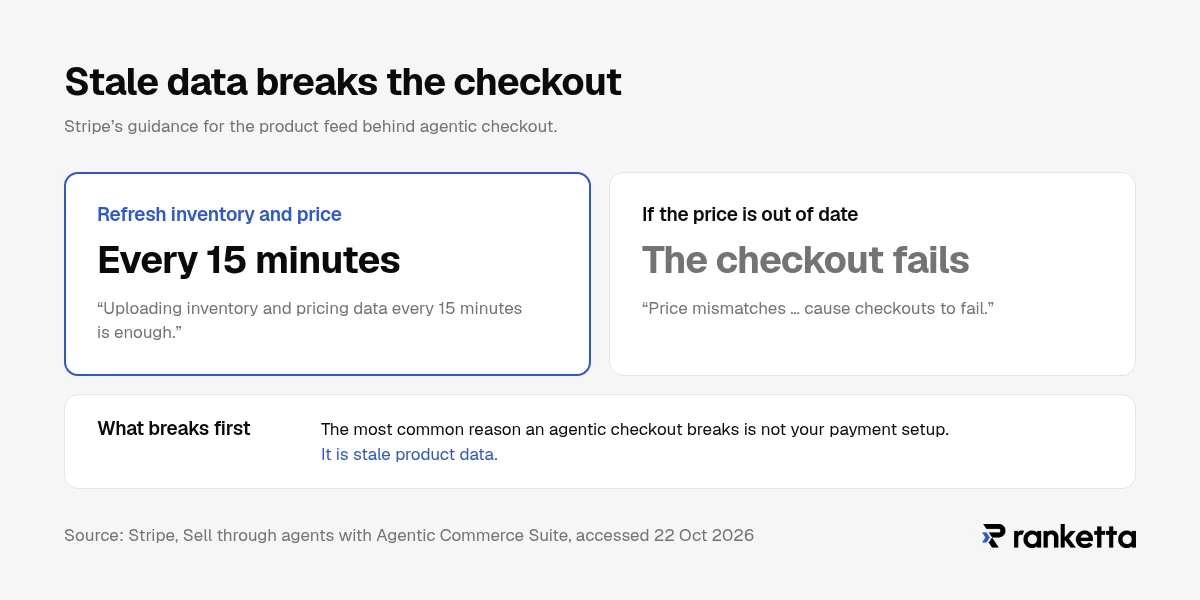
The part that catches people is the feed, not the integration. Stripe's own guidance is that "uploading inventory and pricing data every 15 minutes is enough," followed by a blunt warning: "Price mismatches … cause checkouts to fail." Which fields that feed must carry, and how to structure them so an agent can match your SKUs, is in How to structure product data so AI search can recommend you.
Read that twice. The most common reason an agentic checkout breaks is not your payment setup. It is stale product data.
What this changes for AI visibility
Every protocol on this page starts at the same moment: the agent has already chosen your product. ACP's flow begins with a cart. UCP's Buy button appears against a listing that was already surfaced. Shared Payment Tokens are scoped to a merchant and a cart total that something upstream decided.
None of them help you get into the shortlist. They only help you collect once you are in it.
That upstream step is live right now in a way the payment rails are not. Meta's Muse agent has been shopping on Stripe Link since 8 September 2026. At the "more than 1 million businesses that accept Link," Muse checks out instantly with a saved Link payment method; for other businesses, Link issues "a single-use virtual card scoped to the approved purchase." Grok Bot and Instinct run on the same wallet. How Muse builds that shortlist – and what it takes to get into it – is in Meta Muse Explained. The shortlisting is already happening across these surfaces whether or not your checkout is agent-ready.
The practical reading is Stripe's, not ours: if a price mismatch fails a checkout, then product data quality is a payments problem before it is ever a marketing one.
What to do next
- Implement Visa's Trusted Agent Protocol. It is published, the merchant task is signature validation, and it does not depend on any rail reaching general availability.
- Fix feed freshness before integrating anything. Stripe's threshold is a 15-minute refresh on inventory and price. If you cannot hit that, agentic checkout will fail in ways that look like payment bugs.
- If you want agent checkout this quarter, Stripe is the only self-serve route we could confirm – and go in knowing the API and terms are previews, and that each agent approves you separately.
- Treat Visa's and Mastercard's programmes as roadmap, not procurement. Neither publishes a general-availability date for merchants, and both route merchants through partner programmes. Mastercard's holiday-season 2025 date covered cardholder enablement, not merchant availability.
- Audit whether agents are recommending your products at all, because every rail here assumes that step already happened.
How we verified this
Every claim on this page was checked against the company's own documentation, newsroom or specification repository on 22 October 2026. Where a vendor's own pages disagreed, we said so rather than picking one: Stripe's docs describe ACP as "created by Stripe, OpenAI, and Meta," the specification site says "Stripe and OpenAI developed" it, and the repository names those two as Founding Maintainers while listing Meta as a lead maintainer from April 2026. We could not establish merchant general-availability dates for Visa Intelligent Commerce or Mastercard Agent Pay, because neither company publishes one, and we have not listed live markets for either for the same reason. We also could not establish whether PayPal's Agent Ready onboards self-serve. Every figure and quote on this page comes from a source a reader can open; we have deliberately not used first-party Ranketta data here, so nothing on this page rests on a number only we can see.
Frequently Asked Questions
Sources
- Stripe, Stripe powers Instant Checkout in ChatGPT and releases the Agentic Commerce Protocol, 29 September 2025
- Stripe, Introducing the Agentic Commerce Suite, 11 December 2025
- Stripe, Stripe builds out the economic infrastructure for AI (Sessions 2026), 29 April 2026
- Stripe, Shared payment tokens, accessed 22 October 2026
- Stripe, Sell through agents with the Agentic Commerce Suite, accessed 22 October 2026
- Stripe, Stripe helps Muse, Meta's new personal AI agent, shop with Link, 8 September 2026
- OpenAI, Powering Product Discovery in ChatGPT, 24 March 2026
- OpenAI, Agentic Commerce – key concepts, accessed 22 October 2026
- Agentic Commerce Protocol, specification repository, accessed 22 October 2026
- PayPal, PayPal Launches Agentic Commerce Services, 28 October 2025
- PayPal and OpenAI, OpenAI and PayPal Team Up to Power Instant Checkout and Agentic Commerce in ChatGPT, 28 October 2025
- PayPal, Agent Ready overview, last updated 13 October 2026
- PayPal, PayPal to Acquire Cymbio, Accelerating Agentic Commerce Capabilities, 22 January 2026
- PayPal, Store Sync, accessed 22 October 2026
- Visa, Visa Intelligent Commerce, accessed 22 October 2026
- Visa, Visa Introduces the Trusted Agent Protocol, 14 October 2025
- Visa, Trusted Agent Protocol – getting started, accessed 22 October 2026
- Visa, Visa, BILL and Billtrust Launch First Live Pilot for Trusted AI Agent Payments, 20 October 2026
- Mastercard, Mastercard Unveils Agent Pay, 29 April 2025
- Mastercard, Santander and Mastercard complete Europe's first live end-to-end payment executed by an AI agent, 2 March 2026
- Mastercard, Agent Pay for Machines in action, 20 October 2026
- Google, Universal Commerce Protocol documentation, accessed 22 October 2026
- Google, Universal Commerce Protocol FAQ, last updated 16 October 2026
- Google, A new shopping cart that works across the web, 19 May 2026
- Google, Donating the Agent Payments Protocol to the FIDO Alliance, 28 April 2026
- FIDO Alliance, FIDO Alliance to Develop Standards for Trusted AI Agent Interactions, 28 April 2026
- Linux Foundation, x402 Foundation operational launch, 14 July 2026
Want to see where you stand?
Want to know whether AI assistants are recommending your products before any of this matters? Ranketta tracks product-level recommendations across assistants – the step every payment rail on this page assumes already happened.