


Compared by product-level tracking, feed enrichment, ability to act, and agentic (MCP) access
Agentic commerce was supposed to be a checkout story. In 2026, it turned out to be a product data story. When OpenAI stepped back from Instant Checkout in March and repositioned its Agentic Commerce Protocol around product discovery, it confirmed what retail traffic data had been showing for months: AI agents are already reshaping how people find products, and not yet how they pay for them. Readiness for agentic commerce comes down to one question: can an AI agent find, parse, and trust your catalog? This guide covers what happened to the transaction layer, why product data is the binding constraint, and how the platforms in this space actually compare.
What is agentic commerce?
Agentic commerce is shopping where an AI agent researches, compares and shortlists products, and increasingly completes the purchase on the shopper's behalf. The definition, the live surfaces, and why being recommended is not the same as being buyable are in What Is Agentic Commerce?.
Why agentic commerce matters more for e-commerce in 2026
AI agents already decide which products get considered, and checkout inside the assistant is live for merchants who have integrated — the mechanics are in What Is Agentic Commerce?. This guide compares the platforms that help you get onto that shortlist: SKU-level tracking, feed enrichment, and the ability to ship a fix.
How we evaluated the best agentic commerce optimization platforms
Five criteria, disclosed up front:
- Product-level (SKU) tracking. For any store with more than a handful of SKUs, brand-level data is directional; product-level data is actionable. Which SKUs win AI recommendations, which get skipped.
- Product feed auditing. Does the tool tell you which feed fields (GTIN, attributes, schema, taxonomy) are blocking a specific product's eligibility, or does it stop at "your visibility is low"?
- Ability to act. Auditing the catalog, proposing fixes, and shipping corrected data back to Merchant Center, Shopify, and marketplaces. Measurement without action is a report, not a result.
- Continuous monitoring. Catalogs change daily, AI answers change daily, and product feeds now refresh as often as every 15 minutes. A one-off audit ages in weeks.
- Agentic access (MCP). An MCP server by itself is table stakes in this category: Profound, Semrush, Peec AI, Otterly, and Conductor all ship one. The criterion isn't whether an MCP server exists; it's what it exposes. For agentic commerce, that means product-level shopping data and feed-audit data, not just brand dashboards.
Top agentic commerce optimization platforms for e-commerce brands in 2026
| Platform | Best for | Agentic commerce strength |
|---|---|---|
| Ranketta | E-commerce and D2C brands with their own catalog | SKU-level tracking + feed enrichment + feed export in one loop |
| Alhena AI | Stores that also want its bundled shopping assistant | SKU tracking with closed-loop revenue attribution |
| Profound | Enterprise brand teams | Shopping Analysis module (enterprise tier) |
| Peec AI | Agencies monitoring AI visibility | Product-level AI Shopping tracking via MCP |
| Semrush AI Visibility | Teams already on Semrush | AI visibility inside the SEO suite |
| Ahrefs Brand Radar | SEO research teams | Brand mention tracking |
1. Ranketta: best AI visibility platform for e-commerce and agentic commerce
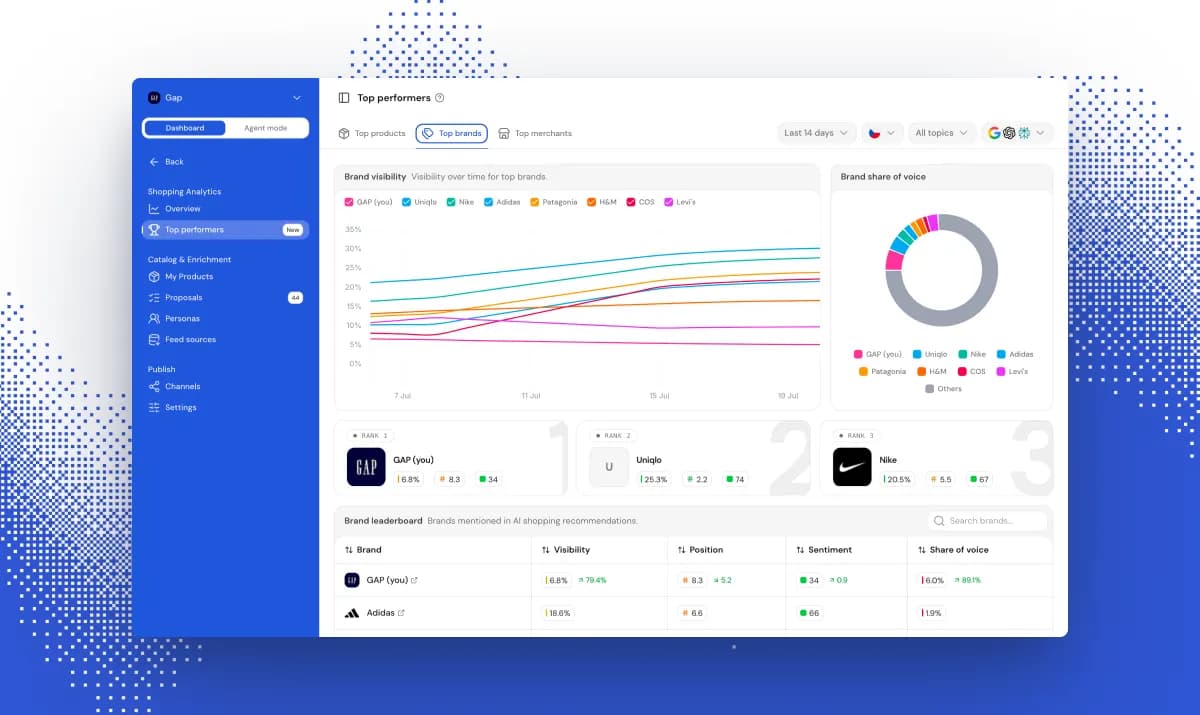
Ranketta is built for exactly the problem this article describes: it tracks which products AI recommends at SKU level, tells you which feed fields hold the losers back, and ships the fix to the channels the store already runs. Founded in 2025 and backed by a €1M pre-seed (Lighthouse Ventures, GI21 Capital), it is the most commerce-native platform on this list.
- Product-level AI visibility tracking across ChatGPT, AI Overviews, AI Mode, Perplexity, Gemini, Claude, Copilot, and Grok, including AI shopping modules, because data comes from browser sessions, not vendor APIs. Each prompt runs repeatedly and continuously, and results are cross-validated and aggregated into daily trend lines, so metrics are stable trends, not one-off scrapes.
- Product feed audit and enrichment. An AI agent rewrites titles, descriptions, GTINs, and attributes, with a confidence score on every proposed fix. You approve, or set a confidence bar and let it run.
- Product feed export to Google Merchant Center, Amazon, and the regional marketplaces and price-comparison channels your market runs on; native integrations for Shopify and other store platforms.
- MCP server exposing SKU-level shopping visibility together with feed-audit data, plus Looker Studio, Google Analytics, and Cloudflare AI-traffic attribution.
Browser sessions are heavier to run than API pulls; we accept that cost because it's the only way to see what buyers actually see.
Limitations: no closed-loop SKU-to-revenue attribution yet. Ranketta attributes AI-referred traffic, but doesn't trace a specific AI recommendation to the resulting order the way Alhena or AthenaHQ do. And as a company founded in 2025, the third-party review base is thin. Judge it on the free audit against your own catalog, not on testimonials.
Who it's for: e-commerce and D2C brands with their own product catalog and Merchant Center or marketplace feeds.
2. Alhena AI: storefront-side tracking with order attribution
The closest peer to Ranketta in the SKU-level e-commerce niche, and pretending otherwise would cost this guide its credibility. Alhena combines SKU tracking with closed-loop order attribution and an on-site shopping assistant.
- SKU tracking with revenue loop: traces AI appearances through to resulting orders.
- Storefront assistant: a conversational layer on the merchant's own site.
Limitations: the loop is storefront-centric, not feed-centric. There is no feed audit, enrichment, or export back into Merchant Center and marketplaces, which is the layer that decides shortlist eligibility in the first place.
Who it's for: stores that want the full Alhena bundle. Visibility doesn't come standalone, so the revenue-attribution loop makes most sense if you also plan to run its shopping assistant on your storefront.
3. Profound: enterprise answer-engine suite for global brand teams
The enterprise reference in the category, with a $96M Series C at a reported ~$1B valuation (February 2026). SOC 2 Type II and Fortune 500 logos make procurement easy.
- Shopping Analysis module: product images, placement, retailer benchmarking (enterprise tier).
- Agents layer: autonomous content automation.
- Proprietary prompt-volume data from real AI users.
Limitations: SKU tracking sits at the enterprise tier rather than in the core product; no native e-commerce platform connections or revenue attribution; the single-workspace model limits agencies and multi-brand setups; the Starter tier covers ChatGPT only.
Who it's for: global brand teams at Fortune 500 scale; the commerce workflow is not the center of the product.
4. Peec AI: multi-model answer monitoring for agencies
The strongest monitoring-first option for product data, and the fastest-growing mid-market tool in the category (~$29M raised).
- Product-level shopping tracking: win rates, ratings, competitor SKUs.
- MCP and API access to that shopping data.
- Agency-friendly multi-client setup.
Limitations: monitoring is the whole product. No feed audit, no enrichment, no content tools; you'll fix everything elsewhere. Some engines are gated to the Enterprise tier.
Who it's for: agencies that need the score across clients and handle execution separately.
5. Semrush: answer tracking add-on inside an SEO suite
Semrush (now an Adobe company) bundles AI answer tracking into the broader SEO platform, with an official MCP server included across Semrush One plans.
- Lowest-friction entry for teams already living in Semrush.
- Bundled with the full SEO toolkit: one contract, one login.
Limitations: shallow on SKU specifics. The DNA is keywords and domains, not catalogs; it won't tell you why a specific GTIN misses the shortlist.
Who it's for: SEO teams adding brand-level AI context to an existing Semrush stack.
6. Ahrefs Brand Radar: keyword-level mention snapshots for SEO research
An add-on to the Ahrefs dataset that tracks brand mentions across ChatGPT, Gemini, and Perplexity at keyword level.
- Massive underlying SEO dataset and unlimited domains.
- Familiar workflow for existing Ahrefs users.
Limitations: no ChatGPT Shopping or product-card tracking, no MCP server, documented data-accuracy concerns in independent reviews, and Claude and Grok are missing.
Who it's for: SEO research teams; not built for agentic commerce.
Also worth knowing: Otterly (budget entry with an MCP server that includes write tools), Conductor's AgentStack (enterprise APIs and answer-engine agents, April 2026), and AthenaHQ (content agents with GA4/Shopify revenue attribution). None of the three is SKU-specialized.
Why your feed tool alone won't get your products recommended by AI
Feed platforms are a different category, but worth a paragraph, because the conventional wisdom about them is out of date: they are not ignoring AI. Feedonomics (BigCommerce) markets an Agentic Commerce product that syndicates enriched feeds to ChatGPT, Perplexity, Gemini, and Copilot; Productsup ships AI Enrich and AI-channel syndication with continuous validation. What neither measures is the outcome: which SKUs actually get recommended, and your share of voice inside AI answers. They distribute; they can't tell you whether it worked. Keep your feed tool if it earns its keep on channel operations and pair it with a measurement layer. Or use the platform on this list that closes the loop itself: Ranketta measures which SKUs AI actually recommends, fixes the feed data holding back the rest, and ships the corrected feed to the same channels your feed tool serves today.
How to choose the best agentic commerce optimization platform for your store
Match the tool to your situation, not to feature counts (for the broader AI visibility field beyond commerce, see our AI visibility platforms comparison):
- Own catalog, Merchant Center and marketplace feeds, mid-market budget: you need the closed loop: measure which SKUs fail, fix the feed, ship it back, re-measure. That's Ranketta.
- Fortune 500 brand team, procurement needs SOC 2: Profound.
- Agency monitoring many clients: Peec AI, with execution handled elsewhere.
- Already deep in Semrush or Ahrefs: their add-ons give you brand-level context cheaply. They will not tell you why a specific GTIN doesn't make the shortlist.
One test cuts through every demo. Ask the vendor to show you, for one specific GTIN: (a) whether it appeared in an AI shopping answer last week, (b) which feed fields are blocking it, and (c) how the fix ships back to Merchant Center. A platform that answers all three is a readiness platform. The rest are dashboards.
Conclusion
Two disclosures first. We build Ranketta, so read our #1 ranking with that in mind; we've kept every claim to what primary sources or vendor documentation support, and named where our own product falls short. And this category moves monthly: every feature claim here was re-verified in July 2026 and will drift, so check live before buying.
The lesson of 2026 is that AI agents got very good at recommending products and stayed slow at buying them. That makes agentic commerce readiness concrete: a catalog an agent can find, parse, and trust: complete GTINs, full attributes, machine-readable product pages, a feed that refreshes as fast as the surfaces reading it. Tracking tells you where you stand; the fix is what moves the shortlist.
See where your catalog stands today: run the free audit: work email and domain, per-SKU report across AI models in minutes, no credit card.