


TL;DR
- Agentic commerce is shopping where an AI agent researches the category, compares products, builds the shortlist and increasingly completes the purchase on the shopper's behalf.
- Agentic commerce is already live: ChatGPT shopping research launched 24 November 2025, Instant Checkout with Stripe on 29 September 2025, and Google's UCP-powered checkout is open to participating merchants in the US, Canada and Australia.
- Two open standards let an AI agent complete a purchase - ACP, maintained by OpenAI and Stripe, and UCP, maintained by Google - and both require the merchant to integrate first.
- Discovery is open, transaction is gated: an agent will read your public product pages whether you have integrated or not, but a shopper cannot buy from you inside the assistant unless you have.
- A purchase completed inside the chat leaves no session in your analytics, so agentic commerce has to be measured by how often your specific products appear in assistants' answers, not by traffic reports.
What is agentic commerce?
Agentic commerce is a purchase in which an AI agent performs part or all of the buying process on a person's behalf - discovery, comparison, shortlisting, and increasingly checkout itself. The shopper states a goal instead of running a search, and delegates the work of comparing to the agent. What arrives back is not a list of results but a decision with reasons attached.
The shopper's input changes shape. Instead of typing "waterproof running jacket women's" into a search box and clicking through six tabs, they say: "I need a waterproof running jacket for autumn, under $200, that packs into its own pocket." The agent asks a couple of clarifying questions, reads product pages, and comes back with a short list and a reason for each pick.
The shortlist is the shelf
If your product is not among the three-to-five items the agent names, you were not beaten on price or on reviews. You were never considered. Traditional search gave a shopper ten results and a scroll; an agent gives them a recommendation, and the items that did not make the shortlist are invisible rather than ranked lower.
The comparison happens without you
The agent reads your product page and your competitor's, side by side, and forms a judgement before the shopper sees either. Your landing page copy is not persuading a human in that moment - it is being parsed by a model looking for attributes it can line up against another product.
The click may never happen
When checkout completes inside the chat, there is no session in your analytics at all. The sale arrives as an order, not as traffic. That is why agentic commerce is not simply "SEO for chatbots": it breaks the measurement model, not just the acquisition model.
Agentic commerce vs. AI search: what's actually different?
The difference between agentic commerce, AI search and traditional e-commerce is who does the comparing. In traditional e-commerce the shopper compares products. In AI search the shopper still compares, but using a summary the assistant wrote. In agentic commerce the agent compares and hands over a decision. These three get conflated constantly, and the difference determines what you should actually do about each.
| Compared on | Traditional e-commerce | AI search | Agentic commerce |
|---|---|---|---|
| Shopper's action | Types a query, browses results | Asks a question, reads an answer | States a goal, delegates the work |
| Who compares products | The shopper | The shopper, using a summary | The agent |
| What you optimise | Rankings and on-site conversion | Being cited in the answer | Being selected into the shortlist, then being buyable |
| Where the purchase happens | Your storefront | Your storefront, after a click | Increasingly inside the assistant |
| What you can measure | Sessions, clicks, revenue | Impressions and clicks, partially | Orders - often with no session attached |
AI search is a visibility problem. Agentic commerce is a visibility problem plus a data-legibility problem plus a transaction-plumbing problem. Solving only the first one gets you mentioned and not bought.
How does an agentic purchase actually work?
An agentic purchase runs in seven steps: the shopper states an intent, the agent asks clarifying questions, gathers candidate products, shortlists them with reasons, takes refinement feedback, completes payment inside the conversation, and passes the order to the merchant's own systems. Stripe and OpenAI published these mechanics when they released the Agentic Commerce Protocol, so this is not speculation about how it might work.
1. The shopper states an intent
The shopper opens the assistant and describes what they want in their own words, usually with constraints attached - budget, size, use case, brand preferences, the occasion. There is no query syntax and no category to browse. The constraints that would have been filter checkboxes on a storefront arrive instead as part of a sentence.
2. The agent asks clarifying questions
Before searching, the agent narrows the brief. OpenAI's shopping research "asks follow-up questions to clarify details, such as preferred brands, size ranges, or whether you care more about performance, comfort, style, or price." Those answers become the criteria your product is judged against - and you never see them.
3. The agent gathers candidate products
The agent assembles a candidate set from three sources: merchant product data supplied through a protocol, publicly available product pages it reads directly, and other retail sources such as marketplaces and review sites. Your store can enter that set through any of the three, which is why discovery does not require an integration.
4. The agent shortlists and explains its picks
The output is a buyer's guide, not a results page: a small set of top picks with a stated reason for each, plus a longer scrollable list of items that also matched. This is the step that decides the revenue. Everything before it is retrieval; this is the moment your product is either named or it is not.
5. The shopper refines the shortlist
"Not interested." "More like this." "Cheaper." The shopper reacts to the picks rather than restarting the search, and the shortlist reshuffles around the feedback. A product that survives several rounds is being compared on attributes - which is why missing attributes drop you out here rather than at the start.
6. Checkout happens inside the conversation
Where the merchant is integrated, the buyer pays without leaving the chat. Stripe issues a Shared Payment Token - "a new payment primitive that lets applications like ChatGPT initiate a payment without exposing the buyer's payment credentials" - and that token travels to the merchant's backend through the protocol.
7. The order lands in your own systems
Per Stripe: "Merchants can accept or decline the order, charge the payment method, calculate and remit sales tax, and handle fulfillment and returns, as they normally would." Nothing about your back office changes. What changes is that the order arrives with no session, no referrer and no landing page attached to it.
Is agentic commerce actually live?
Agentic commerce is live on three surfaces today: ChatGPT shopping research, Instant Checkout in ChatGPT, and Google's UCP-powered checkout in AI Mode and Gemini. All three shipped between September 2025 and 2026, all three are open to merchants who meet the requirements, and none of them is a pilot. This is no longer a forecast.
ChatGPT shopping research
Launched 24 November 2025 to logged-in users on Free, Go, Plus and Pro, on mobile and web. It runs on a version of GPT-5 mini trained with reinforcement learning specifically for shopping tasks, and it produces a personalised buyer's guide rather than a list of links. Results are organic and merchants can follow an allowlisting process to ensure they are available to appear.
Instant Checkout in ChatGPT
Announced 29 September 2025 with Stripe. It went live first with Etsy sellers and US Shopify merchants, and has expanded since. This is the surface where the purchase completes inside the conversation, which means it is also the surface where an unintegrated store loses to an integrated competitor on convenience alone.
Google's UCP-powered checkout
Google describes the Universal Commerce Protocol as "a new open standard for agentic commerce that enables agents and systems to work together across the commerce ecosystem." Participating merchants get a checkout button on eligible product listings in AI Mode in Google Search and in Gemini, paid with Google Pay from methods already in the shopper's Google Wallet. Currently eligible in the United States, Canada and Australia.
What are ACP and UCP?
ACP and UCP are the two open standards that let an AI agent complete a purchase from a merchant - ACP maintained by OpenAI and Stripe, UCP by Google - and both require the merchant to integrate before any purchase can happen. This is the section the payment blogs skip, and it is the one with a to-do list in it. Read the three requirements below together and a single line emerges: discovery is open, transaction is gated.
Agentic Commerce Protocol (ACP) - OpenAI and Stripe
An open interaction standard connecting buyers, their agents, and businesses, published on GitHub and maintained jointly rather than licensed by one assistant. One integration, and per Stripe merchants keep "full control over what's sold, how their brand shows up, and how orders are fulfilled." Orders flow to your backend; you accept or decline them.
Universal Commerce Protocol (UCP) - Google
Powers the Buy button in AI Mode and Gemini. To participate, a merchant must meet Google's requirements, submit an interest form, and complete the technical implementation. And note this detail, because it is the whole gate in one line: only listings carrying the native_commerce(checkout_eligibility) product attribute will display the Buy button. No attribute, no button - however good the product is.
Allowlisting for shopping research - OpenAI
Discovery on this surface needs no integration at all. OpenAI says shopping research works by "reading product pages directly", so an agent can find and recommend you whether or not you have done anything. Separately, "merchants who want to ensure they are available to appear in shopping research results can follow the allowlisting process."
So a store can be recommended and still not be purchasable. In a shortlist where two competitors can be bought in one tap and you require a click-out to a storefront, you are not competing on the same terms. That asymmetry - not the recommendation itself - is what the protocols actually decide.
What does agentic commerce change for your store?
Agentic commerce changes four things for a store: product data becomes the sales pitch, product identifiers decide whether you are comparable at all, brand-level visibility stops predicting product-level sales, and analytics stops being able to see the outcome. They are listed below in the order they will cost you money.
Your product data becomes your sales pitch
An agent reading a product page does not respond to lifestyle copy. It looks for the things it can compare: material, dimensions, weight, compatibility, certifications, care instructions, what is in the box. Missing attributes do not read as minimalism. They read as an unmatchable product, and the agent moves on to one it can match.
Identifiers stop being paperwork
GTINs, MPNs and a consistent variant structure are how an agent knows your product is the same product it saw elsewhere - and therefore how it merges reviews, pricing and availability into a single judgement. Get this wrong and your best-reviewed SKU competes as a stranger. How to structure product data so AI search can recommend you goes through this field by field.
Brand-level visibility stops being a proxy
Being mentioned as a good brand is not the same as being recommended as a specific buyable item. An assistant can praise your brand in one breath and shortlist three competitor SKUs in the next, and a brand-level tracker will record that as a win. Those are separate outcomes and they need separate measurement.
Analytics stops being the scoreboard
When the purchase completes in the chat, there is no referrer, no landing page, no session. Clicks that do happen frequently lose their referrer on the way out of the assistants' mobile apps and land in Direct, indistinguishable from someone typing your URL from memory. Judging agentic performance by traffic reports will tell you nothing is happening while it happens - we put numbers on that gap in Most AI Recommendations Never Become a Click.
Are agentic commerce results ads?
For ChatGPT's shopping research, no: OpenAI states that results are organic and that "ads are separate from shopping research." The full wording is worth having, because this is where the confusion is most expensive: "Results are organic and based on publicly available retail sites — reading product pages directly, citing sources, and avoiding low-quality or spammy sites."
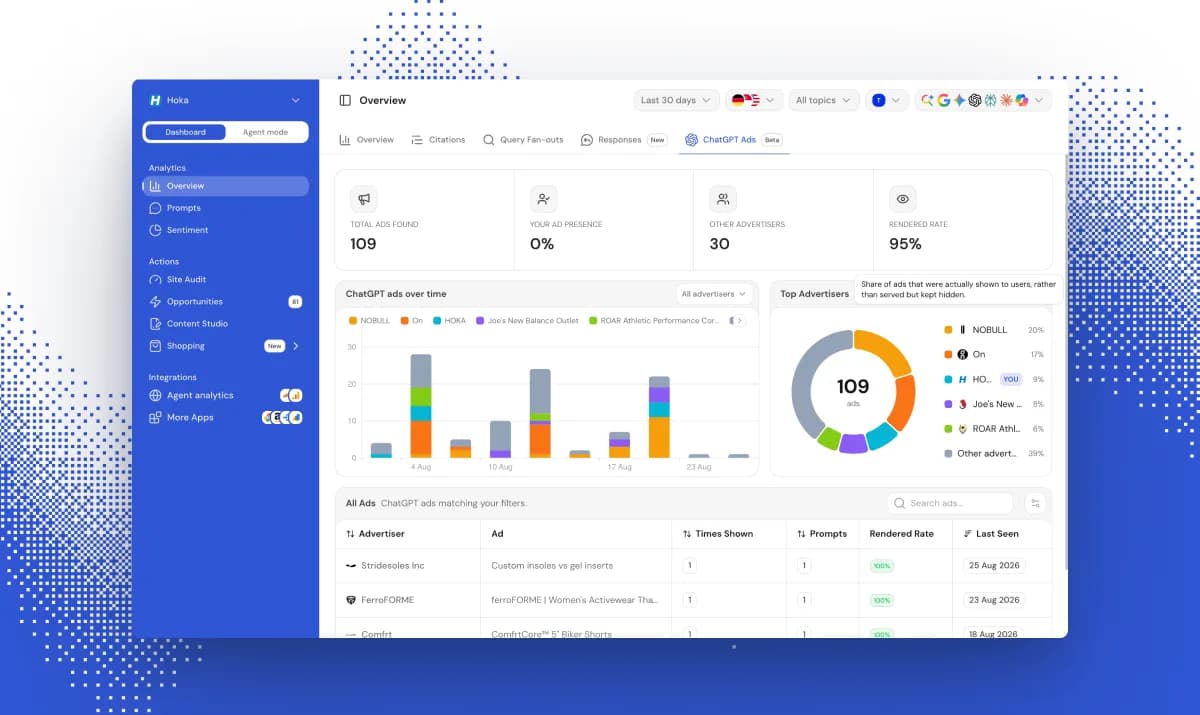
So there are two distinct surfaces inside the same assistant, with two different mechanics. One you influence with product data, structure and credible sources. The other you buy. Optimising for one does nothing for the other, and a budget aimed at the wrong one is simply spent.
Participating in a checkout protocol is not paying for placement either. It makes you transactable; it does not make you recommended. If it is the paid surface you are trying to understand, we have written that up separately: ChatGPT Ads Explained.
How do you know if agents recommend your products?
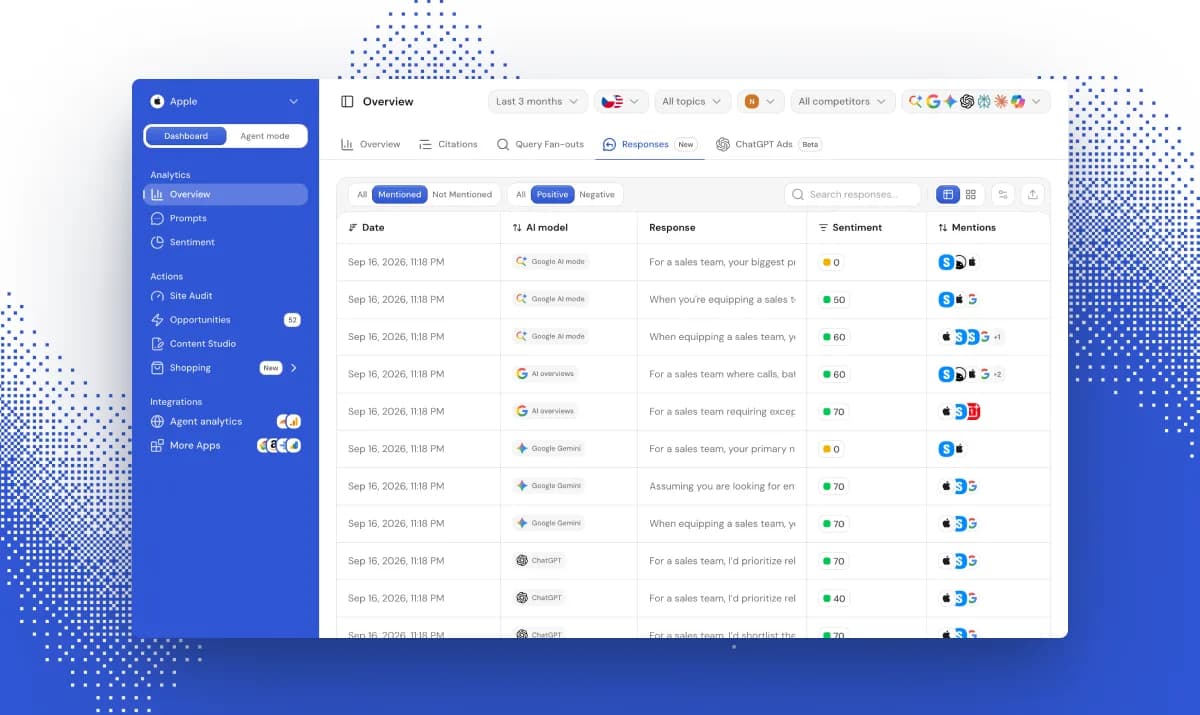
You measure agentic commerce by asking the assistants your customers' buying questions repeatedly and recording how often your specific products appear - not by reading your analytics. If the purchase can complete without a session, your analytics cannot be the measurement. You have to observe the answers themselves. The metric that matters is the share of relevant buying answers in which your specific products appear; everything else is a proxy for it.
Ask at SKU level, not brand level
"Best waterproof running jacket under $200" is the question your customer actually asks. "Is [brand] good" is the question you want the answer to. Only the first puts specific products in front of the agent, and only the first tells you whether yours was among the ones it named.
Repeat the same prompt
Model outputs vary between runs on identical input. One appearance is an anecdote; an appearance rate across repeated runs is a measurement. Decide how many runs make a reading and keep that number fixed - otherwise your trend line is measuring your method rather than your visibility.
Check several assistants
ChatGPT, Gemini, Claude and Perplexity do not agree with each other, and they do not fail in the same places. A product that appears reliably in one can be absent from another on the same prompt, so a single-assistant number tells you very little about your overall exposure.
Record the citations, not just the mention
Which page did the assistant read to reach that conclusion? The cited URL is the actionable half of the result: it tells you which of your pages is doing the work, or which competitor's page is doing it instead. A mention without its citation is a score you cannot act on.
Track competitors in the same run
The useful number is not "were we there" but "who was there instead". Recording the full shortlist on every run turns an absence into a named list of the products that beat you - which is the difference between knowing you have a problem and knowing what to fix.
More on the measurement side: What Is AI Visibility? and How to Get Your Products Recommended by ChatGPT.
What to do next
- Decide whether you need to be transactable, not just findable. If your competitors are integrated with ACP or UCP and you are not, you are losing the shortlist on convenience. That is an integration decision, not a marketing one.
- Audit the comparable attributes on your top SKUs first. Material, dimensions, weight, compatibility, certifications, what is in the box - the fields an agent can line up against a rival product. Start with the SKUs that carry your margin.
- Fix your GTINs, MPNs and variant structure before anything else in the feed. Identifiers are what let an agent merge your reviews and pricing with everyone else's. Without them your best product competes as an unknown.
- If you sell on Google's surface, check the
native_commerce(checkout_eligibility)attribute. No attribute means no Buy button, regardless of how good the listing is. - Set up SKU-level tracking across several assistants before you change anything. Without a baseline you cannot tell whether the product-data work moved anything, and your analytics will not tell you either.
Frequently Asked Questions
Sources
- OpenAI, Introducing shopping research in ChatGPT, 24 November 2025
- OpenAI Help Center, Using shopping research in ChatGPT
- Stripe Newsroom, Stripe powers Instant Checkout in ChatGPT and releases Agentic Commerce Protocol codeveloped with OpenAI, 29 September 2025
- Agentic Commerce Protocol, specification repository
- Google Merchant Center Help, About the Universal Commerce Protocol (UCP) and UCP-powered checkout feature on Google
Want to see where you stand?
Ranketta tracks how often ChatGPT and other AI assistants recommend your brand and products - at SKU level, across repeated runs, with the citations that produced each answer. That is the half of the picture your analytics cannot show you.