


Sometime this week, in a budget meeting, someone will point at a dashboard and say: "AI sends us 2% of traffic. Let's revisit next year."
Here is why that slide is wrong. When an AI assistant names a brand, only 23.1% of those mentions come with a link to click, and in retail just 16.5% (BuzzStream, June 2026). Most recommendations end right there, in the answer, leaving no trace. And many of the clicks that do happen get filed under channels with no AI label on them. The AI line in your analytics is not a measure of AI influence. It is a count of the recommendations that survived every filter on the way to your dashboard.
This article follows one recommendation down that path, filter by filter, and ends with the number worth putting on the slide instead.
Why don't AI recommendations show up as traffic?
Because most of them never carry a link.
Picture the moment that matters. A shopper asks ChatGPT which magnesium to buy, and the answer names three products. Yours is one of them. This is the new shelf, the exact second your brand wins. And in most answers, your name sits there as plain text. Nothing to click. The shopper reads, nods, closes the tab. Your analytics recorded nothing, because there was nothing to record.
How often is "most"? BuzzStream tracked 12,000 answers across ChatGPT, Google AI Mode, AI Overviews and Gemini and found that only 23.1% of brand mentions are backed by a citation in the same response. Retail is the weakest industry in the study at 16.5%. Open-ended prompts like "best project management tools," the shape of every shopping shortlist question, drop to 7.2%. Other 2026 measurements land in the same place: Semrush found 25.1% of brands named with no source link at all (June 2026), and Seer Interactive saw a mentioned brand go uncited nearly half the time across 541,213 answers (March 2026).
Part of the reason is almost funny: the model often is not even online. A 2025 academic study of 14,000 real conversations found that 34% of Gemini and 24% of GPT-4o answers are generated without fetching any web content at all (Strauss, Yang, O'Reilly et al.). The model answered from memory. There was never a link to give you.
A note on craft, because it cuts both ways. Every heading in this article is a question, and the first paragraph under it is a complete answer that stands on its own. AI models cite paragraphs shaped exactly like that. If you want your content inside the answers, write paragraphs the answer can lift.
Where do the clicks that do happen end up?
Often somewhere you would never look for them.
Suppose the shopper does click. If the answer came from Google's AI Overviews or AI Mode, the click lands in Organic Search. That is by design: Google's GA4 documentation defines Organic Search as including "Google's AI Overviews and AI Mode." The largest AI surface your customers use is folded into ordinary search clicks, and no setting will unfold it.
GA4 did add an AI Assistant channel in May 2026, and it helps. But watch the definition move. The launch note named "chatbots like ChatGPT, Gemini, and Claude." Today's documentation names "ChatGPT, Gemini, Deepseek, Copilot, or Grok." Claude quietly left, three others quietly arrived, and unlike its shopping, social and search channels, Google publishes no source list you could check. Your AI traffic line can rise or fall because someone edited a list you cannot read.
And clicks from the assistants' mobile apps often lose their referrer on the way out, a widely documented behavior. Those sessions land in Direct, wearing the same face as a customer who typed your URL from memory.
What do shoppers do with an AI recommendation?
Mostly what you would do: they go check it.
Think of the last time an AI recommended you something that cost real money. Did you buy it from inside the answer? Or did you open a new tab and search for the name, the reviews, the price? CI&T reports that 68% of UK and Ireland shoppers have already used an AI agent when shopping, and the top three uses are comparing brands (45%), finding the lowest price (42%) and finding where to buy (39%) (July 2026). Three verification tasks.
In our reading of that data (CI&T does not draw this conclusion), verification is the quiet killer of attribution: a new tab, a new query, a new session with somebody else's name on it. The customer AI convinced shows up in your dashboard as a customer some other channel delivered. The demand does not disappear. It arrives later, unlabelled. We are testing this on our own data, comparing AI visibility trends against branded search trends, and will publish what we find.
So what does your AI traffic number actually measure?
Follow one recommendation all the way down. First it needs a link; most never get one. Then it needs a click on that link, not a new tab; many shoppers open the new tab. Then the click needs to be filed as AI; AI Overviews clicks are not, and app clicks are not.
What is left at the bottom is your AI traffic number: the share of recommendations that survived every filter. A survival rate, not an influence measure. A perfectly accurate answer to a question nobody was asking.
So when someone says "AI is 2% of our traffic," the honest reply is: 2% is how many customers AI sent us by the one path we can see. It says nothing about how many customers AI convinced.
How big is the gap between influence and measurement?
Ask people, and the influence looks enormous. McKinsey's "New front door to the internet" reports that half of consumers now use AI-powered search, that 40 to 55% of consumers in categories like electronics, grocery, wellness, apparel and beauty use it for purchasing decisions, and that 44% of AI search users call it their primary information source, ahead of traditional search at 31% (survey of 1,927 consumers, August 2025; adoption has more likely grown since than shrunk). McKinsey projects $750 billion of US revenue flowing through AI-powered search by 2028.
Ask the dashboards, and it looks negligible. Previsible analyzed 6.77 million AI-referred sessions across 166 GA4 properties: AI referrals make up 0.17% to 1.71% of total sessions, depending on industry (July 2026).
Half the shoppers in your category deciding with AI. One session in a hundred wearing the label. Both numbers are real. They measure different events: the first counts who asks, the second counts who left a trace your analytics can read.
The floor of what is missing comes from the measurement side itself. Previsible excluded Google's AI Overviews from its dataset because, in the author's words, AI discovery inside Google's results "almost certainly represents a larger volume of AI-driven traffic than all standalone LLM platforms combined." Larger than everything he measured. Which means AI-touched clicks are at minimum double your AI channel, before counting the app clicks sitting in Direct. That is not our estimate. It is the sum of two statements by the author of the largest public dataset on the subject.
What should you report instead?
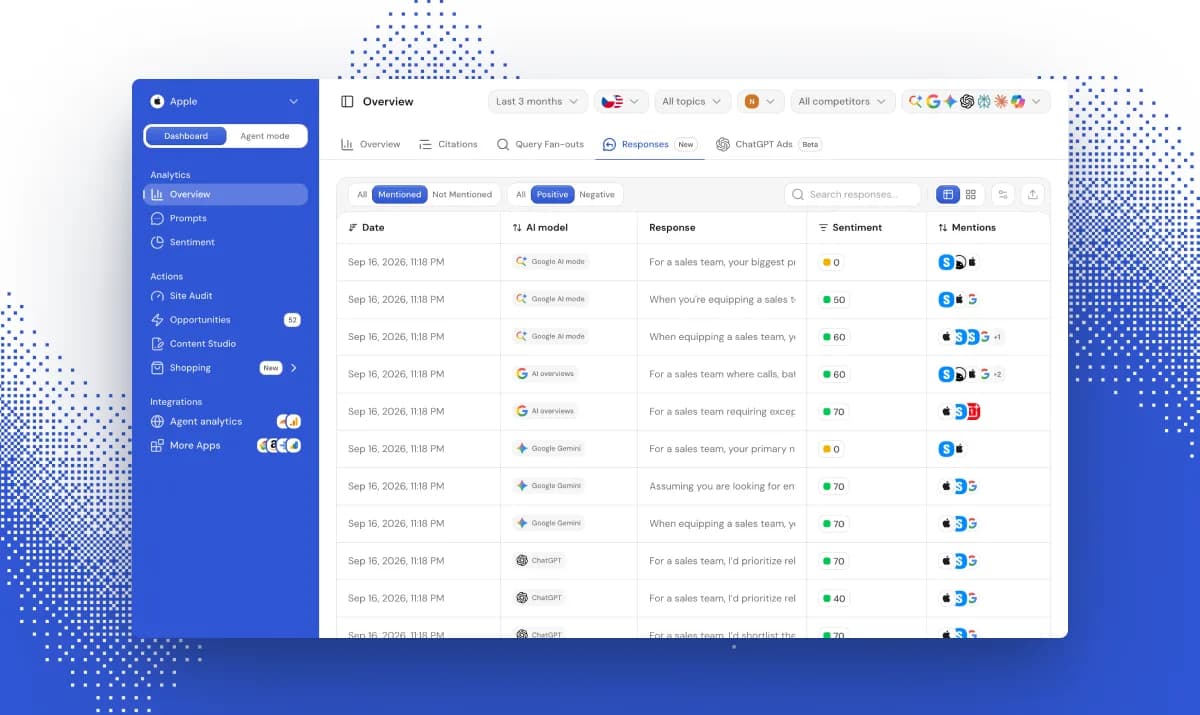
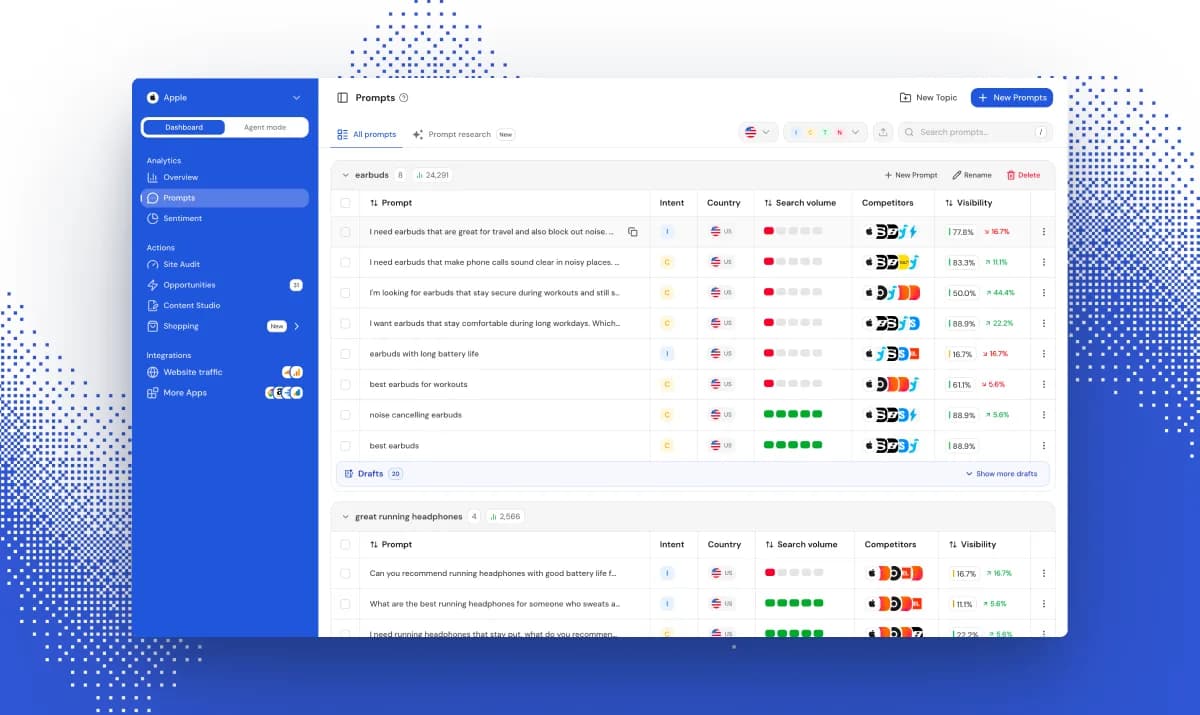
The number that survives all of this is presence in the answer itself. It does not care whether a link existed, whether the shopper clicked it, or how a channel grouping filed it. It was there at the moment the recommendation happened, which is the moment everything else in this article loses sight of.
Measured properly, it means the share of answers your products appear in, over repeated runs, per product, per engine: ChatGPT, AI Overviews, AI Mode, Gemini, Perplexity, Claude, Copilot, Grok. One check is an anecdote; the same question produces different answers hours apart. Percentages over many runs hold still.
So next Monday, put three trends on the slide instead of one traffic line: AI visibility (the share of answers you appear in), average position in the answer, and share of voice against the products recommended next to yours. Keep AI referral traffic as a supporting line. It is real, just late and partial. And when the numbers move week to week, the sentence for your CEO: the answer is assembled fresh every time, so we track the share, not the screenshot.
How we run those measurements, and what we give up doing it this way, is documented in how Ranketta measures AI visibility.