


An LLM optimization tool earns the name when it changes one of four things: the recommendations you get, the content you publish, the page an AI bot sees, or the product data every channel pulls from. We compared eight tools on that axis, verified against each vendor's own docs in October 2026. Ranketta is our product, and it is on this list.
TL;DR: who works on which layer
| Layer | Tools |
|---|---|
| Product data (the feed and catalog every channel reads) | Ranketta, Adobe LLM Optimizer (Adobe Commerce), AthenaHQ (Shopify product copy) |
| Content (articles, guides, product copy you publish) | AthenaHQ, Profound, Conductor, Ranketta |
| The page AI bots see (a bot-facing version of your site) | Scrunch AI, Adobe LLM Optimizer |
| Recommendations (what to fix, you do the work) | Peec AI, Otterly AI |
What is an LLM optimization tool?
An LLM optimization tool is software that changes what large language models read about your brand or products, so ChatGPT, AI Overviews, AI Mode, Perplexity, Gemini, Claude and Copilot are more likely to recommend you. A tool that only reports whether you were mentioned is a tracker, not an optimizer.
The work happens on four layers. The deeper the layer, the more channels a single change reaches.
| Layer | What changes | Example |
|---|---|---|
| Recommendations | A ranked list of what to fix | "Get listed on the three roundups ChatGPT cites for your category" |
| Content | Pages you publish | A comparison page built from the prompts your buyers ask |
| The page AI bots see | A bot-facing version of your site | Cleaner HTML served only to AI retrieval bots |
| Product data | The feed and catalog every channel reads | A missing material, size or GTIN added to the feed and exported to Google Merchant Center |
Trackers still matter. They tell you where you stand. They just don't move you.
Is LLM optimization the same as LLM observability?
No. LLM observability tools monitor the quality, cost and latency of AI applications your own engineers build. They say nothing about whether ChatGPT recommends your product.
Several "best LLM optimization tools" lists mix the two, because both sit under the word "LLM". If a tool traces prompts inside your own chatbot, logs token spend or scores hallucinations in your app, it serves your developers. It does not change what an AI engine tells your buyers. None of the eight tools below is an observability platform.
What actually changes whether an AI engine cites you?
AI engines split a question into sub-queries, retrieve pages for each one and quote passages. What moves citations is content they can lift, data they can parse and sources they already trust.
The evidence points in the same direction:
- Format matters. Listicles account for 21.9% of all AI citations, and around 40% for purchase-intent prompts, according to Wix Studio's AI Search Lab analysis of 75,000 AI answers (March 2026).
- Rankings help, but don't decide. Ahrefs found that 37.9% of AI Overview citations come from Google's top 10, while 31.0% come from pages ranked beyond position 100 (March 2026).
- Evidence gets quoted. Adding statistics, quotations and named sources were among the strongest tactics in the GEO study by researchers at Princeton and IIT Delhi (KDD 2024).
- Schema is not a gate. Google's AI search guide (15 May 2026) says structured data is not required to appear in AI features. It helps machines parse a page. It does not earn the citation on its own.
- For shopping, the feed now leads. Profound's tracking of 1.76 million ChatGPT prompts found that feed-integrated products made up about 65% of ChatGPT Shopping results by 3 September 2026, up from 8% before the July model update.
That last point changes which layer matters for e-commerce. When most shopping answers come from feeds, a better product page is not enough. The fix has to reach the data the engine retrieves. We cover the mechanics in how to structure product data for AI search.
How we compared these LLM optimization tools
We sorted each tool by the deepest layer it can change, then checked three more things:
- Where the change lands. A draft in the tool, your CMS, your store, your CDN, or the feed every sales channel reads.
- Whether a human approves it. And whether you can let high-confidence changes through on their own.
- How the tool measures if it worked. Same prompts, before and after, per product.
Every claim below comes from the vendor's own documentation, checked in October 2026. We left prices out because they change monthly in this category. Ranketta is our product. We wrote its section to the same standard as the others.
If you want the same market compared by how each tool collects its data, read our sister piece on the best AEO tools. This one asks a different question: which of them change something.
The 8 LLM optimization tools at a glance
| Tool | Deepest layer it changes | Where the change lands | Human approval | Best for |
|---|---|---|---|---|
| Ranketta | Product data + content | Enriched feed exported to Google Merchant Center and Amazon; drafts from tracked prompts | Approve, or auto-approve above a confidence bar | E-commerce catalogs sold across several channels |
| AthenaHQ | Product copy + content | Live Shopify product record; 8 CMS destinations | Yes, before publish | Shopify brands whose bottleneck is content |
| Adobe LLM Optimizer | Product data + on-site content + edge | Adobe Commerce catalog, content source, CDN edge | One-click deploy, rollback | Teams already on Adobe Experience Cloud |
| Profound | Content + product copy | Connected CMS; PDP rewrites stay in Profound Sheets | Human Review node | Enterprise brand teams |
| Scrunch AI | The page AI bots see | Parallel AI-ready version served at the CDN edge | Approval workflows | Enterprise sites controlling what bots read |
| Conductor | Content | Writing Assistant drafts | Yes | Large enterprise content operations |
| Peec AI | Recommendations | Ranked actions; you execute | n/a | Agencies and lean teams |
| Otterly AI | Recommendations / audit | GEO audit report | n/a | A first step on a small budget |
1. Ranketta: best for fixing the product data AI reads, across channels
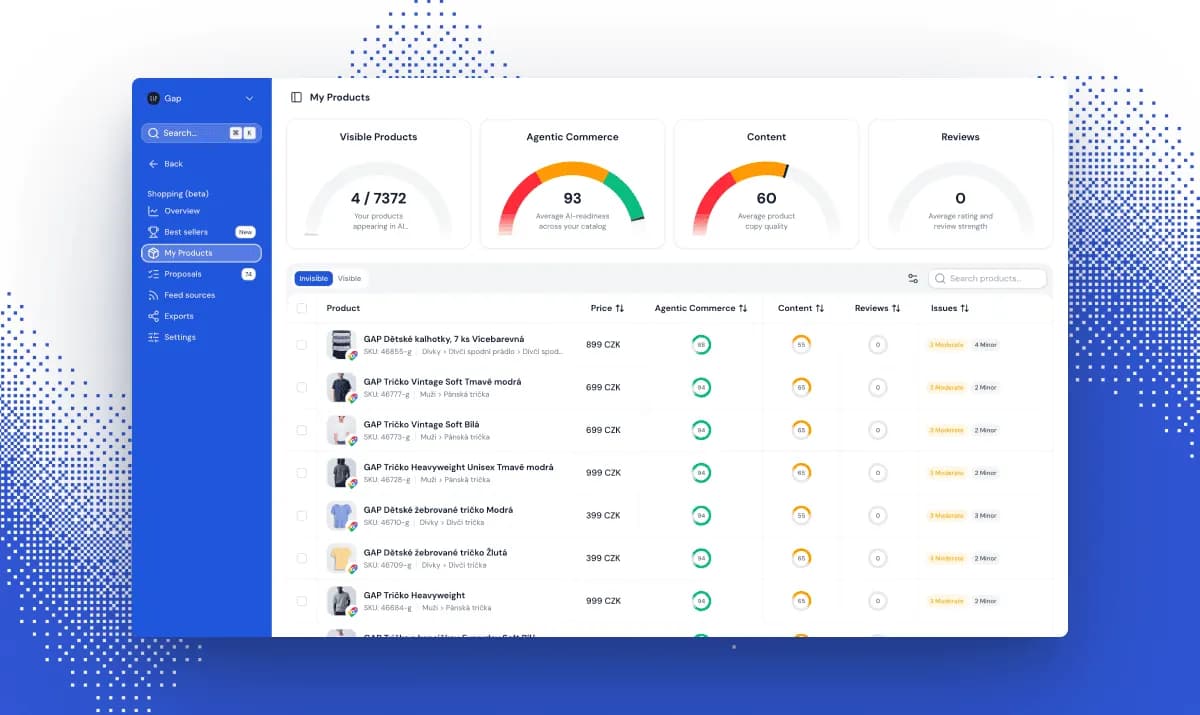
Ranketta changes the product data every channel reads, then shows you whether AI engines started recommending the product.
The result first: a product that was missing from ChatGPT's shortlist because its feed had no material, no use case and a vague title gets those fields filled, checked and sent back to Google Merchant Center and Amazon. One fix, every channel that pulls the feed.
Here is the cycle. Connect a Google Merchant Center or Amazon feed, or sync your Shopify or Shoptet store directly. Ranketta scores every product on essentials, identifiers and product detail. You pick products to enrich, and each proposed change lands with a confidence score. You approve it, or set a confidence bar and let changes above it through automatically. Then you publish the enriched data to Google, Amazon and other channels. The full cycle is in AI product enrichment.
On the content layer, Content Studio drafts listicles, comparisons, guides and FAQ sections from the prompts you track. It speeds up the first draft. It does not replace your copywriter, and we don't want it to: copying what already ranks is how you end up sounding like everyone else.
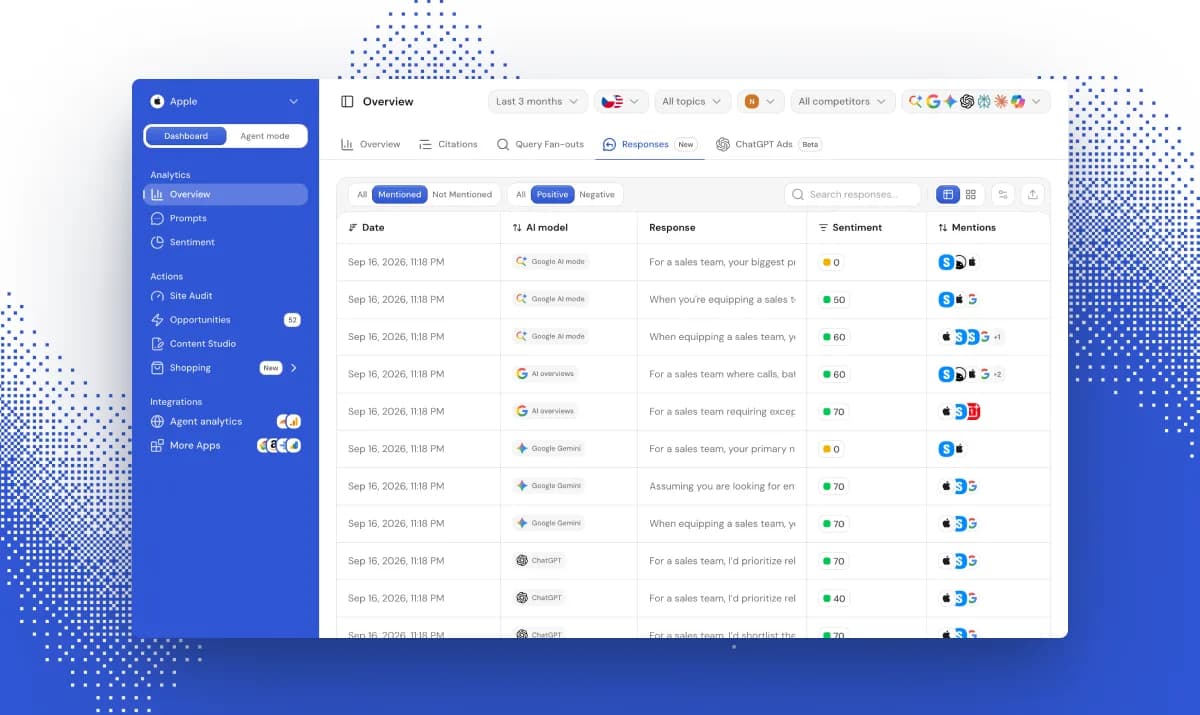
Measurement runs per product. Ranketta tracks which SKUs AI engines recommend, through real browser sessions rather than vendor APIs, with repeated runs of the same prompt. It covers nine engines (ChatGPT, AI Overviews, AI Mode, Gemini, Perplexity, Claude, Copilot, Grok and Amazon Alexa), chosen per plan. Browser sessions are heavier to run. We accept that cost because they return what a shopper sees, not what an API returns (why we run on browser sessions).
Best for: e-commerce teams selling one catalog across Google, Amazon and their own store.
2. AthenaHQ: best when you sell on Shopify and content is the bottleneck
AthenaHQ changes your Shopify product copy and the content you publish.
Its Catalog Optimization imports your Shopify catalog, generates optimized titles, descriptions, metadata and FAQs, and after human approval publishes the changes back into the live Shopify product record (integrations docs). Create & Publish pushes content to eight CMS destinations, including Shopify, Webflow, WordPress, Sanity and Contentful. Shopping Pages generates product listing pages kept in sync with Shopify prices and variants. It also tracks visibility at product, category and brand level. For a content team on Shopify, that is a lot of work taken off the table.
Where it ends: the write-back reaches one channel, Shopify, and Catalog Optimization sits on the Enterprise and Agency plans. What it writes is marketing copy on the product page. Your Google Merchant Center and Amazon feeds stay as they were, and so does every channel that reads them.
AthenaHQ writes the product page. Ranketta fixes the product data every channel reads.
Best for: Shopify-only brands whose bottleneck is producing content.
3. Adobe LLM Optimizer: best if you already run on Adobe
Adobe LLM Optimizer changes product data, on-site content and the version of your pages served at the edge, inside the Adobe stack.
It is one of three tools here that write back into product data. Opportunities can be deployed to an Adobe Commerce catalog and to your content source in one click, with rollback. It flags technical blockers AI agents hit, such as robots.txt rules and 4xx or 5xx errors on pages bots request. Optimize at Edge serves changes at the CDN without touching the origin. Brand Presence tracks ChatGPT, AI Overviews, AI Mode, Copilot, Gemini and Perplexity (Experience League, April 2026). For a team already on Adobe Experience Manager and Adobe Commerce, it plugs into systems you already run.
Where it ends: the write-back targets Adobe systems. If your catalog lives in Shopify, Shoptet or a Merchant Center feed, the product-data layer isn't reachable. Edge automation was still in Early Access when Adobe last updated its docs (28 April 2026).
Best for: enterprise teams already on Adobe Experience Cloud.
4. Profound: best for enterprise brand teams
Profound changes content and product copy, through agents that publish to your CMS.
Its agents produce briefs or fully optimized drafts and publish them to a connected CMS, with a Human Review node that pauses a run for approval. Sheets runs agents across a whole table, and its PDP Optimization template rewrites product titles, descriptions and specs across a product list (Profound blog). Collection runs on the front-end experiences of the chat interfaces, across up to nine engines on Enterprise. Add SOC 2 Type II, SSO and a long CMS integration list, and it fits a large brand team with a procurement process.
Where it ends: the PDP rewrites land back in the sheet for review. Publishing targets connected CMSes, not Google Merchant Center or Amazon. The product copy improves on your site. The feed that shopping engines pull from does not.
Profound writes and publishes the article. Ranketta fixes the product data underneath it.
Best for: Fortune 500 brand teams that need enterprise controls.
5. Scrunch AI: best for controlling what AI bots read on your site
Scrunch AI changes the page AI bots see.
Its Agent Experience Platform (AXP) builds a parallel, AI-ready version of your pages and serves it only to AI retrieval bots, at the CDN edge on Cloudflare, Akamai, Vercel or CloudFront, with version control and approval workflows (scrunch.com). Human visitors see your normal site. Scrunch also tracks individual products in ChatGPT and Copilot shopping answers. If your site is heavy on JavaScript or hard for bots to parse, this is a direct fix.
Where it ends: AXP changes pages, not product data. Shopping tracking picks up products from answers, and catalog import is described as on the roadmap. Nothing reaches your feed.
Scrunch rewrites the page AI bots read. Ranketta fixes the product data every channel reads.
Best for: enterprise sites that want control over what AI bots read.
6. Conductor: best for large enterprise content operations
Conductor changes content.
Writing Assistant generates full drafts. Recommendations, released 21 September 2026, ranks actions from your mentions, citations and sentiment and links them straight into Writing Assistant. AgentStack puts Conductor inside ChatGPT, Claude and Copilot as approved apps, with an MCP server and a Data API. It tracks ChatGPT, AI Overviews, AI Mode, Gemini, Perplexity, Claude, Copilot and Grok, with technical AEO checks for issues like JavaScript-rendered content. For an enterprise running content at scale, the workflow from insight to draft is tight.
Where it ends: Conductor collects through official vendor APIs, by design. That is different data from what a shopper sees in a browser, most of all on shopping surfaces. Product visibility is available as AgentStack templates, not a native per-product view, and nothing writes to product data.
Conductor measures what the model returns through the API. Ranketta measures what the shopper sees in the browser.
Best for: large enterprises with a big content operation.
7. Peec AI: best for agencies that execute the work themselves
Peec AI changes your recommendations: it tells you what to fix, and you do it.
It is strong at that. AI Shopping Analytics shows SKU-level visibility, win rate, position and the merchants whose offers appear. Catalogs come in from Shopify, a CSV or a Google Merchant Center feed. Actions ranks what to do next. Agent actions and the MCP server can create and edit prompts, topics and tracked brands in batches. Agencies get shared credits, client seats and pitch projects.
Where it ends: Peec says in its own docs that it "deliberately does not write or publish content." That is a choice, not a gap they missed. The catalog comes in, nothing goes back out. Someone on your team still writes the fix and gets it into the feed.
Peec can tell you which SKU dropped out. Ranketta writes the fix back into the feed.
Best for: agencies and lean teams that want strong data and do the execution in-house.
8. Otterly AI: best first step on a small budget
Otterly AI changes your to-do list, through an audit.
Its GEO audit shows how engines break your topic into sub-queries (query fan-out) and where you fall short. Agent Analytics tracks which AI crawlers visit your pages, via file upload, Cloudflare or a WordPress plugin, and that data is available through the API and MCP. Unlimited users on every plan and a 7-day free trial make it the lightest way to start.
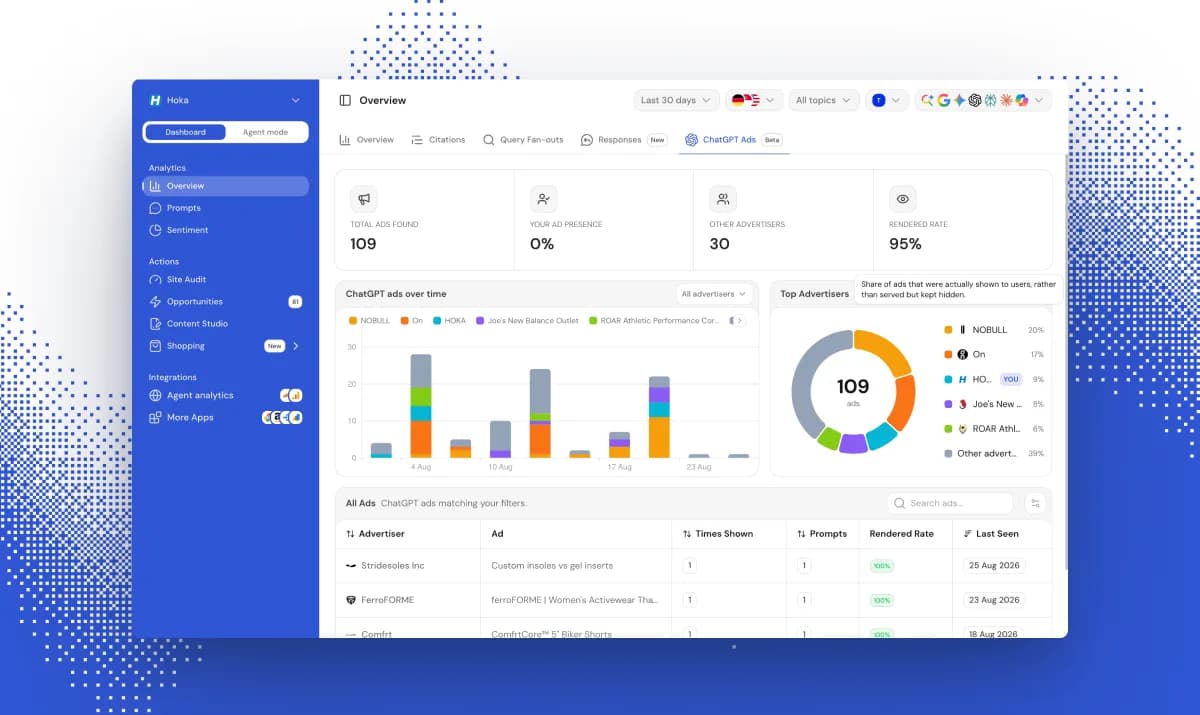
Where it ends: Otterly does not generate content or touch product data. Its ChatGPT Ads reporting has been paused since 16 September 2026, after OpenAI changed how ads display (changelog). Shopping tracking shows where a card appeared, not why a product didn't.
Otterly shows where the card appeared. Ranketta shows why the product didn't.
Best for: teams that want to start measuring before they commit budget.
How to choose an LLM optimization tool
Pick the tool that works on the layer where your bottleneck sits.
You sell one catalog across Google, Amazon and your own store: Ranketta. The fix has to reach the feed, and every channel has to get it.
You sell only on Shopify and content production is the bottleneck: AthenaHQ.
Your whole stack runs on Adobe: Adobe LLM Optimizer.
You're an enterprise brand team publishing through a CMS, with procurement: Profound.
Your problem is how bots read your pages: Scrunch AI.
You just want to start measuring: Otterly AI or Peec AI.
How do you know the optimization worked?
Run the same prompts before and after the change, per product, over many runs. A single AI answer is noise. The same prompt can name different products an hour later.
Three checks make the result trustworthy:
- Same prompts, fixed in advance. Pick them before you change anything, from the questions your buyers actually ask.
- Many runs, not one. Look at the share of runs where the product appears, not a single screenshot.
- The pages behind the answer. Check which pages the models read. If your page or feed still isn't among them, the change hasn't landed yet.
In Ranketta, you see the exact pages the models read in Citations → Pages, and product-level results for every SKU you track. The method is in how Ranketta measures AI visibility. And remember that most AI recommendations never become a click (here's why), so measure the recommendation itself, not only referral traffic.
Try Ranketta for free and see which of your products AI engines recommend today, before you change anything.
When Ranketta is the wrong choice
If you're a B2B or SaaS company with no product catalog, and your bottleneck is producing content, Ranketta's strongest layer does nothing for you. AthenaHQ or Profound will give you more.
For an e-shop, that answer doesn't change. Once most shopping answers come from feeds, the product data is where AI decides, and a fix that stops at one page or one channel leaves the rest of your catalog where it was.