
When an AI assistant skips your store, the cause is almost never one big mistake. It is a title that doesn't say what you sell, a robots.txt that contradicts itself, product data with no GTIN, and category pages with no structured data – small things that add up until a weaker competitor gets cited three times more often than you do. This is what an agency finds when it opens the hood.
TL;DR
- Half of Czech shoppers now use AI when choosing or buying a product. Only a fifth trust what it recommends. That customer is not arriving with trust – they are arriving to verify you.
- Certainty beats price. Free shipping convinces 65% of Czech shoppers at the same price; a 10–20% discount convinces 44.2%. And 52.4% check whether Black Friday discounts are real.
- The first step is diagnosis, not fixing. Ranketta data combined with Search Console, Ahrefs and analytics gives a first diagnosis within days.
- In one audit, a competitor with a weaker domain was cited three times more often in Google AI Overviews. Site speed was not the problem; the homepage title, robots.txt, missing structured data and a collapse in rich product results were.
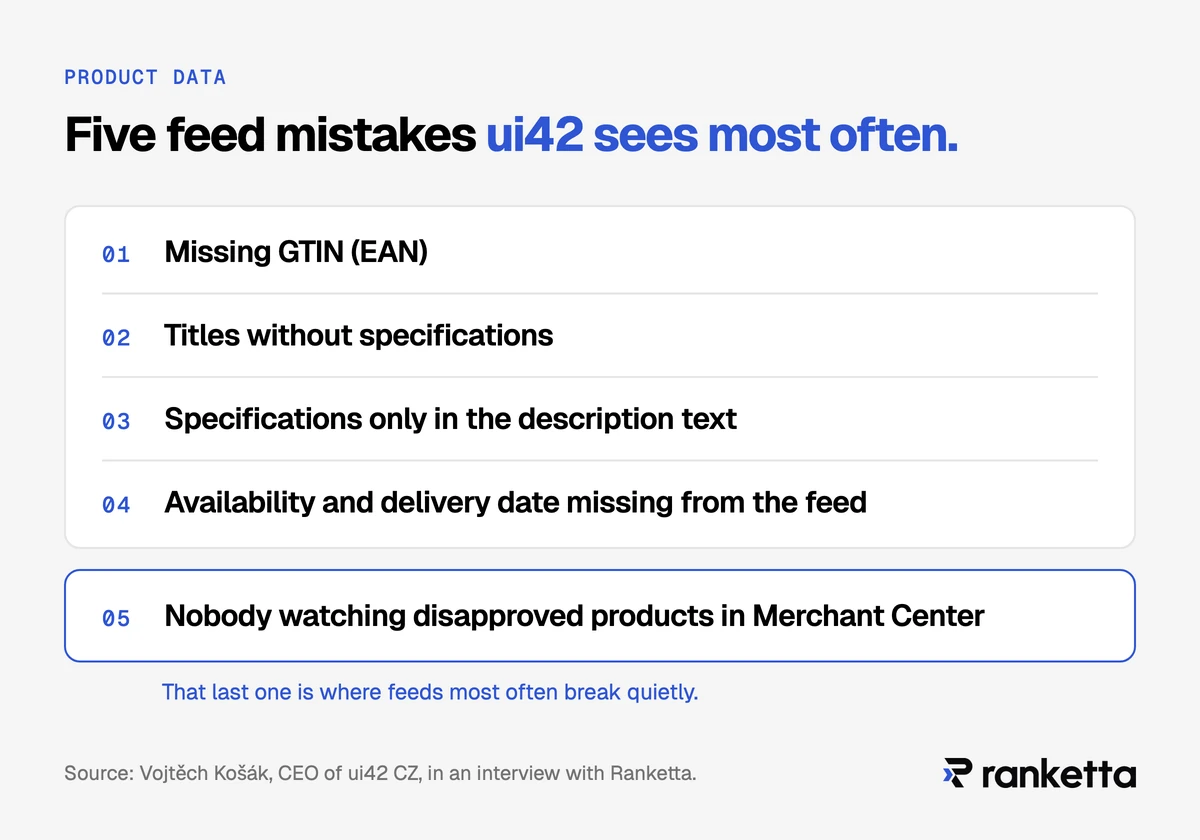
- Product data breaks quietly. Missing GTIN, titles without specifications, specifications buried in description text, and disapproved products nobody watches in Merchant Center.
- Advertising does not replace organic visibility. If AI does not recommend you organically, an ad under an answer that recommends someone else does not build trust.
Half of Czech shoppers use AI when choosing or buying a product. Only a fifth trust what it tells them. That gap is where ecommerce is being won and lost right now – and it is not a gap you close with a better landing page.
We asked Vojtěch Košák, CEO of ui42 CZ, what his team actually does when a client discovers that AI assistants are skipping them. ui42 has been building e-shops and running performance marketing for 29 years, has offices in Prague and Bratislava, is a Shoptet and Shopify partner, and runs its own E-commerce Barometer research with Ipsos.
Ranketta measures AI visibility. ui42 is one of the agencies that fixes what the measurement exposes.
Who ui42 is and what they are strongest at
Ranketta: Tell us about ui42. Who do you work with, and what are you strongest at?
Vojtěch Košák: ui42 is a full-service digital agency. We have been on the market for 29 years, with offices in Prague and Bratislava. We design and build e-shops, websites and mobile apps, we run performance marketing – PPC, SEO & GEO, price comparison sites, email – and we build brands through campaigns, social, video and visual identity.
Our strength is that we build on data and connect creative with performance. The market usually separates those two: one agency makes the nice campaigns, another optimises cost-per-order. At our place, creatives, performance people and GEO specialists sit with developers in one team, over the same data.
The second strength is UX and customer experience, which we work on from the start. Marketing that brings someone to a website or an app that is painful to use, or that converts badly, is money thrown away. So we test our designs on real users.
We work mainly with e-shops and brands selling direct to consumers – BezvaVlasy, Fitmin, Be Lenka, AGEL, Poni Veni – and with large B2B and financial companies. On SEO we have results in numbers: the Terapio platform grew its organic revenue by 376% year on year, and the Vaša Lekáreň e-shop by 217%.
What this year's shopper data actually says
Ranketta: You prepared the E-commerce Barometer 2026 with Ipsos. What surprised you most in this year's data?
Vojtěch Košák: What surprised me most is how little a discount does these days. In September we asked 1,659 people who are planning to buy Christmas gifts this year – 835 in Czechia and 824 in Slovakia. At the same price, free shipping would convince 65% of them; a 10–20% discount only 44.2%. So shaving another slice off your margin is not necessarily the most effective lever.
The second finding is that certainty decides, not price. A pickup point close to home (35.4%) and a guaranteed delivery before Christmas (30.8%) beat both a gift with purchase (17.8%) and a longer return window (8.6%). The delivery date therefore belongs with the product and in the basket, not buried in the terms and conditions.
The third is distrust of discounts. 52.4% of people verify whether Black Friday discounts are genuine, and 20% find Black Friday rather annoying – among 18 to 26 year olds it is 27.1%. More discount emails does not necessarily mean more orders.
The fourth is AI. 52% of people used it when choosing or buying. But AI doesn't read your pretty website. It reads your product data.
In one sentence: this year the winner is not whoever gives the biggest discount, but whoever the customer believes will deliver on time. And anyone launching a campaign only in November is starting second.
E-commerce Barometer 2026, ui42 with Ipsos, September 2026, 1,659 respondents planning Christmas gift purchases (835 Czech, 824 Slovak). Some figures come from the full barometer report rather than the public summary.
Half of shoppers use AI. Only a fifth trust it.
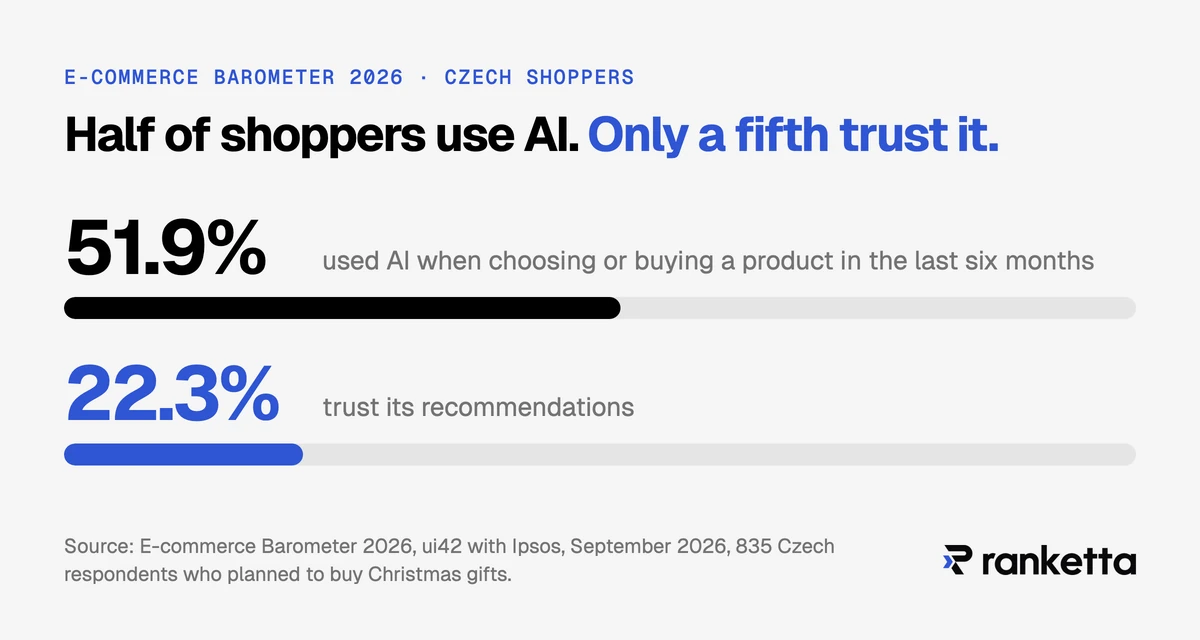
Ranketta: Your own research with Ipsos found that 51.9% of Czech shoppers used AI when choosing or buying a product in the last six months, but only 22.3% trust its recommendations. How does an e-shop earn the trust of a customer who arrived through AI?
Vojtěch Košák: That customer is not arriving with trust. They are arriving to verify you. AI has given them a shortlist and they are looking for a reason to pick you specifically. What decides it is whether they already know you, and whether everyone says the same thing about you.
That is why building the brand and its credibility matters so much right now. Either you become the front door to your category – the site that people and AI treat as the default source – or you find your niche and are clearly the best in it. A broad e-shop that sells "everything" with no clear differentiation is something AI will happily mistake for a marketplace.
In practice it comes down to three things.
Verifiability. Reviews with actual text, not just stars. Ratings on the comparison sites people in your market use. Real answers to real questions. In one audit we found that people were searching "[brand] reviews" right before buying, and the e-shop had no page that answered it.
Consistency. The same price, the same specifications and the same company story on your site, in your feed, on comparison sites, on LinkedIn and in the media. AI cross-checks it.
Certainty instead of discounts. In our barometer, free shipping convinces 65% of Czech shoppers; a 10–20% discount convinces 44.2%. And 52.4% check whether Black Friday discounts are real. A delivery guarantee and clear terms build more trust than a crossed-out price.
What happens when AI skips your store
Ranketta: An e-shop opens Ranketta and sees that AI is skipping it. What do you do first?
Vojtěch Košák: First we find out why. It is usually not one big mistake but several small things adding up. We combine the Ranketta data with Search Console, Ahrefs and analytics. Our AI agent FLUIDUM helps us with that, so we have a first diagnosis within days.
An example from a recent audit. An e-shop with the strongest domain in its segment and a large network of physical stores. In Google AI Overviews, a competitor was being cited three times more often – 46 citations against 15 – despite having a weaker domain and less content. Here is what we found:
- The homepage title did not say what the shop actually sells.
- Robots.txt disallowed filters on one line and allowed them a few lines below, so the index held hundreds of technical URLs, including the basket and newsletter links.
- Categories had good FAQ blocks but no structured data. There was no Organization markup describing the company, and no article authors.
- Rich product results in Google fell from 35,529 impressions to 914 in a quarter.
Site speed, on the other hand, was not a problem – so the developer did not have to waste time on it.
We split the plan by impact and by who makes each change. Half of the quick fixes for the first 30 days can be done by an in-house SEO specialist in the CMS. For the developers we supply an exact specification and finished code. We expect first results in 4–8 weeks, and new landing pages in 2–4 months.
ui42 SEO audit; Google Search Console, Ahrefs and PageSpeed Insights data, Q3 2026 vs Q3 2025. Client anonymised.
Product data that machines can actually read
Ranketta: How should product data and feeds be prepared so that search engines, comparison sites and AI all understand them?
Vojtěch Košák: The basic rule: one source of truth, and every export comes from it. The problem usually does not start in the e-shop. It starts the moment Merchant Center has a different price than the comparison site, and the comparison site has a different price than the website. AI notices, and it will not recommend a product it cannot trust.
From our feed work – we are a Mergado gold partner and a certified Heureka partner – these are the mistakes we see most:
- Missing GTIN (EAN). Without it, neither a search engine nor an AI can match your product to the reviews and comparisons that exist elsewhere on the web. Ranketta sees GTIN missing or wrong in 77% of the e-shops whose catalogues it can read, and we would confirm that.
- Titles without specifications. A good title is brand + model + key specification + variant. "Pro Running Shoe" tells nobody who it is for.
- Specifications only in the description text, not as separate attributes, so machines cannot compare them.
- Availability and delivery date missing from the feed. Our barometer shows a guaranteed Christmas delivery convinces more people than a free gift does.
- Nobody watching disapproved products in Merchant Center. A disapproved product does not appear in ads, and it does not appear in Google's shopping answers either.
That last one is where feeds most often break quietly. So we monitor it automatically through FLUIDUM. A manual check once a month is not enough.
What changes in SEO, and what does not
Ranketta: How is SEO changing as AI search arrives? What still holds, and what do you do differently?
Vojtěch Košák: What is changing is what "being found" means. Content for AI has to be accessible, useful, recognisable with clear signals about the brand, consistent across sources, backed by independent sources, current, and transactional – with a clear price, availability and comparison. Classic SEO mostly dealt with the first two. Today we deal with all of them.
The fundamentals still hold. The site has to be crawlable, every page has to answer a specific question, and you need links from credible sources. Without technical SEO you will not get into AI answers at all, because AI draws heavily on what is well indexed.
You can see it in the data. For one e-shop, the how-to and why articles kept their rankings, but clicks dropped by as much as 72%, because Google answers directly in the results. So we no longer write that kind of content for traffic. We write it to become a source that AI cites. And we point articles at the queries people use when they are deciding to buy.
We measure success in three layers:
- Search Console and organic revenue. Terapio's organic revenue grew 376%, Vaša Lekáreň's 217%.
- Citations and share of AI recommendations, which Ranketta measures.
- Brand search volume. When AI recommends you, people then search for you by name.
The agent that watches the rest of the marketing
Ranketta: You built your own AI agent, FLUIDUM. What does it do, and what does it find in client data?
Vojtěch Košák: FLUIDUM is our AI agent that watches the performance of the website and the campaigns continuously, 24/7. It flags a problem on its own, traces the cause, and for campaigns it can prepare the fix ready for approval. Think of it as an SLA for website performance: not a monthly report in which you discover that something broke three weeks ago, but an alert at the moment it happens.
It connects data that otherwise sits in ten different tools: GA4, Google Ads, Meta Ads, ChatGPT Ads, Search Console, Merchant Center, Heureka, Sklik and Zboží.cz, but also the CMS and the ERP. That way it does not just see that revenue dropped – it sees why.
The most common finding is banal and expensive: advertising a sold-out product. The campaign keeps paying for clicks, the customer lands on an "out of stock" page and leaves. FLUIDUM spots it and stops the ad. Other typical findings are disapproved products in Merchant Center, broken conversion tracking, a lost gclid, or an organic drop on one specific group of queries. FLUIDUM also helps us prepare SEO audits like the one I described earlier.
Ranketta and FLUIDUM complement each other naturally. Ranketta shows what AI assistants say about your products. FLUIDUM shows what is happening in the rest of the marketing and on the website. Together you see the whole customer journey.
ChatGPT Ads is a channel, not a miracle
Ranketta: You have written about ChatGPT Ads. What are your first experiences, and who is the channel for?
Vojtěch Košák: Honestly: it is a channel like any other. There is a lot of hype around ChatGPT Ads right now, and some agencies are selling it as a miracle. The same rules apply as everywhere else – a good landing page, correct product data, conversion measurement. Without those you will pay for clicks that bring nothing.
The interesting part is the targeting. It is not built on a keyword list but on the context of the conversation. The advertiser describes the situations in which their offer is relevant. When someone asks which collagen to take after forty, an ad from a specific e-shop can appear under the answer. That is an intent somewhere between search and product advice. You pay per impression or per click, and there are conversion-optimised campaigns too.
But advertising does not replace organic visibility. If AI does not recommend you organically, an ad sitting underneath an answer that recommends someone else does not build trust.
ui42 internal research, August 2026.
How Ranketta and ui42 work together
Ranketta: How do you work with Ranketta, and who benefits most from the combination?
Vojtěch Košák: Ranketta measures, evaluates and recommends. It shows which answers you are missing from, who is getting ahead of you, and what to fix first and how. We make it actually happen, so it does not end as a report sitting in a drawer because the team has no capacity to work through it. Our added value is mainly in three things.
Creative differentiation. When AI is choosing between ten e-shops with the same assortment and the same manufacturer descriptions, it has no reason to recommend you. Clear positioning, original content, and campaigns that make people remember you and search for you by name are now as important as the technical work.
Fast, expert progress. A complete SEO and link-building strategy, development changes to the site, content aimed at the queries Ranketta surfaces, and work on feeds. We do not push tasks to "the next sprint" – we work in order of impact, so the first movement shows within weeks.
E-E-A-T. For Google and AI to trust you, they need to see real expertise: named authors and subject-matter guarantors, current content, original data, and mentions in media and industry sites. You do not solve that with one technical fix. It is long-term work that we know how to run systematically.
It works as a cycle. Ranketta finds the gaps, we fix them, Ranketta measures the impact, and FLUIDUM watches in the meantime so nothing breaks. As partners of both Shoptet and Shopify, we deploy the changes directly on the platforms Ranketta connects to.
On a new market, AI does not know you, so you are building visibility from zero. An example: the Czech pet food maker Louie moved to Shopify with us and opened Germany and Austria. In October 2025 they had 198% more orders year on year. I no longer consider an expansion like that finished until you know whether ChatGPT recommends you in the new country too.
What this means for your store
Three things carry over from this conversation.
Measure before you fix. Every item on ui42's audit list was invisible from the inside. The shop could see its revenue; it could not see that a competitor was being cited three times more often, or that its rich product results had collapsed by 97%.
Most of the fix is unglamorous. A homepage title. A contradictory robots.txt. A missing GTIN. None of it is a strategy deck, and all of it decides whether a machine can describe your products accurately enough to recommend them.
Visibility and advertising are not substitutes. You can buy a placement under an AI answer. You cannot buy the answer itself.
See how AI sees your store
Ranketta shows you which AI answers your products appear in, who is recommended instead of you, and what to fix first. Run a free AI visibility audit with your domain, or book a 30-minute walkthrough with our team.
Want the fixes implemented rather than listed? Vojtěch and the ui42 team take on exactly that work – you can reach them at ui42.cz.

Vojtěch Košák is CEO of ui42 CZ. ui42 is a full-service digital agency with 29 years on the market, offices in Prague and Bratislava, and partnerships with Shoptet, Shopify, Mergado and Heureka.