


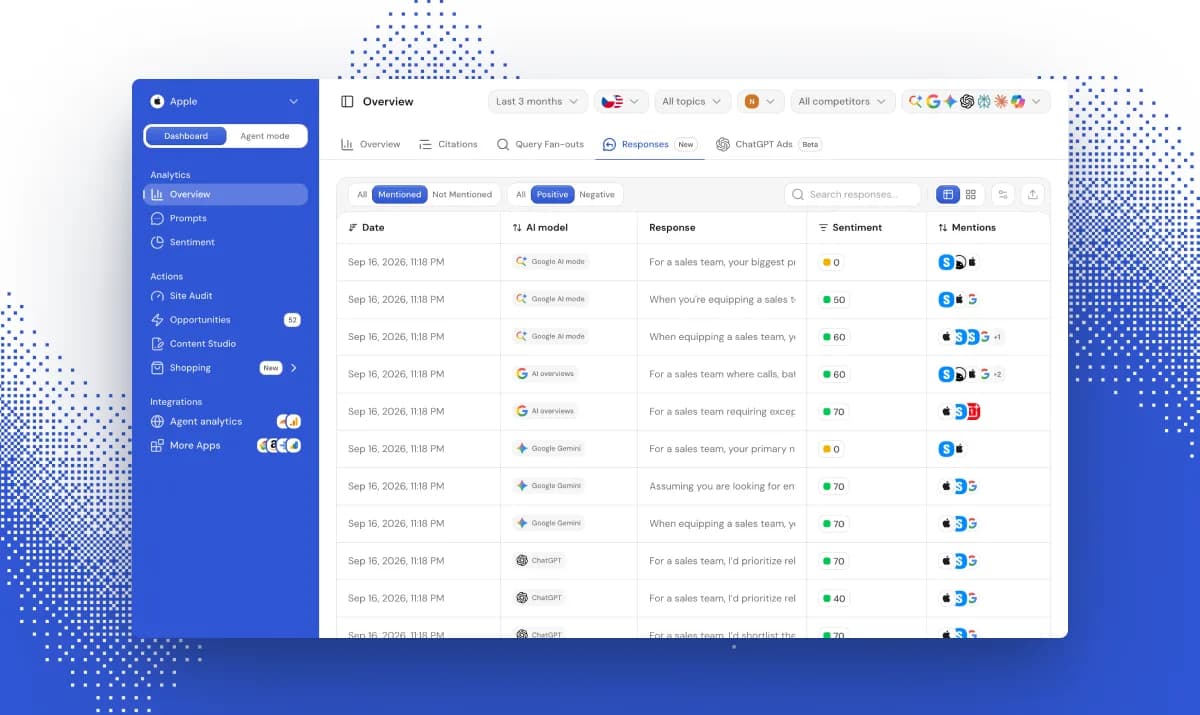
Every AEO tool will sell you a visibility score - almost none of them will tell you where the number came from, and that is the only thing that decides whether you can act on it.
TL;DR
AEO tools measure whether answer engines like ChatGPT, Perplexity, Gemini and Google AI Overviews mention, cite and recommend you - and the better ones show which of your pages the engine actually read to get there.
The real difference between them is how they collect the data. Semrush states its data is "captured from real requests and not via any APIs of LLMs". Conductor documents the opposite and defends an API-first approach. Peec documents UI scraping. Several vendors document nothing at all.
Collection method changes the answer, not just the confidence interval. An official API returns what the model returns; a browser session returns what a shopper sees, including shopping modules and ad placements that the API never shows.
Product-level tracking is now common; product-level fixing is not. Peec, AthenaHQ, Profound and Ranketta all report at SKU level. Of the eleven tools compared here, only AthenaHQ and Ranketta write corrected product data back into a live channel, and only Ranketta exports a corrected feed beyond Shopify.
Run frequency is the quietest trap. Peec, Profound and Conductor document one run per prompt per model per day. Model outputs vary between runs, so a single daily pass produces a number that moves on its own.
Start free before you buy. HubSpot's AI Search Grader gives a one-off brand snapshot across three engines with no account, which is enough to find out whether you have a problem worth paying to track.
What is an AEO tool?
An AEO tool measures how answer engines - ChatGPT, Perplexity, Gemini, Google AI Overviews and AI Mode, Copilot, Claude - describe, cite and recommend a brand or product, by running a fixed set of buying questions repeatedly and recording what comes back. The output is an appearance rate across many runs, the competitors that appeared instead of you, and the pages the engine read to reach its answer.
AEO stands for answer engine optimization. The category has three other names in circulation - generative engine optimization (GEO), LLM optimization, AI search optimization - and the tools behind all four labels do substantially the same job. Choose the label your team already uses and stop worrying about it; the vendors have not agreed either.
What separates an AEO tool from a rank tracker is what it has to observe. There is no results page to scrape and no position 1 to hold. There is a paragraph of generated text that differs between runs, between engines, and between countries, and the tool's entire value is in turning that into a number you can trust twice in a row.
AEO vs SEO: what actually changes
AEO and SEO differ in three places - what you measure, how a page gets selected, and what you change to improve it - and the third one is where most teams lose time. Everything you know about crawlability and clean markup still applies. What stops applying is the assumption that a ranking position predicts whether you get the business.
What you measure
SEO measures positions and sessions: where you rank, how many people clicked, what they did next. AEO measures appearance rate - the share of relevant answers in which you are named - plus share of voice against competitors, and which URL the engine cited. There is often no session attached to any of it, because the answer resolves the question without a click.
How a page gets selected
A search engine matches a query to an index and orders results. An answer engine expands the question into several keyword-shaped sub-queries - query fan-out - retrieves against those, and composes an answer from the passages it pulled. So the page that gets cited is the one that matches the sub-query the engine actually ran, which is frequently not the sentence the person typed.
What you optimise
In SEO you optimise a page for a query. In AEO you optimise a passage for extraction: a self-contained answer near the top of a section, with the entity named in the first sentence, so the passage survives being lifted out of its page. For a store, the same logic reaches the product feed, because attributes are what an agent compares. Our guide to structuring product data for AI search covers that side field by field.
What do AEO tools actually measure?
Every AEO dashboard reports some combination of five numbers - appearance rate, share of voice, citations, sentiment and position in the answer - and they are not equally useful. Knowing which one a vendor leads with tells you what the tool is really built for, and knowing which one you will act on tells you which vendor to buy.
Appearance rate
The share of tracked prompts in which you are named, across repeated runs. This is the number that behaves most like a ranking: it moves slowly, it is comparable week to week, and it survives the variance in individual answers. If a tool reports only "mentions" without a denominator, you cannot tell a rising brand from a growing prompt set.
Share of voice
Your appearances as a proportion of all brands named in the same answers. It is the only metric that tells you whether you are losing ground or the whole category is being named more often. Read it alongside appearance rate - a flat appearance rate with falling share of voice means competitors are being added to answers you already appear in.
Citations
The URLs the engine actually read to compose its answer. This is the most actionable field any AEO tool produces, because it points at the specific page doing the work - or the competitor's page doing it instead. Some tools separate cited from found but not cited, which is a meaningful distinction: being retrieved and being credited are not the same event. We go deeper on this in our comparison of AI citation tracking tools.
Sentiment
How the model describes you when it names you - positive, neutral, negative, and on some tools a breakdown by attribute. Useful for brand and PR teams, close to useless for a store trying to get a SKU onto a shortlist, because an agent that likes your brand can still recommend three competitor products.
Position in the answer
Where you land inside a generated list or carousel. It matters most on shopping surfaces, where the first two products carry the clicks, and least in a prose answer where order is closer to arbitrary. Treat it as a signal on shopping modules and ignore it elsewhere.
How we compared these 11 tools
We compared the tools on four things a buyer can verify in vendor documentation: how the data is collected, whether tracking reaches product level, how often each prompt runs, and whether the tool does anything beyond reporting. Feature counts and engine logos were deliberately left out - every vendor in this category has a long list and the lists are converging.
Collection method is first because it determines what the other three numbers mean. API-collected data reflects what a model returns to a developer. Browser-collected data reflects what a person sees in the product, including shopping modules, ad slots and personalisation that do not exist on the API surface.
How we verified this. Every claim below comes from the vendor's own documentation, changelog or help centre, checked on 16 September 2026. This category ships weekly, so treat any specific claim as dated and re-check before you buy. We have not included competitor pricing, because it changes faster than we can publish.
Why we weight collection method so heavily is set out in our measurement methodology, which documents how we run and cross-validate prompts. Hold every vendor on this list - including us - to the same standard of disclosure.
Disclosure. Ranketta is our own product and appears first. We have written the entry the same way as the others - what it does, and where it stops - and every competitor's genuine strength is stated before any contrast.
The 11 AEO tools at a glance
| Tool | Collection method | Product / SKU level | Beyond reporting | Best for |
|---|---|---|---|---|
| Ranketta | Browser sessions, repeated runs | Yes | Feed enrichment + export to channels | E-commerce catalogs |
| Peec AI | UI scraping (documented); API for extra models | Yes | Scored recommendations only | Agencies, smaller teams |
| Profound | Consumer panels + platform data | ChatGPT only, Enterprise | Publishes content to CMS | Enterprise brand teams |
| AthenaHQ | Not documented | Yes | Publishes product copy to Shopify | Content-bottlenecked teams |
| Ahrefs Brand Radar | Public web interfaces; Claude via API | No | No | SEO teams inside Ahrefs |
| Semrush AI Visibility | Real requests, explicitly not LLM APIs | No | No | Existing Semrush customers |
| Conductor | Official vendor APIs (documented) | Agent templates, not a dashboard | Writing Assistant drafts | Enterprise content ops |
| Otterly AI | Not documented | Ad and shopping cards only | No | Budget monitoring |
| HubSpot AI Search Grader | Not documented | No | No | A free first check |
| Rankscale | Not documented | No | Technical audit checkpoints | Engine breadth on one plan |
| Scrunch AI | Not documented | Partial | Generates an AI-agent site layer | Crawler and bot analytics |
1. Ranketta - best for product-level AEO in e-commerce
Ranketta tracks how AI answers recommend individual products across ChatGPT, AI Overviews, AI Mode, Perplexity, Gemini, Claude, Copilot and Grok, and then rewrites the product data holding them back.
How it collects. Browser sessions rather than vendor APIs, so the data includes shopping modules and surfaces with no public API, and prompts are run repeatedly and cross-validated rather than sampled once. Metrics are percentages over many runs, which is what makes a trend readable instead of noisy.
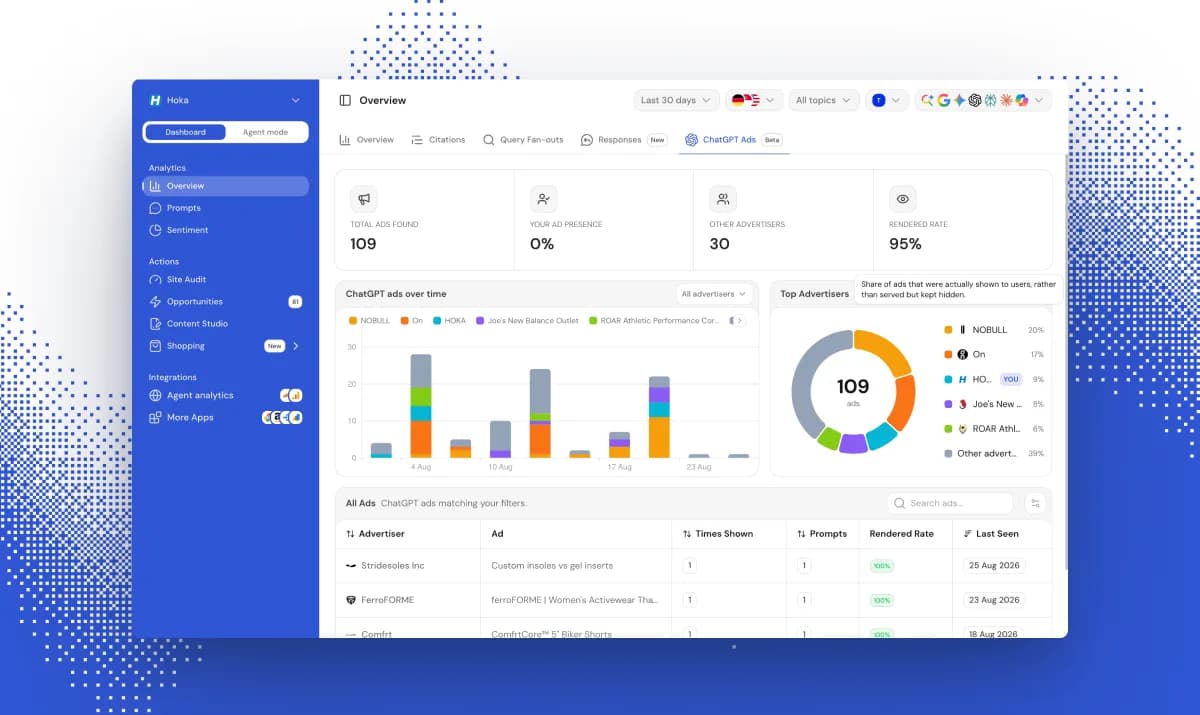
What it does beyond reporting. A product data enrichment agent rewrites titles, descriptions, GTINs and attributes with a confidence score on every proposed fix, which you approve or auto-approve. Corrected feeds export to Amazon, Google Merchant Center, Heureka and Zboží.cz, with native Shopify and Shoptet integrations. A ChatGPT Ads tab (beta since 31 August 2026) sits on the same dataset, so paid placements in your category appear next to your organic visibility.
Where it stops. It is built around a product catalog. If you have no catalog - a services business, a media site, pure B2B SaaS - the enrichment layer is dead weight and a brand-level tracker will cost you less and serve you as well.
Best for: e-commerce and D2C brands with their own GTINs running Merchant Center or marketplace feeds.
2. Peec AI - best for agencies and smaller teams
Peec's AI Shopping Analytics is the strongest SKU-level reporting in the category outside our own: win rate, position, appearances, co-featured products, catalog-versus-mentioned price, and a merchant view showing which sellers' offers appear and who wins the buy box.
How it collects. UI scraping of the chat interfaces for the core engines, documented openly - which is more than most of this list does. The extra Enterprise models (Claude, GPT-5 Search, DeepSeek, Qwen, Mistral) run via API.
What it does beyond reporting. Not much by design. Peec ingests your catalog from Shopify, CSV or a Google Merchant Center feed and matches it against the last 30 days of chats, then hands you scored recommendations. Peec states plainly that the user keeps execution. The product API is catalog CRUD in one direction; nothing is written back to the source feed.
Where it stops. One run per prompt per model per day, per its own credit formula - larger agency plans can drop to weekly. Three of six models on Starter, Pro and Advanced. No GA or GSC integration, and its own G2 reviewers name the missing page-level optimization and content workflow. GTIN is not a documented required field; title and brand are.
Best for: agencies and smaller in-house teams who need to know whether AI mentions them and will do the fixing themselves. If you are choosing between Peec and the enterprise options, our Profound alternatives comparison goes deeper on that bracket.
3. Profound - best for enterprise brand teams
Profound has the deepest enterprise stack in the category: SOC 2 Type II, SSO, SCIM, activity logs, Fortune 500 clients, Domain Segments for sub-brands, a Citation Decay metric, and proprietary prompt-volume data from consumer panels across 35 countries.
How it collects. Consumer panel data for prompt volume, alongside platform-collected answer data. The panel layer is genuinely differentiated - it is an estimate of what people actually ask, not an extrapolation from keyword volume.
What it does beyond reporting. A great deal. Aim is a background agent that builds and runs sub-agents from human-approved plans, with a Human Review node that pauses a run for approval. The content-optimization agent produces either structured briefs or fully optimised drafts published directly into a connected CMS. The integration directory covers CDN and log sources and eight or more CMS platforms.
Where it stops. Shopping is ChatGPT only and Enterprise only, as are the API and multi-company. Shopping diagnoses feed-field and structured-data problems and gives guidance, but there is no enrichment and no feed export. The content agent runs on a credit pool, and whether a Starter allowance covers a real publishing workflow is not documented.
Best for: Fortune 500 brand teams with a procurement process and a content operation to feed.
4. AthenaHQ - best when content production is the bottleneck
AthenaHQ is the closest competitor to Ranketta in the execution layer. It monitors at product, category and brand level, with a Shopping Insights view showing per-product appearances, rating, retailer and average carousel position across 185 markets with city-level targeting.
How it collects. Not documented anywhere. For a tool sold on accuracy, that is a fair question to put to a sales rep before signing.
What it does beyond reporting. Publishes directly to Shopify, Webflow, Wix, Framer, WordPress, Payload, Contentful and Sanity. The Shopify integration imports the product catalog, generates optimised titles, descriptions, metadata and FAQs, and - per its own documentation - publishes approved product changes back into the live Shopify record after human review. Shopping Pages generates product listing page templates across the catalog, kept in sync with Shopify prices and variants, launched behind experiments to measure lift.
Where it stops. The product work is generated marketing copy on one channel. There is no Google Merchant Center, Amazon or Heureka export, no GTIN-level matching and no confidence scoring - so it improves the Shopify product page, not the feed every other channel reads. There is no changelog page; updates ship as monthly blog posts.
Best for: teams whose bottleneck is producing content, not deciding what to produce.
5. Ahrefs Brand Radar - best for SEO teams already in Ahrefs
Brand Radar has the best citation mechanics on this list. It separates cited from found but not cited, reports impressions and share of voice excluding uncited mentions, and adds Bot Visits and AI Traffic columns per cited page - so you can see which pages the crawlers read and which of them actually sent you a human.
How it collects. Prompts run through the public web interfaces of ChatGPT, Gemini, Perplexity and Copilot. Claude runs via API, for custom prompts only. Prompt sets are built from the Ahrefs keyword database plus People Also Ask and fan-out expansion, which is a genuine advantage if you trust that database already.
What it does beyond reporting. Nothing inside Brand Radar. Execution lives in other Ahrefs products.
Where it stops. No product or SKU layer at all, so for a catalog business this is a brand tool only. No agency mode. Paid Ahrefs plans include a small daily prompt allowance, with custom prompts and full engine indexes as paid add-ons on top. Grok collection is paused per the Ahrefs help documentation.
Best for: SEO teams who already live in Ahrefs and want AI visibility in the same tab as everything else.
6. Semrush AI Visibility Toolkit - best if you already pay for Semrush
Semrush publishes the most transparent collection description of any vendor here. Its data is "captured from real requests and not via any APIs of LLMs", with clickstream-derived prompt data across 117 regional databases. When every other vendor is vague, that sentence is worth something.
How it collects. Real requests and clickstream, explicitly not LLM APIs, as quoted above.
What it does beyond reporting. Visibility overview, competitor research, prompt research, weekly brand performance, daily prompt tracking, an AI search site audit and white-label reporting. There is an official Semrush MCP connector for Claude, ChatGPT and Gemini - but note that AI Visibility Toolkit data is not exposed through it, per Semrush's own blog.
Where it stops. No product or SKU module; the e-commerce page promises only that you will see how your brand and products are described. Its knowledge base lists ChatGPT, Gemini, Google AI Overviews and AI Mode, with Prompt Tracking covering AI Mode, AI Overviews, Gemini and ChatGPT Search - Claude, Copilot and Grok are not documented as tracked. No CDN log ingestion, and no agency mode for the AI toolkit specifically. It is also a separate subscription from the main Semrush plan.
Best for: teams already paying for Semrush who want one more tab rather than one more vendor.
7. Conductor - best for large enterprise content operations
Conductor is the most engineering-forward option: AgentStack with native LLM apps, an MCP server, Data, Content and Monitoring APIs, turnkey agents, citations at subfolder level, and nine engines across 160+ countries with city-level tracking on most.
How it collects. Through official vendor APIs - documented, and defended as "API-first" against scraping. This is a real philosophical split in the category and it is worth understanding rather than dismissing. API data is stable, permissioned and reproducible. It is also not what a shopper sees, which matters most on exactly the shopping surfaces where a purchase gets decided.
What it does beyond reporting. A Writing Assistant generates full drafts. Fan-out query visibility is exposed in the MCP. SOC 2, ISO 27001 and ISO 42001 for procurement.
Where it stops. Shopping visibility exists as AgentStack agent templates - "Check Product Visibility in AI Shopping" and "Surface Unmet AI Shopping Demand" - delivered as an agent output rather than a persistent per-product tracking table. No feed export, no enrichment, no confidence scoring. Tracking cadence is daily, weekly or monthly per topic, not continuous. Aimed at enterprise, not agencies.
Best for: enterprises with a large content operation and an engineering team that will use the APIs.
8. Otterly AI - best lightweight monitoring
Otterly is the lightest way to find out whether AI mentions you, and it does one thing better than tools several times its size: it tracks ChatGPT Ads and Shopping Cards - advertiser, destination, ad copy, products, prices and retailers surfaced - on every plan, not as an enterprise upsell.
How it collects. Not documented.
What it does beyond reporting. Agent Analytics tracks AI crawlers from your logs via upload, webhook, Cloudflare or a WordPress plugin. There is an MCP server with prompt and tag management, a Looker Studio connector, query fan-out inside the GEO audit, 65+ countries, unlimited users on all plans, agency workspaces and CSV export.
Where it stops. Shopping here means tracking where a card or an ad appeared, not working with a catalog. Three of seven engines - Claude, AI Mode and Gemini - are paid add-ons on every tier; ChatGPT, AI Overviews, Perplexity and Copilot are included. No content generation.
Best for: budget-constrained monitoring, and anyone who wants ad placements visible without an enterprise contract. If the paid surface is the part you are trying to understand, we cover it separately in ChatGPT Ads Explained.
9. HubSpot AI Search Grader - best free first check
The AI Search Grader is a free one-off snapshot of how ChatGPT, Perplexity and Gemini describe your brand. No account is required and results come back in under two minutes, which makes it the cheapest way to find out whether you have a problem worth paying to solve.
How it collects. Not documented. It analyses how the three models describe your brand and returns a score.
What it measures. Five weighted dimensions: Sentiment Results (40 points), Presence Quality (20), Brand Recognition (20), Share of Voice (10) and Market Competition (10).
Where it stops. It is a one-time check, not tracking - and since model outputs vary between runs, a single snapshot is an anecdote rather than a measurement. It is brand-only, with no product or SKU layer, and covers three engines. Continuous monitoring requires HubSpot's paid AEO product.
Best for: the first fifteen minutes of a serious AEO evaluation. Run it, screenshot the result, then go and buy something that runs the same questions repeatedly.
10. Rankscale - best engine breadth without tier gating
Rankscale's positioning is a direct shot at how the rest of this list prices: "One Rank Tracker for Every AI Engine - No Upsell". All 17+ engines - ChatGPT, Perplexity, Gemini, AI Mode, AI Overviews, Claude, DeepSeek, Mistral, Grok, Copilot and more - are included on all plans, across 240+ countries and all languages.
How it collects. Not documented on the site.
What it does beyond reporting. A technical audit runs 94+ checkpoints on the structural and authority signals engines use to verify and cite content, alongside citation analysis and intent-based prompt research.
Where it stops. Brand and topic-level monitoring, not individual SKUs - so a catalog business will hit the same wall as with Ahrefs or Semrush. Pricing is credit-based with in-app top-ups, which is worth modelling before you commit if you plan to track many prompts across all 17 engines.
Best for: teams who want the widest engine coverage on one plan and are not tracking products.
11. Scrunch AI - best for the crawler and agent-experience side
Scrunch approaches the problem from the infrastructure end rather than the reporting end. Alongside tracking across ChatGPT, Perplexity, Claude, Gemini and Copilot, its Agent Experience Platform creates a parallel, lightweight version of your site translated for AI agents.
How it collects. Not documented.
What it does beyond reporting. A real-time bot feed with crawl health and error detection shows how AI bots move through your site - the crawler half of the picture that most trackers ignore. Its optimisation guidance reaches product specs, pricing and product claims, so it is not purely brand-level. Enterprise controls include SOC 2, RBAC and a Data API, and the site cites 500+ companies and agencies.
Where it stops. The brand-versus-product boundary is not clearly drawn in the documentation, and there is no catalog ingestion or feed export. Generating a parallel site for agents is an architectural commitment, not a dashboard you can cancel quietly.
Best for: teams whose AEO problem is being crawled and parsed correctly, rather than being described correctly.
How to choose the right AEO tool
Choose on the shape of your business, not the length of the feature list. Every tool here will show you a visibility score. What differs is whether the score is measured the way your buyers actually see the answer, and whether anything happens after the dashboard.
If you sell products from your own catalog
Brand-level tracking will mislead you. An assistant can praise your brand in one breath and shortlist three competitor SKUs in the next, and a brand tracker records that as a win. You need SKU-level reporting - Ranketta, Peec, AthenaHQ, or Profound on Enterprise - and you need to decide whether you also want the fixing layer or will do the feed work yourself.
If you manage multiple clients
Check the agency mechanics before the engine count: shared credit pools, client seats, white-label reporting and per-client workspaces. Peec and Otterly are built for this; Conductor and Profound are not. We go deeper on that bracket in our AI visibility platforms for agencies comparison.
If you already pay for an SEO suite
Start with the add-on you already own. Ahrefs Brand Radar and the Semrush AI Visibility Toolkit are both genuinely useful, both are brand-level only, and both cost less in switching pain than a new vendor. Move only when the missing product layer starts costing you specific decisions.
If you only need to know whether AI mentions you
Run HubSpot's free grader first, then pick the cheapest continuous option that covers the engines your customers actually use. Do not pay for seventeen engines when your buyers use two.
If you need enterprise procurement
The shortlist is short: Profound and Conductor both carry the certifications, SSO and audit trails that a security review will ask for. Everyone else will slow the process down.
What to test during a trial, before you buy
Run the same four checks on every tool on your shortlist, with your own brand and your own buying questions. Vendor demos use prompts chosen to look good. Fifteen minutes of your own prompts will separate the tools faster than any feature table, including this one.
Ask the same prompt twice on the same day
Then compare the two answers. If the tool shows one result per prompt per day, you are looking at a single sample presented as a measurement, and any week-on-week movement you see later may be variance rather than progress. Ask the vendor directly how many runs sit behind a reported number.
Check a prompt where you know the real answer
Pick a buying question in your category where you already know who gets recommended, because you have asked ChatGPT yourself. If the tool's answer does not match what you see in the app, the collection method is showing you a different surface - which is the whole argument for asking how the data is gathered.
Look for your products, not your brand
Search the dashboard for one of your own SKUs. If the tool can only tell you that your brand was mentioned, it cannot tell you whether the item you actually sell was on the shortlist. For a catalog business that gap is the difference between a report and a decision.
Export something
Ask for a CSV, an API call or a Looker Studio connection on the plan you are actually going to buy - not the enterprise tier. Several tools in this category gate the API and the MCP server behind the top plan, and a number you cannot get out of the dashboard will not reach the people who act on it.
What AEO tools still cannot do
No tool on this list can tell you why a specific answer chose a competitor over you. They are getting good at measuring the outcome and still weak at explaining it, and vendors are not always careful about that line.
Visibility scores are not comparable between tools
Two tools running the same prompt set on the same brand in the same week will disagree, because they ask different questions, run them a different number of times, and collect from different surfaces. A score is only meaningful against itself over time. Never benchmark one vendor's number against another's.
Citations tell you what was read, not why it won
The cited URL is the most actionable field any of these tools produce - it tells you which page did the work. What it does not tell you is why the model ranked one product above another, because that judgement happens inside the model and no vendor has visibility into it.
The traffic will not show up in your analytics
When an answer resolves the question, there is no session. Clicks that do happen often lose their referrer leaving the assistants' mobile apps and land in Direct. Judging AEO by traffic reports will tell you nothing is happening while it happens - we put numbers on that gap in Most AI Recommendations Never Become a Click.
See which products AI recommends - yours or a competitor's
Ranketta tracks how often ChatGPT and other AI assistants recommend your brand and your individual products, across repeated runs, with the citations that produced each answer - then rewrites the product data holding them back and ships it to the channels you already sell on.
Get a free AI visibility report · Book a demo · Try for free
FAQs
Sources
All vendor claims checked 16 September 2026
- HubSpot, AI Search Grader
- Rankscale, product site
- Scrunch AI, product site
Vendor documentation and changelogs
- Peec AI, changelog and API changelog
- Profound, product changelog
- AthenaHQ, integrations documentation (Action Center > Catalog Optimization) and monthly feature posts on athenahq.ai/blog
- Ahrefs, Brand Radar help centre (Grok collection paused) and ahrefs.com/blog/new-features
- Semrush, semrush.com/news and semrush.com/blog (collection methodology and MCP scope)
- Conductor, AgentStack template gallery and conductor.com/docs/platform/release-notes
- Otterly AI, changelog