




Agentic checkout is when an AI assistant completes a purchase for the shopper, using their saved payment and shipping details, without the shopper going through your checkout pages. It is live or rolling out in Google's AI Mode and Gemini (for select merchants), Microsoft Copilot, Perplexity, Amazon's Buy for Me and agents that pay with Shop Pay. In every program that states it, your store stays the merchant of record and handles returns. What differs is how much customer data you get. OpenAI and Amazon say there are no fees; as of 25 November 2026, the others don't publish one.
TL;DR
- You still own the sale. Google, Microsoft and PayPal (for Perplexity) all say the store stays the merchant of record.
- Returns stay with you too. Amazon, Shop and Perplexity all point shoppers back to the store for returns, refunds and support.
- Customer data is the real difference. Amazon's Buy for Me passes name and address, Shop Pay agents pass name, contact details and address, and Google doesn't say what it passes.
- Fees are mostly unpublished. OpenAI says there are no fees on purchases that start in ChatGPT, and Amazon says there are no fees to participate in Shop Direct. As of 25 November 2026, we could not establish a published merchant fee for the others.
- Most of it is US-only. If you sell in Europe, check each program's markets before you plan around it.
What is agentic checkout?
Agentic checkout is the purchase step done by an AI agent. The shopper says what they want, the assistant finds the product, and then the assistant, not the shopper, submits the order. It uses payment and shipping details the shopper has already saved with the assistant or a wallet such as Google Pay, PayPal, Shop Pay or Stripe's Link.
Agentic checkout vs traditional checkout
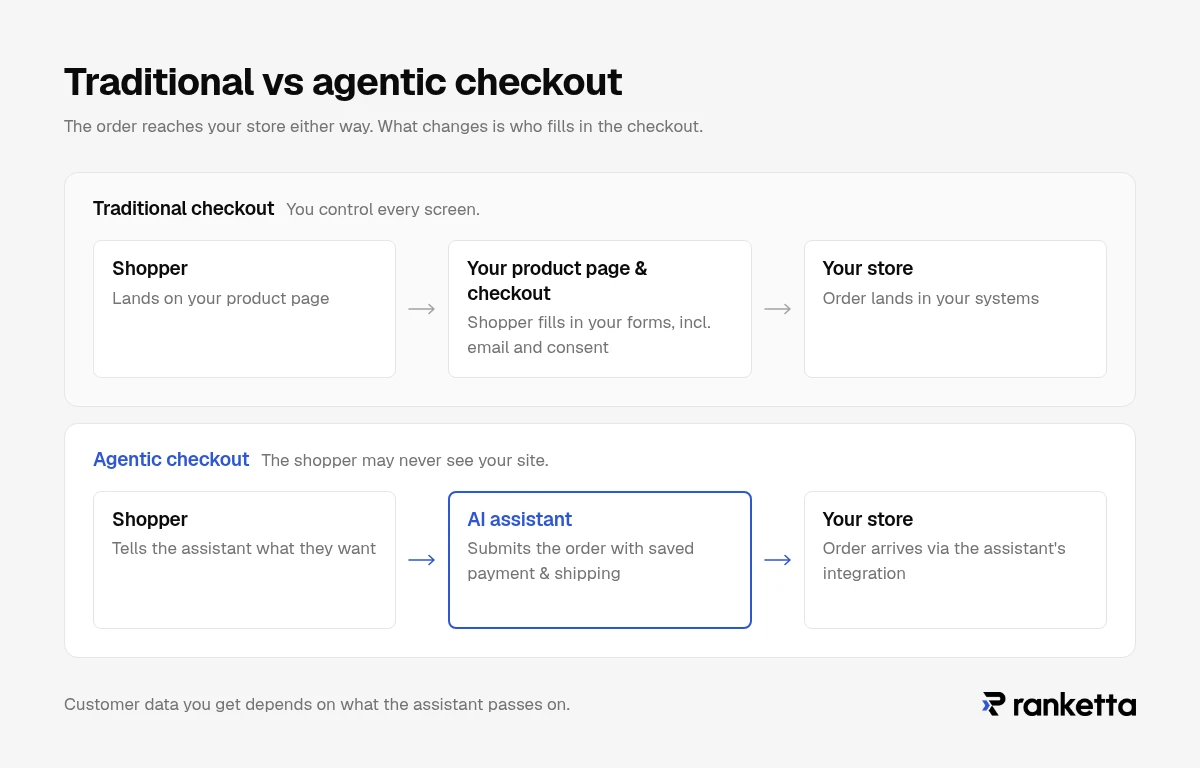
In a traditional checkout, the shopper lands on your product page, adds to cart and fills in your checkout form. You control every screen, and you collect whatever the form asks for, including an email address and marketing consent.
In an agentic checkout, the assistant replaces those screens. The order still reaches your store, but through the assistant's integration or protocol, such as Google's Universal Commerce Protocol (UCP). The shopper may never see your site, so anything you used to collect on your checkout pages depends on what the assistant passes on.
Agentic checkout vs agentic commerce
Agentic commerce is the whole journey: discovery, comparison and purchase by AI agents. Agentic checkout is the last step of it. We cover the wider picture in what is agentic commerce, and how the money moves in agentic payments.
Where agentic checkout is live today
These are the programs a store can be part of today, as each company describes them.
- Google AI Mode and Gemini. Google is adding a checkout button to eligible listings through UCP, "for select merchants at this time." Google first launched agentic checkout in AI Mode in the US in November 2025, which it says is "built on Google's Shopping Graph and payments infrastructure." Checkout covers products eligible in the US, Canada and Australia.
- Microsoft Copilot Checkout. Shoppers buy inside Copilot. It is open to "English-language merchants who sell to US buyers", through Microsoft Merchant Center and a UCP-compliant feed. Shopify merchants have been enrolled automatically.
- Perplexity Instant Buy. US shoppers buy on Perplexity, and "your order and payment are securely sent directly to the merchant." PayPal merchants can join through store sync.
- Amazon Buy for Me. For eligible products, Amazon buys from the brand's own site "using the customer's encrypted payment and shipping information." Stores get in through Shop Direct product feeds. Shop Direct is available for all U.S. customers, and Amazon says "there are no fees to participate."
- Agents that pay with Shop Pay. Shop's help center lists personal agents, including Muse, Instinct, Claude Duet and Grok Bot, that can check out with Shop Pay. Claude Duet, a research preview in the US, "pays with a virtual card."
ChatGPT is a special case. OpenAI is moving away from a standalone Instant Checkout. In its words: "Customers complete their purchase on your site or app." The AI finds the product, but your own checkout takes the order, so strictly it is no longer agentic checkout. For the full map of assistants, see AI shopping assistants.
Who owns the customer: assistant by assistant
We checked four questions on each company's own pages on 25 November 2026: what you pay, who is the merchant of record, who handles returns, and what customer data reaches you. "Not stated" means the company's page does not say.
| Program | Fee to the store | Merchant of record | Returns and support | Customer data you get |
|---|---|---|---|---|
| Google AI Mode and Gemini (UCP checkout) | Not stated | You: "You will remain the seller of record" | Not stated | Not stated |
| Microsoft Copilot Checkout | Not stated | You: "Copilot does not become merchant of record" | You set the return policy and customer support | "The customer relationship, the data" (fields not listed) |
| Perplexity Instant Buy | Not stated | You: PayPal says the retailer stays "the merchant of record" | You: Perplexity sends shoppers to the store | The order, with the shopper's saved checkout details |
| Amazon Buy for Me | None: "There are no fees to participate in Shop Direct" | Not stated | You: the brand "manages product delivery, returns, exchanges, and customer service" | Name and address |
| Shop Pay agents (Muse, Instinct, Claude Duet, Grok Bot) | Not stated | Not stated | You: the store handles "returns, refunds, warranties, and product support" | Name, contact information, shipping address and items |
| ChatGPT (purchase on your site) | None: "There are no fees on purchases that start in ChatGPT" | Your normal checkout | Your normal policy | Whatever your checkout collects |
Do you pay a fee?
OpenAI and Amazon both publish their fee, and it is zero. OpenAI: "There are no fees on purchases that start in ChatGPT." Amazon: "There are no fees to participate in Shop Direct, and merchants can opt out at any time." As of 25 November 2026, we could not establish a published merchant fee for Google's UCP checkout, Copilot Checkout, Perplexity Instant Buy or Shop Pay agents. Your usual payment processing costs are a separate line, set by your payment provider. Ask each program for its terms before you sign up.
Who is the merchant of record?
The merchant of record is the business legally responsible for the sale. It takes the payment, issues the receipt, pays sales tax and answers for refunds and chargebacks.
Three programs state it plainly, and all three leave it with you. Google says "you will remain the seller of record." Microsoft says "you are the merchant of record. Copilot does not become merchant of record," and Copilot uses your existing payments, fraud, tax and fulfillment systems. PayPal says Instant Buy "keeps the retailer in control as the merchant of record," and retailers are paid directly.
Amazon's Buy for Me and Shop Pay agents don't use the term, but in both the order is placed on your own store. Shop's help center adds that "Shop might pay the online store on your behalf," so the payment can come from Shop rather than from the shopper's own card.
Who handles returns and refunds?
You do, wherever the company says. Amazon says the brand "manages product delivery, returns, exchanges, and customer service." Shop says the store "remains responsible for fulfilling your order and handling returns, refunds, warranties, and product support." Perplexity tells shoppers to "contact the brand or retailer directly" and says its own support can't answer questions about the products. Microsoft lists the return policy and customer support among the settings the merchant controls.
In practice, a shopper who never saw your site will still come to you with a problem. Your return policy has to be clear to them, and readable by the assistant that sold them the product.
What customer data do you get?
This is where the programs differ most, and where the published detail is thinnest.
- Amazon Buy for Me: "The merchant receives the customer's name, address." Amazon doesn't say whether an email address is included.
- Shop Pay agents: the agent prepares "a checkout for you with your name, contact information, shipping address, and items."
- Perplexity: the order goes to the merchant "using your saved checkout details."
- Microsoft Copilot: "Merchants keep the customer relationship, the data, and full control," without a list of fields.
- Google UCP checkout: as of 25 November 2026, we could not establish from Google's pages which customer details reach the store.
None of these pages mentions marketing consent. If your email list depends on a checkbox in your checkout, assume an agentic order arrives without it until the program tells you otherwise.
What to check before you turn it on
- The fee in writing. Most programs don't publish one, so get it in the agreement.
- Your return policy, where the assistant can read it. Put it on your site and in your product feed or Merchant Center settings, so the assistant can show it before the sale.
- Which customer fields arrive with the order. Check for email and phone, not just name and address, and test with a real order.
- Marketing consent. Decide how you will ask agentic buyers to join your list, for example in the order confirmation.
- Chargebacks and fraud. As merchant of record, disputes land with you. Check that your fraud rules don't block legitimate agent orders.
- Attribution. Tag agentic orders in your store so you can see how much revenue each assistant brings.
Before any of this matters, your products have to be recommended in the first place. Run a free AI visibility audit to see which assistants show your products today.
If you sell outside the US
As of 25 November 2026, most agentic checkout is US-first. Google's UCP checkout covers eligible products in the US, Canada and Australia. Copilot Checkout is for merchants selling to US buyers, Perplexity's Instant Buy is for US users, and Claude Duet is a US research preview. Meta's Muse is available in the US, Canada, Mexico, Japan, Singapore and Australia. Amazon says Shop Direct is available for all U.S. customers. For a European store, these are programs to watch, not yet to plan around.
How we verified this
Every fee, merchant-of-record and returns statement on this page was checked against the company's own website on 25 November 2026. Where a company does not say something, we wrote "not stated" or "we could not establish" rather than fill the gap.
Frequently asked questions
Sources
Every quote in the article links to its source where it appears. The main source for each program:
- Google Merchant Center Help, UCP-powered checkout, accessed 25 November 2026
- Microsoft Advertising, Copilot Checkout, accessed 25 November 2026
- Perplexity Help Center, What is Instant Buy, accessed 25 November 2026
- PayPal, PayPal and Perplexity Launch Instant Buy Ahead of Black Friday, 25 November 2025
- Amazon, Amazon is making it easier for merchants to sell from external stores, 11 March 2026
- Amazon, Shop Direct merchant workspace, 4 November 2026
- Shop Help Center, Using Shop with AI agents and agentic platforms, accessed 25 November 2026
- Anthropic, Introducing Claude Duet, 21 October 2026
- OpenAI, ChatGPT merchants, accessed 25 November 2026